

Discover the best Italian craft vodkas! Unique stories and authentic flavours await you on this journey into the world of craft vodka.
Italian craft vodka: excellences and unique stories
Apr 25, 2026

TL;DR:
- Italian craft vodka stands out for its use of ancient grains and terroir-specific waters.
- Traditional techniques and transparent sourcing are fundamental characteristics.
- Each bottle tells a territorial and cultural story, enhancing biodiversity and tradition.
Finding truly authentic Italian craft vodka isn't as simple as it seems. The market is flooded with labels claiming to be artisanal, yet they conceal industrial processes and anonymous raw materials. However, those who know where to look discover a surprising world: passionate distillers resurrecting almost forgotten ancient grains, carefully selected spring waters, and local stories that transform each bottle into a narrative object even before it becomes a spirit. This article is a map to navigate Italian excellences, understand what truly distinguishes them, and learn how to choose and savor them mindfully.
Table of Contents
- What Makes Italian Craft Vodka Special
- Key Italian Craft Vodkas to Discover
- Comparison Between Italian and International Craft Vodkas
- How to Taste and Pair Craft Vodka
- Our Vision: The Future of Craft Vodka in Italy
- Discover the Exclusive Mezzanotte Selection
- Frequently Asked Questions About Italian Craft Vodka
Key Points
| Point | Details |
|---|---|
| Territorial Identity | Italian craft vodka reflects the biodiversity of grains and local history. |
| Conscious Choices | Reading labels and discovering the origin of the spirit ensures unique experiences. |
| Authentic Tasting | To fully appreciate craft vodka, it's best to taste it neat at a controlled temperature. |
| International Comparisons | Italian craft vodkas offer more personality than industrial alternatives. |
What Makes Italian Craft Vodka Special
Starting from the challenge of choice, let's delve into the characteristics that distinguish Italian craft vodka.
When talking about vodka, the collective imagination immediately goes to Russia or Poland. Yet, in recent years, Italy has built its own identity in this sector, and it has done so in the most Italian way possible: starting from the land, from the grains, from the water. As our guide to artisanal excellences explains, the starting point is always the raw material, and in Italy, raw material has a millennial history.
The heart of this silent revolution is ancient grains. Varieties such as Sicilian Russello, Romagnolo Gentil Rosso, Altamura durum wheat, and Cilentano wheat are not just ingredients: they are custodians of agricultural biodiversity that was at risk of disappearing. These cereals, cultivated according to traditional methods and often organically, give vodka aromatic profiles impossible to replicate with industrial wheat. Each grain carries the flavor of the soil in which it grew, the altitude, the microclimate, the farmer's hand.
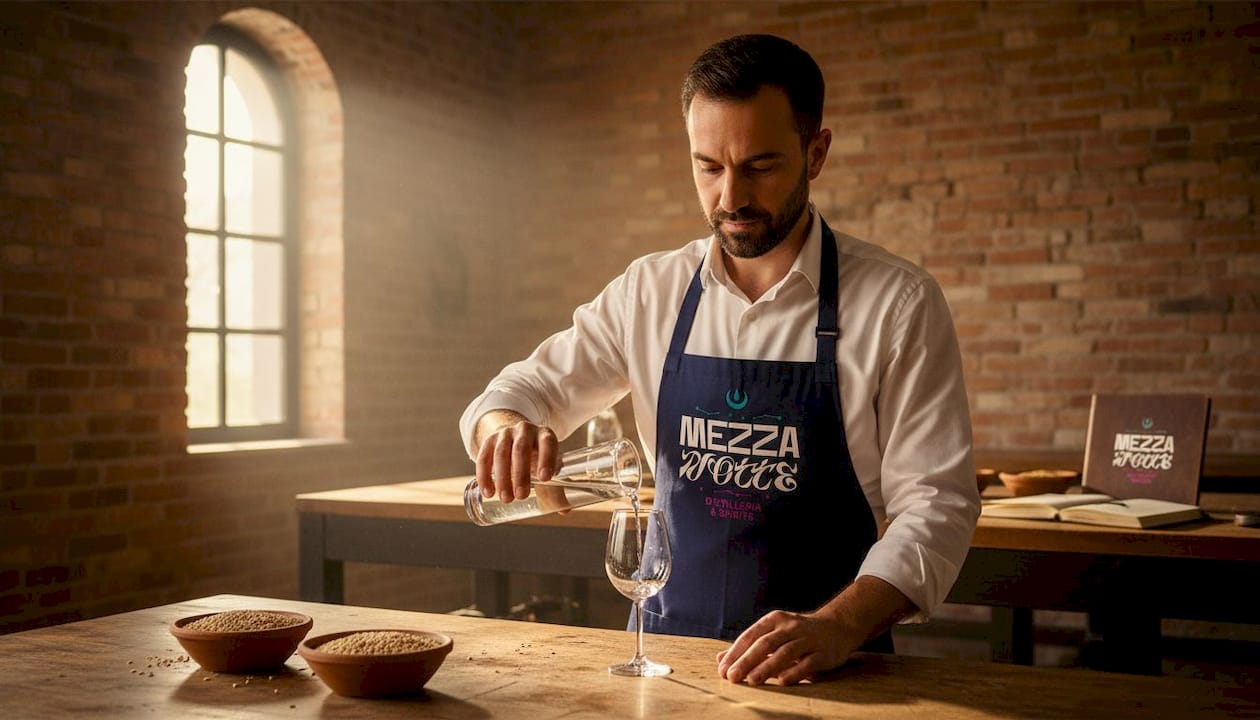
As confirmed by Italian craft vodkas that use local ancient grains and are distilled with regional waters to express a unique terroir, the concept of terroir, borrowed from the world of wine, applies perfectly to vodka as well. Water, in particular, plays a fundamental role. Alpine springs, calcareous waters from the South, oligomineral waters from the Apennines: each source contributes to the final texture of the spirit, its smoothness or its vivacity on the palate.
The distillation techniques adopted by Italian craft producers are distinctly different from industrial ones. While large factories use continuous distillation columns that maximize yield and eliminate any character, small Italian distillers prefer discontinuous stills, often copper, which allow control over every stage of the process. Some use bain-marie distillation, others on marble plates, techniques that slow down the process but guarantee a smoothness and complexity difficult to achieve otherwise.
“Italian craft vodka is not a copy of Northern European ones. It is a spirit that tells the story of a territory, an agricultural culture, a story of recovery and valorization.”
The advantages of craft spirits over industrial ones are also measured in terms of transparency. Italian craft producers always indicate the origin of the cereals, the type of water used, the number of distillations. Nothing is hidden.
Here's what to look for when choosing an Italian craft vodka:
- Grain of origin: must be specified and preferably local
- Water source: identified spring, possibly near the distillery
- Distillation method: discontinuous still, preferably copper
- Number of distillations: lower does not mean worse, it means more character
- Filtration: minimal or absent to preserve aromas
Pro Tip: When reading the label of an Italian craft vodka, always look for the description of the grain used. If it's not specified, it's likely neutral industrial alcohol that has been repackaged.
Key Italian Craft Vodkas to Discover
Now that we know what makes this spirit special, let's discover some truly unique bottles.
As the craft stories of Italian vodka highlight, each producer brings a precise vision of their territory. The Italian vodka revolution focuses on biodiversity, local grains, and the narrative of terroir, and this is clearly evident in the most representative bottles.
-
Vodka from Sicilian Russello: Produced in the province of Ragusa by a micro-distillery founded in 2019, this vodka exclusively uses Russello wheat, an almost extinct native Sicilian variety. The aromatic profile is surprising: notes of warm bread, almond, and a slightly saline finish reminiscent of the Mediterranean wind. The producer, a former agronomist, recovered the seeds from an elderly farmer in Chiaramonte Gulfi. A story of preservation even before distillation.
-
Vodka from Romagnolo Gentil Rosso: Romagna is not just Sangiovese. This vodka is made from an ancient soft wheat grown on the hills of Faenza, distilled in a small copper still by a family that has been producing spirits for three generations. The result is a smooth spirit, with a natural sweetness and floral notes that recall the Romagna countryside in spring.
-
Vodka from Altamura durum wheat: Puglia enters the world of vodka with a product of strong character. Altamura durum wheat, famous worldwide for bread and pasta, here becomes the base of a mineral and structured vodka. The distillery, founded in Gravina in Puglia, uses local groundwater and distills twice in a discontinuous still. The result is a spirit with a strong personality, ideal for those who love clear and persistent sensations.
-
Vodka from Cilentano wheat: Cilento, a UNESCO heritage site, offers a vodka of rare elegance. The ancient wheat grown on the terraces of the Cilento National Park is distilled with Apennine spring water. The profile is delicate, with herbaceous notes and a long finish reminiscent of freshly cut hay. A bottle that speaks of landscapes even before alcoholic beverages.
-
Vodka from einkorn farro: Produced in Tuscany, this vodka uses einkorn farro, the oldest cultivated grain known to man. The spirit has unexpected complexity: toasted notes, a hint of hazelnut, and an almost creamy texture on the palate. The micro-distillery that produces it has fewer than ten employees and produces no more than three thousand bottles a year.
-
Vodka from ancient Veneto corn: A surprise from the Northeast. Marano corn and Biancoperla corn, almost extinct Venetian varieties, become the base of a vodka with a sweet and round character. The Vicenza distillery that produces it collaborates with guardian farmers who keep these varieties alive.
“Each bottle of Italian craft vodka is an act of cultural resistance against the homogenization of global taste.”
Discover the most representative craft vodka collections to understand how design and narrative combine with the quality of the spirit.
Comparison Between Italian and International Craft Vodkas
After exploring Italian excellences, it's worth comparing them with international icons.
| Origin | Base Grain | Distillation Method | Tasting Experience |
|---|---|---|---|
| Italian Craft | Ancient local grains | Discontinuous copper still | Complex, territorial, narrative |
| Traditional Russia | Wheat or rye | Multiple column | Neutral, clean, slightly sweet |
| Traditional Poland | Rye or potato | Column with intense filtration | Robust, spicy, persistent |
| Scandinavia | Potato or wheat | Column with glacial water | Smooth, crystalline, mineral |
| New World (USA) | Corn or grape | Variable, often column | Sweet, accessible, less complex |
As experts highlight, bain-marie and marble plate distillation ensures greater smoothness compared to industrial columns, and this is clearly perceptible on the palate when comparing the two approaches. Explore the different types of craft vodka to delve into these differences with concrete examples.
The main differences between Italian craft vodka and Northern European or Eastern ones can be summarized as follows:
- Aromatic complexity: Italian craft vodkas have more articulated profiles thanks to ancient grains, while industrial ones aim for absolute neutrality
- Territorial connection: each Italian vodka tells the story of a specific place, while large international brands are often produced in centralized facilities with no connection to the territory
- Limited production: Italian micro-distilleries produce a few thousand bottles a year, ensuring artisanal attention to each batch
- Storytelling: Italian craft vodkas are accompanied by authentic narratives about farmers, grains, landscapes, and local traditions
- Filtration: Italian craft producers filter as little as possible to preserve the character of the spirit
When to choose an Italian vodka over a foreign one? The answer depends on the occasion and intention. If you want to explore the complexity of an Italian territory through a spirit, the choice is obvious. If you are preparing a cocktail where vodka is just a neutral base, a quality Scandinavian production might be fine. But if you want a complete tasting experience, Italian craft vodka has no rivals in its genre.
How to Taste and Pair Craft Vodka
Knowing the differences and stories is fascinating, but even more exciting is savoring craft vodka by following a few simple rules.
As Italian experts remind us, favoring neat tasting allows you to grasp the nuances of local grains that would otherwise be lost. Follow the Italian spirits tasting method to structure your experience professionally.
Here are the essential steps for correct tasting:
-
Temperature: serve craft vodka between 8 and 12 degrees Celsius. Too cold blocks aromas, too warm enhances alcohol at the expense of nuances. Avoid the freezer: it's a common mistake that destroys the complexity of the spirit.
-
The glass: use a tulip glass or a tasting glass, not a classic shot glass. The shape of the glass concentrates the aromas towards the nose and allows a complete olfactory evaluation even before tasting.
-
Visual observation: pour about 30 ml and observe the color (it should be clear and crystalline) and viscosity. The tears slowly running down the glass indicate a good glyceric structure.
-
Aroma: bring the glass to your nose without immersing your face. Look for primary notes: cereal, hay, flowers, dried fruit. Then look for secondary notes that emerge after a few seconds.
-
The first sip: small, held in the mouth for a few seconds before swallowing. Note the texture, the progression of aromas, the length of the finish.
-
Rest: wait a few minutes between sips. Craft vodka gradually opens up, revealing nuances that were hidden at the first taste.
Pro Tip: Add a drop of natural water to the craft vodka during tasting. It slightly lowers the alcohol content and allows more delicate aromas to emerge with greater clarity, just like with single malt whiskies.
The most common mistakes to avoid are drinking ice-cold vodka directly from the freezer, using shot glasses, and accompanying it only with tonic water without ever tasting it neat.
For food pairings, Italian craft vodka pairs beautifully with:
- Seafood appetizers: raw fish, oysters, tuna tartare
- Aged cheeses: pecorino di fossa, aged Parmigiano Reggiano
- Artisanal cured meats: culatello, bresaola, lardo di Colonnata
- Spicy dishes: vodka cleanses the palate and prepares for the next bite
For cocktails with craft vodka, try a Moscow Mule with artisanal ginger beer and fresh lime, or a simple Vodka Tonic with quality tonic water and a slice of cucumber. The complexity of Italian vodka also shines through in the simplest cocktails.
Our Vision: The Future of Craft Vodka in Italy
Looking ahead, we believe that Italian craft vodka is only at the beginning of its story. This is not a fleeting trend: it is a cultural revolution that starts from the land and reaches the glass, passing through stories of farmers, distillers, and rural communities who are rediscovering the value of their identity.
The connection with ancient grains and artisanal tradition is not nostalgia: it is a concrete response to the globalization of taste. The new generation of enthusiasts doesn't just want a good spirit. They want to know who made it, where, with what. They want a true story to tell.
Trends in artisanal production tell us that the future will be increasingly narrative and localized. Each bottle will become a cultural document, a way to preserve agricultural varieties, taste dialects, and endangered landscapes. Those who invest in an artisanal Italian vodka today are not just buying a spirit: they are supporting an ecosystem of producers, farmers, and biodiversity guardians who deserve to exist.
Discover the exclusive Mezzanotte selection
If these stories have inspired you, put theory into practice with the exclusive selection you can find on Mezzanotte.

On Mezzanotte, you'll find a curated selection of artisanal Italian vodka chosen according to precise criteria: origin of raw materials, distillation method, and authenticity of the narrative. Every bottle in our catalog has a verified story and a distinctive aromatic profile. If you love to explore, you'll also find a range of artisanal Italian gin with the same philosophy: quality, territorial identity, and authentic storytelling. Mezzanotte is not just a shop: it is a point of reference for those who want to experience the world of spirits as a true cultural adventure.
Frequently asked questions about artisanal Italian vodka
Where can I buy authentic artisanal Italian vodka?
In specialized shops, selected wine shops, and online stores dedicated to artisanal spirits, such as Mezzanotte, which guarantees a careful selection and verified origin.
What grains are typically used in artisanal Italian vodkas?
Local ancient varieties such as Russello, Gentil Rosso, Altamura durum wheat, and Cilento wheat are often used, as confirmed by the most representative artisanal Italian vodkas on the national scene.
What is the difference between artisanal Italian vodka and industrially produced vodka?
Artisanal vodka focuses on local raw materials, traditional techniques, and territorial narrative, while industrial vodka aims for neutrality and maximum yield, as highlighted by the Italian vodka revolution based on biodiversity and terroir.
How is artisanal vodka best tasted?
It is suggested to taste it neat at a temperature between 8 and 12 degrees Celsius, in small sips with a tulip glass, as Italian experts prefer pure tasting to capture the nuances of local grains.
Recommendation
- Italian Vodka: Guide to Artisanal Excellences – Mezzanotte | Distillery & Spirits
- Smooth Vodka: Authentic Purity and Artisanal Stories – Mezzanotte | Distillery & Spirits
- Italian Alcoholic Drinks: Unique Spirits and Stories to Savor – Mezzanotte | Distillery & Spirits
- Vodka Collections: Art, Stories, and Unique Designs – Mezzanotte | Distillery & Spirits