

Discover the differences between Italian spirits, liqueurs, amari, and vodkas. A practical guide to Italian artisanal spirits terminology for informed choices.
Complete guide to Italian spirits terminology
Apr 24, 2026

TL;DR:
- Distillates are made from fermentation and distillation; liqueurs are made with infusions and sugars.
- Italian gins are distinguished by their types, native botanicals, and territorial roots.
- Amaro and bitter are aromatic liqueurs with different origins, used as digestifs or aperitifs.
Gin, amaro, vodka, bitter, distillate, liqueur: these terms fill the labels of the best Italian craft spirits, but are often used confusingly or interchangeably. For those who truly love quality spirits, knowing the differences is not just an academic exercise; it's the key to making informed choices, appreciating the nuances of each bottle, and recognizing the value behind every artisanal production. In this guide, you'll find clear definitions, practical comparisons, and everything you need to navigate the rich universe of Italian spirits, from botanical gin to regional amaro, and innovative vodka.
Table of Contents
- Distillates and Liqueurs: Fundamental Definitions
- Italian Gins: Types, Botanicals, and Terroir Culture
- Amaro and Bitter: Secrets, Classifications, and Typical Uses
- Italian Vodka: Purity, Raw Materials, and Local Innovation
- What Truly Distinguishes an Italian Craft Spirit
- Discover Italian Craft Excellences
- Frequently Asked Questions on Italian Spirits Terminology
Key Points
| Point | Details |
|---|---|
| Clear Definitions | Understanding distillate, liqueur, amaro, and gin allows for more informed choices. |
| Importance of Terroir | Local botanicals and artisanal techniques make Italian spirits unique. |
| Differences Between Amaro and Bitter | Though similar, amaro and bitter differ in origin, aromas, and use. |
| Innovation in Vodka | Italian craft vodkas stand out for their ingredients and creative approach. |
| Choose with Terminology | Knowing key terms helps identify quality and authentic products. |
Distillates and Liqueurs: Fundamental Definitions
To navigate the world of Italian spirits, it's essential to start with basic terminology. The difference between a distillate and a liqueur is not a matter of personal taste, but of process and regulation.
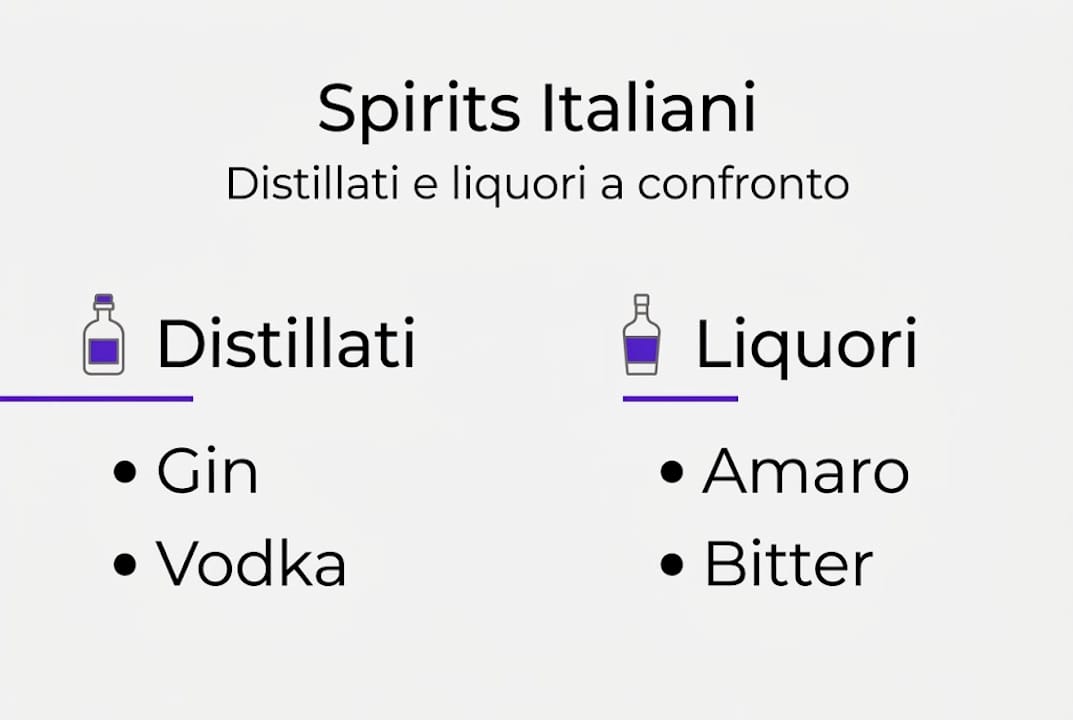
A distillate is obtained by heating a fermented substance (grains, fruit, pomace) until the alcohol vaporizes, which is then condensed and collected. The result is a high-proof beverage, technically pure, whose aromatic profile depends on the raw materials and distillation method. Gin, vodka, and grappa are classic examples of distillates.
A liqueur, on the other hand, is made by adding flavors, herbs, spices, and sugar to an already prepared alcoholic base. Amari and bitters fall into this category: their aromatic complexity comes from the infusion of botanical ingredients, not from a proper distillation. By European law, a liqueur must contain at least 100 grams of sugar per liter and a minimum alcohol content of 15% vol.
Here is a summary of the main differences:
| Characteristic | Distillate | Liqueur |
|---|---|---|
| Main Process | Distillation | Infusion + Sweetening |
| Typical Alcohol Content | 37.5% and above | 15% and above |
| Added Sugars | Absent or minimal | Mandatory by law |
| Italian Examples | Grappa, gin, vodka | Amaro, limoncello, bitter |
Some hybrid categories exist: barrel-aged gin, for example, combines distillation and barrel aging, while certain modern amari use botanical distillates as a base.
- Grappa: pomace distillate, typically Italian
- Gin: distillate flavored with juniper as the main botanical
- Amaro: bitter liqueur made from herbs and roots
- Bitter: drier and more alcoholic version of amaro, often of Northern European origin
Pro Tip: Before buying a spirit, always read the technical data sheet section on the production process. If you find the word "infused" or "macerated," you're looking at a liqueur, not a pure distillate. To delve deeper, you can explore the distillation terminology on Mezzanotte.
Italian Gins: Types, Botanicals, and Terroir Culture
Having clarified the basics, let's dive into the gin categories, the flagship of Italian craft distillation. Gin is not a monolithic product: there are many different types of gin, each with very specific characteristics.
London Dry: the most widespread category in the world. No artificial flavors, botanicals added only during distillation, minimum alcohol content 37.5% vol. Dry and clean.
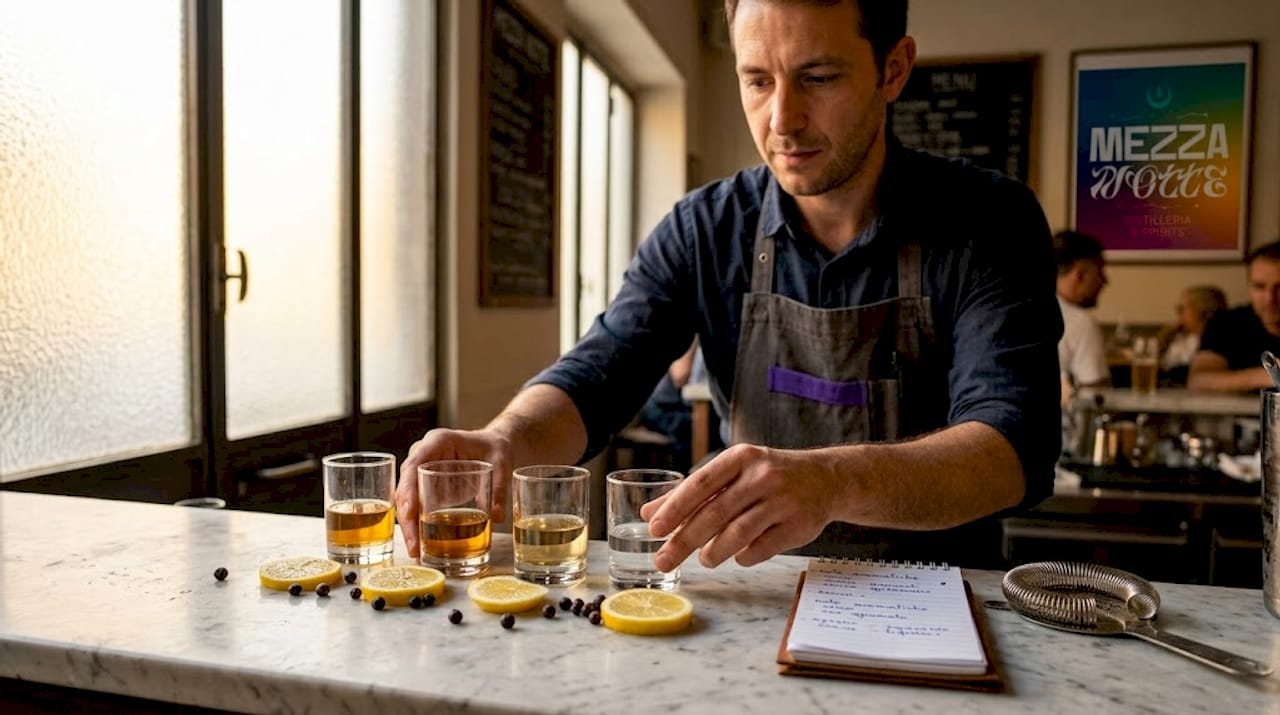
Distilled Gin: similar to London Dry but allows the addition of natural flavors after distillation. More flexible in its nuances.
Old Tom: sweeter and softer, of historical English origin, it is making a comeback in classic mixology.
New Western (or Contemporary): a category that has revolutionized the market. Juniper is still present but does not dominate, leaving room for unusual botanicals, flowers, Mediterranean citrus fruits, alpine herbs.
Compound Gin: produced without distillation, by adding botanical extracts to a neutral spirit. Quality varies greatly.
Sloe Gin: technically a liqueur, made from gin and wild sloes. Sweet and fruity.
Barrel Aged: gin aged in barrels, which acquires woody and vanilla notes.
| Type | Sweetness | Botanical Intensity | Typical Use |
|---|---|---|---|
| London Dry | Low | High (juniper dominant) | Classic Gin Tonic |
| New Western | Medium | High (various botanicals) | Contemporary Cocktails |
| Old Tom | High | Medium | Historical Cocktails |
| Barrel Aged | Medium | Medium | Pure Sipping |
Italy has brought a new perspective to gin production, enhancing native gin botanicals: Sicilian lemons, Calabrian bergamot, Sardinian juniper, Florentine iris. This connection to the territory transforms every bottle into a geographical story.
The alcohol content of gin is a factor not to be underestimated: it affects the aromatic perception and intensity on the palate. A gin at 47% vol will express the botanicals more powerfully than one at 37.5%.
- Identify the type from the technical sheet or label
- Look for the main botanicals listed by the producer
- Consider the alcohol content to understand the intensity
- Pair the gin with your preferred cocktail style
- Experiment with tonic waters of different aromatic profiles
Pro Tip: New Western Italian gins pair better with floral or citrus tonic waters, to enhance Mediterranean botanicals without overpowering them. You can explore a guide to the variety of Italian gin to find your favorite style.
For those who want to delve deeper, a useful resource on gin types according to experts offers an excellent overview of different contemporary styles.
Amaro and Bitter: Secrets, Classifications, and Typical Uses
If gin tells the story of Italian botanicals, amari and bitters embody our most authentic regional tradition. In Italian, "amaro" and "bitter" are often used as synonyms, but there are important nuances.
Amaro is a typically Italian product, with deep roots in monastic tradition and folk medicine. It is a liqueur flavored with herbs, roots, spices, and peels, with a predominant bitter component balanced by sweetness and complexity. According to the classification of Italian amari, the sugar content and alcohol level vary greatly among regional categories.
Bitter has more Northern European and Anglo-Saxon origins. It tends to be drier, less sweet, with a sharper bitter profile. In mixology, bitter is often a concentrated element (a few drops are enough), while amaro is used as a main ingredient in a drink or as a digestif on its own.
| Characteristic | Italian Amaro | Bitter |
|---|---|---|
| Origin | Italian monastic tradition | Northern Europe, Anglo-Saxon |
| Sweetness | Medium, balanced | Low, dry |
| Main Use | Digestif, Spritz, cocktail | Cocktail, flavoring |
| Typical Alcohol Content | 16% - 35% vol | 40% - 70% vol |
The main families of Italian amari include:
- Alpini: based on mountain herbs, bitter roots, gentian. Examples: Braulio, Averna
- Siciliani: Mediterranean citrus, aromatic herbs from the south. Fresh and intense profile
- Fernet: a category of its own, with mint, rhubarb, anise. Very bitter and dry
- Aromatici: like Campari, often used as an aperitif rather than a digestif
"Italian amari are a living botanical archive: each region has preserved its own recipes for centuries, passing them down as intangible heritage."
The use of amari is divided into three key moments: as an aperitif (mixed with prosecco or soda), as an ingredient for complex cocktails (Negroni, Paper Plane), and as a pure digestif, served cold or at room temperature. For a comprehensive guide to amari and bitters, there are dedicated resources on international classifications.
Italian Vodka: Purity, Raw Materials, and Local Innovation
Alongside the ancient traditions of gin and amari, Italian vodka surprises with its creativity and innovative approach. Often associated with Eastern European countries, vodka finds an original reinterpretation in Italy that is worth knowing.
By technical definition, vodka is a neutral spirit obtained from the distillation of fermented grains, potatoes, or fruits, filtered to achieve maximum purity. Tradition dictates that it should be odorless and colorless, but the craft reality is much richer.
Italian craft vodka experiments with unusual raw materials:
- Wine base: some productions use wine as the primary fermentation material, imparting fruity notes and smoothness
- Ancient grains: spelt, barley, Sicilian durum wheat add character and complexity
- Cold distillation: an innovative technique that preserves the delicate aromas of the raw materials
- Lava stone or wood charcoal filtration: for a purity different from industrial ones
| Aspect | Industrial Vodka | Italian Craft Vodka |
|---|---|---|
| Raw Materials | Standard grains or potatoes | Grapes, spelt, ancient wheat |
| Distillations | Multiple, until absolute neutrality | Selective, to preserve character |
| Filtration | Industrial activated charcoal | Lava stone, wood charcoal |
| Profile | Neutral, clean | Slightly characterized |
Reading an Italian craft vodka label requires attention to a few key elements: the raw material used for fermentation, the number of distillations, and the filtration method. These three pieces of information already tell a lot about the product's personality. For concrete examples, it's interesting to discover an example of Italian craft vodka that uses wine as its base.
Pro Tip: An Italian craft vodka is best enjoyed slightly chilled (not frozen), to appreciate the aromatic nuances that extreme cold would tend to neutralize. You can delve into the excellences of Italian vodka and discover the types of Italian vodka available in the national craft scene.
What Truly Distinguishes an Italian Craft Spirit
Having clarified the technical terminologies and practical distinctions, what remains is to address what lies behind the "craft" label. It's a word that risks becoming hollow if used indiscriminately.
An authentic Italian spirit carries a connection to the territory that cannot be simulated. It's not just about choosing local botanicals for marketing, but about knowing those plants, the soil they grow in, the season they are harvested. The frontier of native spirits today rewards those who demonstrate this connection with rigor and transparency.
Technique alone is not enough. There are distilleries with state-of-the-art equipment that produce flat, soulless spirits, and small craft realities with historic stills that bottle unforgettable experiences. The difference lies in the true story behind each product, in the choice of raw materials, in the decisions made by the distiller at every stage of the process.
Today, the most significant international awards also consider sustainability and ethics: how botanicals are grown, what impact production has on the territory, how local workers are respected. These criteria are redefining what "excellence" means in the sector. The differences of Italian gin compared to others, for example, emerge precisely from this intertwining of technique, territory, and authentic narrative.
A tip: beware of spirits that focus solely on bottle aesthetics. Beautiful design can accompany a great product, but it never replaces it.
Discover Italian Craft Excellences
If you want to put what you've learned to the test and truly savor the meaning of "artisan," here's where to start. At Mezzanotte, we meticulously select each product: we're not interested in spirits that merely seem artisanal; we seek those that truly are, with a discernible history, territory, and identity from the very first sip.

In our catalog, you'll find artisanal Italian gin of various types, from classic interpretations to more experimental ones, each with a detailed technical sheet. If vodka intrigues you, the section dedicated to artisanal Italian vodka will lead you to discover productions that overturn every cliché about neutral spirits. Explore, read, compare, and choose consciously.
Frequently Asked Questions about Italian Spirits Terminology
What is the difference between a distillate and a liqueur?
A distillate is obtained from the distillation of fermented raw materials, while a liqueur is alcohol enhanced with aromas and sugar. The production process is radically different, and this is reflected in the aromatic profile and structure of the beverage.
What is the purpose of local botanicals in Italian gins?
Local botanicals give Italian gins a unique character, tied to specific territories and traditions. Calabrian bergamot, Sicilian lemon, or Florentine iris transform each gin into a precise geographical narrative.
Are there differences between amaro and bitter?
Amaro and bitter are similar but have distinct origins: Italian amaro is typically sweeter and richer in aromas, while bitter is drier and from a Northern European tradition. In mixology, bitter is often used in concentrated doses, while amaro is used as a main ingredient.
How can you recognize an artisanal Italian vodka?
Artisanal Italian vodka is distinguished by quality raw materials, such as grapes or ancient grains, and by distillation techniques that preserve the product's character instead of completely eliminating it. The label already tells a lot: read carefully.
Recommendation
- Why Choose Artisan Spirits in 2026: Unique Quality – Mezzanotte | Distillery & Spirits
- Guide to Buying Authentic Italian Spirits 2026 – Mezzanotte | Distillery & Spirits
- Spirits Distillation Guide 2026: Avoid 40% Common Errors – Mezzanotte | Distillery & Spirits
- Distillation Terminology: A Guide for Gin and Amaro Enthusiasts 2026 – Mezzanotte | Distillery & Spirits