

Discover the various types of Italian regional liqueurs: stories, craftsmanship, and how to choose an authentic product for a unique experience. Read more!
Types of Regional Liqueurs: Stories and Italian Craftsmanship
Apr 27, 2026

TL;DR:
- Italian regional liqueurs are handcrafted using techniques such as maceration and infusion, respecting local traditions.
- Each region has iconic liqueurs, such as Centerbe in Abruzzo and Mirto in Sardinia, with authentic ingredients and unique stories.
- True quality is distinguished by a direct relationship with producers and authentic techniques, while many historical recipes are disappearing.
Choosing among Italian regional liqueurs is like opening a book of forgotten stories: each bottle tells a geography, a flavor, a family. From Sardinia with its wild myrtle to Abruzzo with its powerful Centerbe with a hundred mountain herbs, the landscape of Italian artisanal liqueurs is one of the vastest and most fascinating in Europe. But how do you navigate hundreds of types? And how do you distinguish a true artisanal product from an industrial one disguised as folklore? This article guides you through concrete criteria, authentic stories, and production techniques to help you choose with awareness and passion.
Table of Contents
- How to recognize a true artisanal regional liqueur
- The iconic liqueurs of each region: stories and ingredients
- Maceration, infusion, distillation: how unique flavors are born
- Where and how to taste them: experiences and pairings
- Regional liqueurs: craftsmanship at risk of disappearing (but reinventing taste)
- Enter the Mezzanotte world: authentic craftsmanship
- Frequently Asked Questions
Key Points
| Point | Details |
|---|---|
| Surprising regional variety | Each Italian region preserves unique liqueurs often linked to local ingredients and stories. |
| Artisanal transmission | Original recipes survive thanks to family production and the passion of artisans. |
| Conscious tasting | Tasting liqueurs slowly and paired with local specialties enriches the experience. |
| Key production techniques | Maceration, infusion, and distillation determine intense and inimitable aromas. |
How to recognize a true artisanal regional liqueur
The first step to truly appreciating an Italian regional liqueur is to understand what makes it so. It's not just a matter of label or careful packaging: it's a set of production choices, raw materials, and time that differentiate a living product from a standardized one.
By definition, Italian artisanal liqueurs are produced by macerating fruit, herbs, spices, or roots in alcohol, followed by dilution with sugar syrup and resting periods to harmonize the aromas. This process requires patience, knowledge, and locally selected raw materials. No shortcuts.
The main techniques that characterize an authentic artisanal liqueur are:
- Maceration: raw materials are immersed in alcohol for weeks or months, releasing color, aroma, and active ingredients.
- Infusion: similar to maceration but with shorter times and slightly higher temperatures.
- Distillation: used to extract volatile aromatic components, typical of grappas and anise liqueurs.
- Aging in barrels: for liqueurs that require structure and softness over time.
How to learn to choose a quality artisanal spirit? Observe the producer's transparency: those who do good work explain the ingredients, the origins of the plants, and the methods used. Those who don't often have something to hide.
“An artisanal liqueur is never the same from one year to the next: the herbs change, the seasons change, the producer changes. It is this variability that makes it alive.”
One of the most surprising aspects concerns certifications. Very few liqueurs have PDO/PGI certifications: one case is Calabrian Licorice PDO, but as a base and not as a finished liqueur. Most Italian regional liqueurs are recognized as PAT (Traditional Agri-food Product), a ministerial list that protects traditional recipes without guaranteeing a uniform production standard.
Pro Tip: when visiting an artisanal production, always ask where the herbs come from. A serious producer will be able to name the gatherer, the area, and the harvesting season.
This means that authenticity does not necessarily come from an official stamp, but from a direct relationship with the producer and knowledge of the artisanal distillation techniques behind each bottle. The territory speaks through its ingredients: mountain herbs, coastal citrus, Mediterranean scrub berries. These elements are not found in a catalog.
The iconic liqueurs of each region: stories and ingredients
Every corner of Italy has its iconic liqueur. Not just for taste, but for history, for ritual, and for the way it is told to travelers and passed down through generations.
Let's start with Abruzzo. Centerbe is a liqueur at 70 alcoholic degrees, obtained by infusing a hundred mountain aromatic herbs, invented by Beniamino Toro as a remedy against the plague. It is one of the most powerful and aromatically complex Italian spirits: bright green, almost medicinal on the nose, with an herbaceous trail that lingers for a long time. The other great Abruzzo protagonist is Genziana Liqueur, obtained by infusing gentian roots in alcohol or wine, recognized as PAT and appreciated as a bitter digestif.
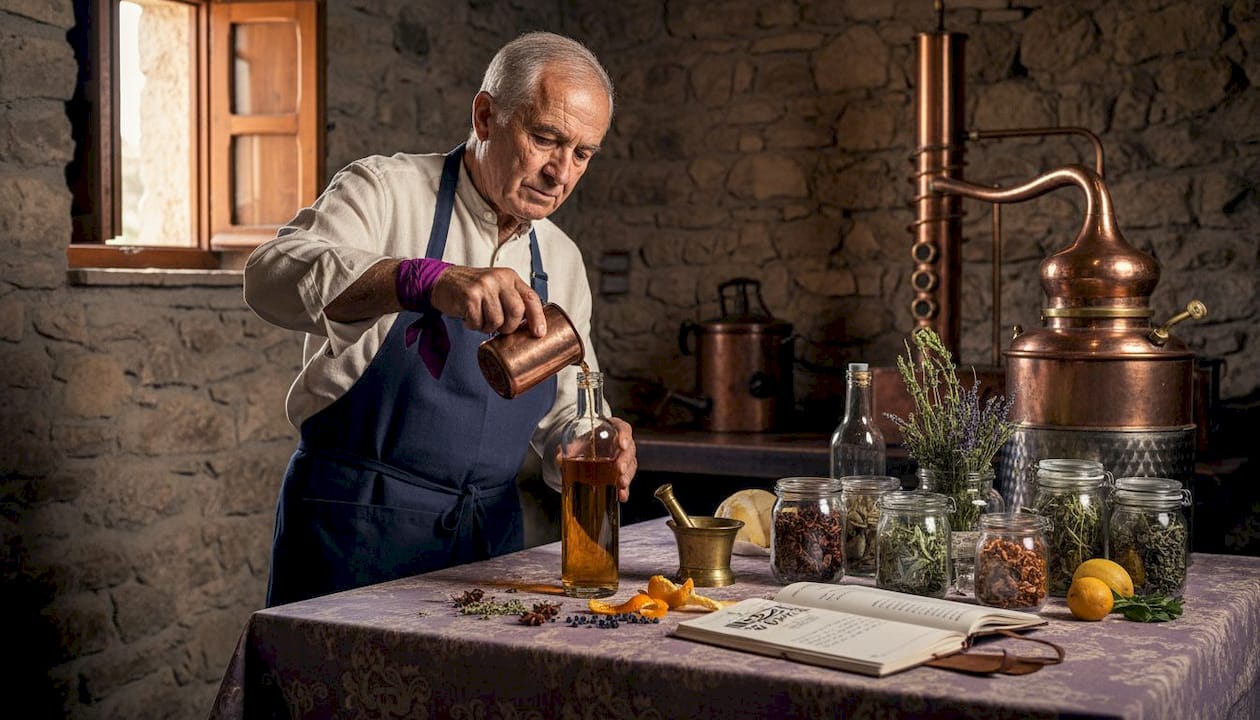
Tuscany, on the other hand, is a land of historical amari. Among the most representative are the Elisir di China Acef from Fivizzano, with cinchona and herbs, Biadina from Lucca with cinchona, gentian, and spices, and Gemma d’Abeto from Mugello obtained from fir cones. Each of these products has origins in pharmacies and convents, where liqueurs were born as curative remedies.
Here's a comparative look at the most iconic regional liqueurs:
| Region | Liqueur | Key ingredient | Alcohol content | Notes |
|---|---|---|---|---|
| Abruzzo | Centerbe | 100 mountain herbs | 70% vol | One of the strongest in Italy |
| Sardinia | Mirto | Wild myrtle berries | 30-35% vol | Red and white versions |
| Campania | Limoncello | Sfusato lemon peels | 25-30% vol | Recognized Amalfi PDO |
| Tuscany | Gemma d’Abeto | Fir cones | 30-35% vol | Convent origin |
| Emilia | Sassolino | Star anise | 40% vol | Swiss tradition |
| Calabria | Licorice Liqueur | Licorice root | 28-32% vol | PDO base |
Sardinia has its gem in Mirto, a liqueur obtained from the maceration of wild myrtle berries hand-picked between October and December. It exists in the red version, with ripe berries, and the white version, more delicate, with flowers and leaves. Sardinian families still prepare it today following verbally transmitted recipes, never writing them down.
“Sardinian myrtle is not a product, it's a gesture of hospitality. You find it on every home's table, after dinner, as an act of welcome.”
Exploring the history of Italian spirits also means understanding how these liqueurs have survived centuries of economic and cultural changes, maintaining their local identity intact.
Maceration, infusion, distillation: how unique flavors are born
Understanding the production techniques of a regional liqueur is not just a technical matter: it is the way to understand why two products made with the same ingredients can have completely different aromatic profiles.
-
Natural maceration: fruits or herbs are immersed in alcohol between 40 and 70 degrees for periods ranging from 40 to 70 days. This is the basic technique for Limoncello, where the peels of the Amalfi Sfusato lemon release their essential oils into pure alcohol, then diluted with sugar syrup and left to rest for weeks to soften and balance the flavor.
-
Cold infusion: herbs remain in alcohol for a shorter time, at room temperature or slightly higher. It is widely used for amari and liqueurs like Genziana. The result is a more delicate but less extractive aroma compared to long maceration.
-
Distillation: a fundamental technique for Grappa and Anise, but also for creating high-quality alcoholic bases to be used later in macerations. Artisanal distillation techniques allow for the selection of the most precious aromatic fractions, discarding the head and tail.
-
Barrel aging: some regional liqueurs are aged in barriques or wooden barrels to acquire structure, softness, and toasted notes. This technique is less common in traditional liqueurs, but is making a comeback in more experimental productions.
An often underestimated detail concerns seasonal harvesting of raw materials: walnuts, for example, are traditionally harvested on June 24th, St. John's Day, when the husk is still green and rich in essential oils. The same applies to gentian at high altitudes, harvested in late summer when the root is at its maximum aromatic concentration.
Pro Tip: taste the same liqueur at two different times: immediately after production and after six months of resting in the bottle. The difference will make you understand how important time is in the artisanal process.
The final result depends on the balance between these factors: the quality of the base alcohol, the freshness of the raw materials, the maceration time, and the care in balancing sweetness and aromatic structure. An industrially produced liqueur bypasses this complexity with artificial flavors and stabilizers. An artisanal liqueur carries every choice made along the way.
To delve into how these aromas reveal themselves in the glass, it's worth studying a structured method for tasting Italian spirits, capable of guiding you beyond first impressions.
Where and how to taste them: experiences and pairings
Knowing an Italian regional liqueur in its bottle is just the beginning. The complete experience is lived in the place where it was born, with the people who produce it and with the foods that traditionally accompany it.
The best ways to encounter these authentic products:
- Open distilleries: many artisanal producers organize guided tours with tastings. It's the most direct way to understand the process and purchase products not distributed elsewhere.
- Festivals and local fairs: events like the Myrtle Festival in Sardinia or the amaro fairs in Tuscany are unique opportunities to taste dozens of variations in a single context.
- Wine bars and historic venues: bars and taverns with historical roots often preserve bottles from defunct artisanal producers or unique limited editions.
- Food and wine tours: structured experiences that combine visits to producers, guided tastings, and local gastronomic pairings.
“Italian amari dominate world rankings: five Italian products in the top 10 of TasteAtlas 2025, including Montenegro, Bràulio, Lucano, Strega, and Averna. Yet, many of the most interesting regional liqueurs remain unknown outside their province.”
This paradox is one of the most fascinating in the world of Italian spirits: the most celebrated products are industrially produced for global markets, while the most authentic liqueurs live in the shadow of a local market. Discovering them requires curiosity and a willingness to look beyond the most beaten tourist paths.
Regarding pairings, a simple rule applies: following local tradition rarely disappoints.
| Liqueur | Classic pairing | Ideal moment |
|---|---|---|
| Limoncello | Lemon desserts, granitas, seafood | After dinner |
| Red Mirto | Aged cheeses, dark chocolate | End of meal |
| Centerbe | Alone, small doses | Digestive |
| Tuscan Amaro | Dry biscuits, cantuccini | After dinner |
| Genziana | Fresh cheeses, appetizers | Aperitif |
The history of many of these liqueurs originated in pharmacies or convents, as told by the tradition of Tuscan amari, born as curative remedies and then becoming gastronomic pleasures.
For those who want to organize a tasting at home, the advice is to serve three or four different regional liqueurs in increasing order of intensity, starting with the most delicate (Limoncello, white Mirto) and arriving at the most potent (Centerbe, Genziana). Pair each glass with a gastronomic element from the same region to create a complete territorial journey.
You can find inspiration on how to pair artisanal liqueurs and discover unique Italian spirits with extraordinary stories.
Regional liqueurs: craftsmanship at risk of disappearing (but reinventing taste)
There is something paradoxical about the historical moment we are living in. It has never been so easy to buy an artisanal liqueur online, yet some of Italy's oldest recipes are silently disappearing, taken away by the advanced age of producers and the absence of heirs willing to continue.
Most historical recipes exist only in the memory of those who created them. No patents, no certifications, no written manuals. The transmission has always been oral, from father to son, from grandmother to grandchild. When that chain breaks, the liqueur disappears forever.
Yet this very fragility creates fascination. A liqueur that does not exist on Amazon, that is found only in a small shop in a mountain village, has a value that no marketing can artificially build. The tradition of Italian spirits has survived centuries not thanks to laws but thanks to the authentic passion of those who have chosen, drunk, and sought them.
Anyone who chooses an artisanal regional liqueur today performs a cultural act, not just a gastronomic one. They keep a recipe alive, support a family, and preserve a territory. This awareness is the future of good drinking.
Enter the Mezzanotte world: authentic craftsmanship
After this journey through mountain herbs, citrus peels, and gentian roots, the natural next step is to bring these stories into your home, into your glass.

On mezzanotte.shop, you'll find artisanal Italian spirits selected with the same care a producer chooses their herbs: each has a story, a precise aromatic identity, and a design that tells it. Whether you're looking for a craft gin with a unique personality or a craft vodka of absolute purity, the Mezzanotte catalog is designed for those who want to drink mindfully. Explore the products, read the stories, and begin your journey of authentic tasting.
Frequently asked questions
What is the difference between a regional artisanal liqueur and an industrial one?
Regional artisanal liqueurs are produced according to traditional recipes with manual processing and local ingredients, while industrial ones use additives and standardized processes. As confirmed by specialized sources, regional artisanal liqueurs are obtained by macerating fruit, herbs, or roots in alcohol, with resting periods to harmonize the aromas.
Which are the strongest regional Italian liqueurs?
Abruzzo's Centerbe, with an alcohol content of up to 70% vol and one hundred mountain herbs, is one of the most potent Italian liqueurs, originally invented as a remedy against the plague, along with some traditional high-proof bitters.
How can a regional liqueur be best tasted?
Pour small doses at room temperature into tulip-shaped tasting glasses, sip slowly to appreciate the aromas and balance, and pair with a gastronomic element from the same region of origin as the liqueur.
Are there regional liqueurs with DOP or IGP certification?
Only some bases like Calabria DOP Licorice, but most regional Italian liqueurs are recognized as PAT. As indicated by institutional sources, very few liqueurs have DOP/IGP certifications, and the protection concerns the raw material, not the finished liqueur.
Recommendation
- History of Italian spirits: artisanal tradition 2026 – Mezzanotte | Distillery & Spirits
- Italian alcoholic drinks: unique spirits and stories to savor – Mezzanotte | Distillery & Spirits
- Discover types of Italian bitters for unique cocktails – Mezzanotte | Distillery & Spirits
- Guide to flavored liqueurs: flavors, stories, and uses – Mezzanotte | Distillery & Spirits