

Discover cocktail presentation styles that will transform every drink into a work of art. Impress your guests with creative ideas and techniques...
Cocktail presentation styles: artistic ideas and techniques
Apr 29, 2026

TL;DR:
- Cocktail presentation is as crucial as the quality of the ingredients.
- The choice of glass, ice, and garnishes influences sensory perception and aesthetics.
- Simplicity and attention to detail enhance the elegance and authenticity of the drink.
A mediocre cocktail served beautifully is worth more than a liquid masterpiece in the wrong glass. This is a truth every professional bartender knows but rarely shares openly. When you want to impress your guests, or simply elevate your home experience, presentation is not an optional detail: it's an integral part of the taste. The brain perceives aroma and flavor through powerful visual filters. An elegant, well-constructed, and carefully decorated drink communicates quality even before you taste it.
Table of Contents
- Essential Criteria for Cocktail Presentation
- Serving Techniques: Stir, Shake, Build and Beyond
- Garnishes and Decorations: The Detail That Makes the Difference
- Presentation for Italian Artisanal Spirits
- The Truth Few Tell About Cocktail Presentation
- Discover Artisanal Spirits to Present Unique Cocktails
- Frequently Asked Questions About Cocktail Presentation
Key Points
| Point | Details |
|---|---|
| Glass and Ice | Choosing the right glass and quality ice changes the aesthetic and taste of every cocktail. |
| Targeted Techniques | Shaking or stirring according to desired characteristics ensures the best visual and gustatory result. |
| Functional Garnishes | A well-thought-out decoration enhances aroma and presentation, without ever overdoing it. |
| Enhance Spirits | Presenting Italian artisanal spirits well highlights their uniqueness and refinement. |
Essential Criteria for Cocktail Presentation
Before adding edible flowers or cotton candy, you need to master the basics. Cocktail presentation styles are built on four fundamental pillars: the glass, the ice, the garnishes, and the serving technique. Ignoring even one of these elements compromises the final experience.
The choice of glass is not purely aesthetic. Each shape amplifies specific characteristics:
- Rocks glass (or Old Fashioned): short, stout, ideal for strong spirits on the rocks. Enhances color and body.
- Coupe: the short stemware with a wide bowl is the symbol of 1920s elegance. Perfect for cocktails served without ice like Daiquiris and Sidecars.
- Tumbler: versatile, tall, suitable for long drinks and highballs. Leaves room for abundant ice and vertical garnishes.
- Balloon glass: the bulbous bowl, classic for Spanish gin and tonics, concentrates aromas towards the nose even before tasting.
Choosing the wrong glass is not just an aesthetic error: it changes the olfactory perception and the drink's temperature over time.
Ice is the second often underestimated element. The comparison between artisanal and industrial ice is stark: the former offers controlled dilution, no impurities, and a visual impact that no standard cube can replicate. Consider that presentation influences up to 80% of flavor perception through olfactory aroma. A 6 cm crystal cube in a rocks glass with a Negroni immediately communicates care and attention. An ice sphere, on the other hand, slows down melting and maintains a constant temperature throughout the drink.
Functional garnishes and aromas: an orange peel expressed over a Negroni is not just decorative, it's olfactory. The essential oils it releases into the air before tasting measurably change the drink's perception. Every garnish should follow this logic: add something sensory, not just visual.
“A perfect garnish speaks before it is seen, through the aroma it carries with it.”
Pro Tip: To make a perfect cocktail at home, always start with the glass. Chill it with ice to lower its temperature before pouring any liquid. Those thirty seconds make a real difference in the final quality.
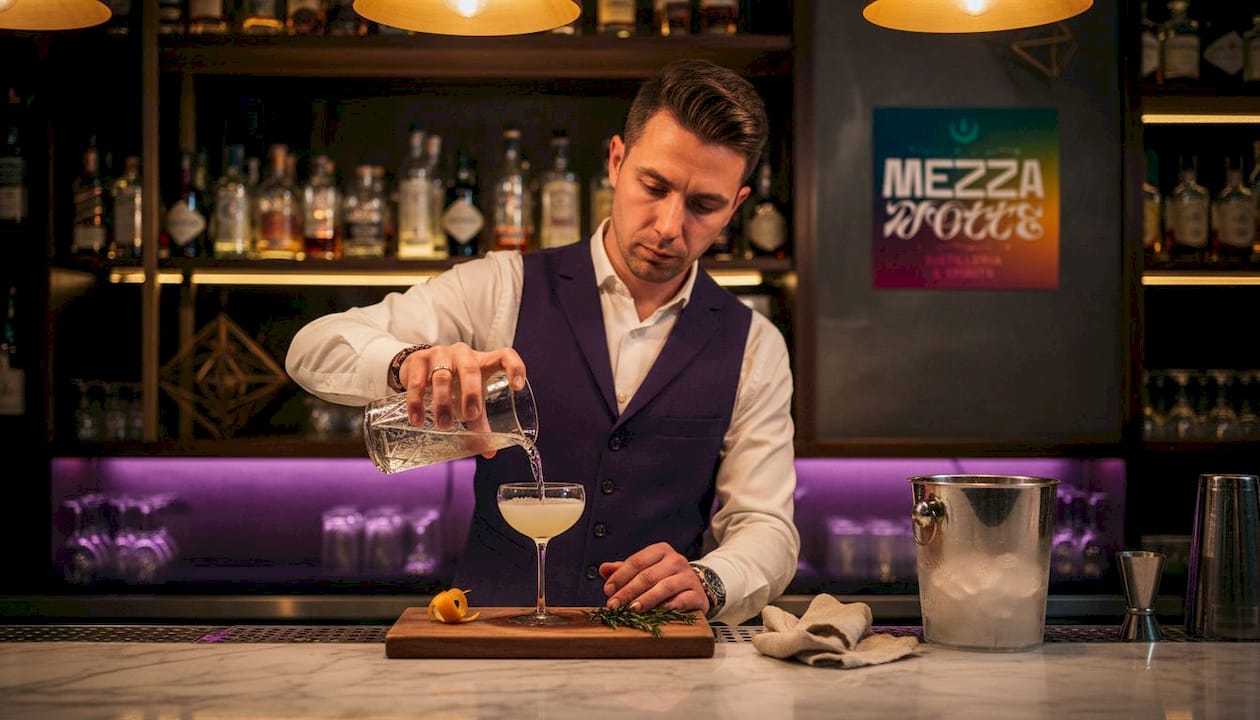
The serving technique enhances everything that comes before it. A direct, controlled pour, without splashes, communicates competence. The same care you put into choosing ingredients must shine through when the drink reaches the glass.
Serving Techniques: Stir, Shake, Build and Beyond
Once the fundamental criteria are defined, techniques transform selected ingredients into a complete experience. The main serving techniques are stir for clear drinks (20-30 seconds), shake for emulsification (10-15 seconds), direct build, controlled muddling, and strain or double strain.
Here's how to guide your choice:
-
Stir: used when you want to maintain the drink's clarity and don't want to incorporate air. The Martini and Negroni are classic examples. Stir with a long spoon in a circular motion in a mixing glass with plenty of ice. The result is a smooth, shiny, elegant drink.
-
Shake: ideal for cocktails containing juices, syrups, eggs, or cream. The process incorporates air and creates an emulsion. A shaken Whiskey Sour has a completely different texture than a stirred version: fuller, slightly opaque, with a natural foam on the surface.
-
Direct Build: the drink is built directly in the serving glass, often with ice already present. The Moscow Mule or gin and tonic are prepared this way. Speed and simplicity, but also less control over mixing.
-
Muddling: gently crush solid ingredients like fresh mint, ginger, or fruit cubes at the bottom of the glass or shaker. The keyword is "gently": excessive muddling can release bitter oils from leaves, ruining the aromatic profile.
-
Double strain: after shaking, the cocktail is filtered through a Hawthorne strainer and then a fine-mesh strainer, removing any ice fragments or pulp. Result: a perfectly smooth drink free of visual impurities. Ideal for those seeking aesthetic perfection.
“The choice between shake or stir is not arbitrary: it is dictated by the chemistry of the ingredients and the desired visual effect.”
From an aesthetic point of view, stirring wins in clarity and the drink appears translucent, almost jewel-like. Shaking creates a lively surface, with micro-bubbles that slowly disappear. Both communicate competence when performed correctly.
Pro Tip: explore cocktail garnishes that match the technique used. A stirred Martini calls for a minimal and precise garnish. A shaken Sour tolerates something more structured on the surface.
Garnishes and Decorations: The Detail That Makes the Difference
After refining the technique, garnishes become the field where creativity finds its place. It's not just about aesthetics: every garnish acts on at least one of the senses before the drink is tasted. Artistic garnishes include citrus peels, edible flowers like violets and nasturtiums, dehydrated elements, infused herbs, cotton candy in wafer or cloud versions with colored powders, and molecular spherification.
| Garnish | Visual Effect | Aromatic Impact | Difficulty |
|---|---|---|---|
| Citrus peel (twist) | Elegant, classic | High, essential oils | Low |
| Flambé peel | Spectacular | Caramelized, smoky | Medium |
| Edible flowers | Romantic, colorful | Delicate or neutral | Low |
| Dehydrated (citrus, fruit) | Contemporary, crispy | Concentrated | Medium |
| Cotton candy | Theatrical, spectacular | Sweet neutral | High |
| Molecular spherification | Futuristic, surprising | Variable, controllable | Very high |
| Fresh herbs (rosemary, mint) | Natural, rustic | Strong, aromatic | Low |
Citrus peels remain the most versatile garnishes. The classic twist releases essential oils that settle on the drink's surface and the rim of the glass. Flambéing the peel adds a caramelized note and creates a small visual spectacle that your guests won't forget.
Edible flowers like nasturtiums and edible violets add color without significantly altering the aromatic profile. They work best on clear or rosé cocktails, where the chromatic contrast is immediate.
Cotton candy is the most theatrical and also the most technical garnish. The visual result is extraordinary, but it requires attention: in high humidity environments, it melts quickly. For a truly original creative pairing, infuse cotton candy with aromatic powders like dried rose, violet, or coffee.
“The garnish is not a hat on the drink: it is its aromatic and visual signature at the same time.”
Mistakes to absolutely avoid:
- Overloading the glass with multiple uncoordinated garnishes
- Using flowers not certified as edible
- Cutting peels irregularly or thickly: they communicate a lack of care
- Adding already wilted herbs that damage both aesthetics and aroma
The practical rule is always the same: every element present in the glass must have a sensory reason for being there.
Presentation for Italian Artisanal Spirits
Having explored garnishes and decorations in detail, it's time to apply all of this to what we are most passionate about: great Italian cocktails made with quality artisanal spirits. Every classic drink has a tradition of presentation that deserves respect, but also leaves ample room for conscious personalization.
For Italian artisanal spirits, the choice of glass and garnishes is never random. Rocks and coupe glasses enhance the ruby tones of a Negroni or the transparent elegance of a Martini. Citrus and local herb-based garnishes complete the aromatic picture without overpowering the featured spirit.
The great Martini debate deserves specific attention. The classic presentation sees the Martini stirred: clear, shiny, with minimal dilution that preserves the gin's profile. The shaken Martini, made famous by James Bond, is slightly cloudy, colder, with a different texture. Which to choose depends on the quality and character of the gin used.
Comparison of presentation styles for Italian classics:
| Cocktail | Ideal Glass | Classic Garnish | Artistic Alternative |
|---|---|---|---|
| Negroni | Rocks glass | Orange peel | Dehydrated orange slice, flambé |
| Martini | Coupe or cone | Olive or lemon twist | Edible flower, olive sphere |
| Spritz | Balloon or wine glass | Fresh orange slice | Fresh aromatic herbs, mixed citrus |
| Americano | Tumbler | Orange and lemon peel | Dehydrated, double twist |
| Sbagliato | Flute or rocks | Orange peel | Flowers, Prosecco bubbles |
How to best enhance Italian spirits in presentation:
- Let the color speak: a gin with particular botanicals can change color with certain mixers. Choose the glass that enhances this transformation.
- Use local garnishes: Sardinian rosemary, Calabrian bergamot, Genoese basil. They enhance the spirit and tell a geographical story.
- Respect the aromatic profile: if the spirit is floral, avoid pungent garnishes like chili. Sensory coherence is everything.
- Experiment with ice: a clear sphere in an artisanal Negroni is not a whim, it's a gesture of respect for the spirit.
The stories of Italian spirits are rooted in deep regional traditions. Presenting a cocktail made with an artisanal Sicilian bitter differently from a Lombard one is not pedantry: it's cultural contextualization. Discover how to personalize Italian cocktails according to the specific characteristics of each spirit.
You can also delve into the types of Italian bitters to understand which aromatic profile best pairs with the presentation styles you've learned.
The Truth Few Tell About Cocktail Presentation
The mixology industry tends to celebrate visual excess: more garnishes, more elements, more spectacle. But after years of observation and practice, the strongest conviction is this: well-executed minimalism always beats creative excess.
A single precise element is worth more than five random garnishes. The chromatic contrast between a brilliant garnish and a dark drink captures the eye immediately and cleanly. Layering by density, the pousse-café technique, creates extraordinary visual stratifications without the need for anything else. Smoke produced with a smoke gun adds theater without compromising the drink's profile. Negative space in a large glass is itself a design element.
Commonly hidden technical errors: cloudy ice alters aromas because it contains trapped air micro-bubbles that modify the contact surface with the liquid. Cotton candy in humid environments melts in seconds: if you want to use it, keep it separate until the last possible moment. Over-garnish, overloading the drink with decorations, does not communicate creativity. It communicates insecurity about the quality of the drink itself. The drink must speak for itself. Presentation introduces it, it does not replace it.
Discover Artisanal Spirits to Present Unique Cocktails
Every technique learned in this article expresses its full potential only when you work with truly exceptional ingredients. An artisanal gin with carefully selected botanicals, a bitter with history and character, a vodka produced with artisanal care: these are the protagonists that deserve a presentation of equal stature.

On mezzanotte.shop you can find Italian artisanal gin selected for quality, storytelling, and unique aromatic identity. Each bottle tells a story that translates into the glass with immediate personality. Also explore the selection of Italian artisanal vodka to build cocktails with a high-quality neutral base, ready to enhance every presentation technique you've learned. The right spirit is the starting point for everything.
Frequently Asked Questions about Cocktail Presentation
How important is the choice of glass in presentation?
The choice of glass enhances the color, aromas, and overall perception of the drink, emphasizing the cocktail's identity: according to presentation criteria, it is one of the four fundamental pillars of the visual and sensory experience.
What is the difference between artisanal and industrial ice?
Artisanal ice melts more slowly due to controlled dilution and the absence of impurities, better preserving the aroma, while industrial ice can subtly alter the drink's flavor over time.
Is it better to shake or stir a cocktail?
The basic rule is that shaking creates emulsion in 10-15 seconds for drinks with juices or eggs, while stirring in 20-30 seconds maintains clarity and refinement for cocktails based solely on spirits.
What mistakes should be avoided in cocktail presentation?
Avoid excessive decorations and opaque ice, which compromise the drink's identity and aromatic profile respectively, signaling a lack of confidence in the quality of the prepared cocktail.
How do you choose artistic garnishes that also have a function?
Choose elements like citrus peels, edible flowers, or fresh herbs that add a noticeable aroma without overpowering or altering the taste profile of the main spirit in the cocktail.
Recommendation
- 6 types of cocktail garnishes you absolutely need to know – Mezzanotte | Distillery & Spirits
- How to make a perfect cocktail: a practical Italian guide – Mezzanotte | Distillery & Spirits
- Cocktails and creative pairings: unique ideas and tips – Mezzanotte | Distillery & Spirits
- Aperitifs and cocktails: recipes, stories, and Italian spirits – Mezzanotte | Distillery & Spirits