

Premium spirits: definition, varieties, quality criteria, European regulations, and differences from standard options. For discerning connoisseurs.
Premium Spirits: Excellence That Makes Sense
Feb 24, 2026

Defining what a premium spirit truly is may seem obvious, but for many enthusiasts, the real distinction lies in authenticity, artisanal excellence, and a captivating story in every bottle. Through the premiumization of spirits, collectors in Central Europe are seeking rare experiences where the quality of ingredients, craftsmanship, and cultural storytelling take precedence over simple brand prestige. Discover what differentiates an exceptional distillate that one wishes to pass on, savor, and collect.
Table of Contents
- Defining a Premium Spirit Today
- Types and Families of Premium Spirits
- Criteria for Excellence and Artisanal Production
- European Regulations and Labeling
- Premium vs. Standard: How to Choose?
Key Points
| Point | Details |
|---|---|
| Definition of a Premium Spirit | A premium spirit is an experience that combines quality, authenticity, and cultural narrative. |
| Search for Authenticity | Modern consumers prefer products with clear, artisanal origins, far from large commercial brands. |
| Importance of Transparency | A good premium spirit must offer clear information about its origin, ingredients, and production methods. |
| Selection Criteria | Before purchasing, it's crucial to verify traceability, labeling, and the fairness of the price in relation to the product's quality. |
Defining a Premium Spirit Today
A premium spirit is not just an expensive alcohol. It is a complete sensory experience that combines superior quality, authenticity, and cultural narrative.
The premiumization of spirits reflects a profound transformation of the market. Consumers in Central Europe are now looking far beyond the simple product: they want meaning, history, and artisanal excellence in every sip.
What Truly Defines a Premium Spirit
Premium quality rests on several distinct pillars:
- Authentic ingredients and rigorous sourcing to guarantee an incomparable taste base
- Artisanal craftsmanship where each distillation step reflects generational expertise
- Strong cultural storytelling that connects the drinker to a particular history, mythology, or universe
- Exclusivity and rarity that reinforce the feeling of owning something special
- Thoughtful design and presentation that transform the object into a collector's item
The trend towards authenticity and diversity in spirit choices shows that enthusiasts are seeking products from new origins and independent small producers.
The Evolution of Premium Consumption
This phenomenon has accelerated in recent years. Consumers are no longer satisfied with major commercial brands. They want to discover artisanal brands with a distinct aromatic identity and a transparent production philosophy.
Premium spirits are consumed differently: neat to savor their complexity, or integrated into carefully crafted cocktails that respect their unique taste profile.
Premium excellence means quality ingredients, expertise of the master distiller, and a cultural narrative that gives meaning to each bottle.
This evolution responds to an increased education of consumers. Current enthusiasts understand the nuances between an ordinary vodka and an elaborate artisanal distillate. They appreciate uniqueness and actively seek out products that stand out from the ordinary.
Rum, whiskey, and craft vodka currently dominate the preferences of European collectors, consumed for their pure taste or intelligently integrated into cocktails.

Why Cultural Context Matters
A premium spirit tells a story. Whether inspired by ancient mythologies, contemporary pop culture, or forgotten regional traditions, this narrative becomes an integral part of the tasting experience.
This is what transforms a simple bottle into a conversation piece, a collector's item, an invitation to explore richly documented taste universes.
Pro tip: Before buying a premium spirit, explore its history and origin: a distillate with an authentic narrative will enhance your tasting pleasure and enrich your collection.
Types and Families of Premium Spirits
The world of premium spirits is divided into several distinct main families, each with its own identity, traditions, and unique aromatic profile. Understanding these categories helps you explore diversity and refine your collection preferences.
Each spirit family reflects ancestral know-how and specific production methods that directly influence the quality and rarity of the final product.
The Main Categories to Discover
Premium spirits encompass several main families:
Here is a comparison of the main families of premium spirits and their remarkable characteristics:
| Family | Base ingredient | Emblematic terroir | Dominant aromas |
|---|---|---|---|
| Whisky | Grains (barley, rye) | Scotland, Ireland, Japan | Peat, vanilla, wood |
| Rum | Sugar cane | Jamaica, Martinique | Caramel, banana, spices |
| Gin | Juniper berries, botanicals | England, Italy | Citrus, herbs, flowers |
| Vodka | Grains or potatoes | Poland, Russia | Pure, mineral, slightly sweet |
| Cognac | Grape (Ugni Blanc) | Cognac, France | Dried fruits, nuts, spices |
| Tequila | Blue agave | Jalisco, Mexico | Vegetal, pepper, citrus |
- Whisky: grain distillate aged in barrels, offering incomparable aromatic complexity with woody and spicy notes
- Rum: alcohol derived from sugar cane, characterized by its rich taste and exotic nuances
- Gin: spirit flavored with various botanicals, prized for its freshness and its diversity of flavorful profiles
- Vodka: neutral and pure distillate, appreciated for its purity and potential in sophisticated cocktails
- Cognac: aged grape brandy, a symbol of French excellence and prestige
- Tequila: Mexican spirit made from agave, offering rich and authentic profiles
What Differentiates Each Family
The raw material forms the foundation of each premium spirit. The grains, fruits, plants, or agaves used are rigorously selected to guarantee a superior taste base.
Unique traditions and know-how also define each category. A French master distiller does not apply the same techniques as a Scottish producer or an Italian artisan.
Terroir plays a crucial role. The water, climate, soil type, and even altitude influence the final result. That's why a rum from Jamaica differs profoundly from a rum from the Caribbean.
Each family of premium spirits offers specific aromatic richness, attributed to the raw material used and artisanal manufacturing methods.
Italian Spirits: A Category Apart
European enthusiasts are increasingly discovering artisanal Italian distillates. Beyond gin and vodka, Italian amari represent a rich tradition of complex bitter liqueurs, often made according to secret family recipes passed down through generations.
These spirits reflect the very essence of Mediterranean culture and offer an authentic alternative to major commercial brands.
Choosing Your Favorite Family
Your choice depends on your taste preferences and your approach to consumption. Do you prefer neat spirits, slowly savored for their complexity? Or will you use them to create elaborate cocktails?
The diversity of families ensures that there is a perfect category for every palate and every occasion.
Pro tip: Start by exploring several different families during comparative tastings to identify the one that resonates most with your palate, then delve deeply into that category before expanding your collection.
Criteria for Excellence and Artisanal Production
The excellence of a premium spirit relies on precise and measurable criteria. It's not marketing or labels that make the difference, but rather rigorous choices at every stage of production.
Artisanal production transforms simple ingredients into memorable sensory experiences through expertise, patience, and passion.
The Pillars of Excellence
Three fundamental elements determine the quality of a premium spirit:
- Quality of raw materials: rigorous selection of grains, fruits, plants, or agaves, often sourced from specialized producers
- Controlled manufacturing process: each step, from fermentation to distillation, is precisely controlled
- Patient aging: time transforms the raw distillate into a complex and balanced product
Exceptional spirits are distinguished by their authenticity and rarity, resulting from strict control of artisanal processes and uncompromising technical expertise.
Authenticity and Terroir
A premium spirit always expresses a specific terroir. The water used, the local climate, even the ambient air influence the final result. That's why two distilleries a few kilometers apart produce distinct spirits.
Authenticity also means transparency. Artisanal producers share their methods, ingredients, and history. There's nothing to hide when quality speaks for itself.
Excellence relies on the quality of raw materials, patience in aging, and the technical expertise of distillers who control every variable.
What Artisanal Distillers Do Differently
Small producers make choices that large commercial brands refuse. They use special barrels, extend aging periods, or experiment with rare and expensive botanicals.
Each batch becomes unique. Two bottles of the same spirit, produced at different times, can show distinct nuances. This is the signature of artisanal production.
Rarity and Exclusivity
Rarity is not an artificial marketing strategy. It naturally stems from limited artisanal production and the specialized ingredients used.
A premium spirit produced in small quantities by a master distiller in a remote region inherently possesses an exclusivity that no industrial factory can replicate.
Recognizing Artisanal Production
As a collector, you identify artisanal quality through several clues:
- Transparent labeling mentioning the producer and precise origin
- Absence of excessive standardization: natural variations between batches
- Price justified by rare ingredients and long processes
- Presence of a coherent and documented narrative
Pro tip: Before buying a premium spirit, check if the producer openly shares their distillation methods, sourcing, and history: complete transparency reveals a true artisan confident in the quality of their work.
European Regulations and Labeling
European regulations strictly govern the production and marketing of spirits. For collectors in Central Europe, understanding these rules guarantees the authenticity and quality of the products you purchase.
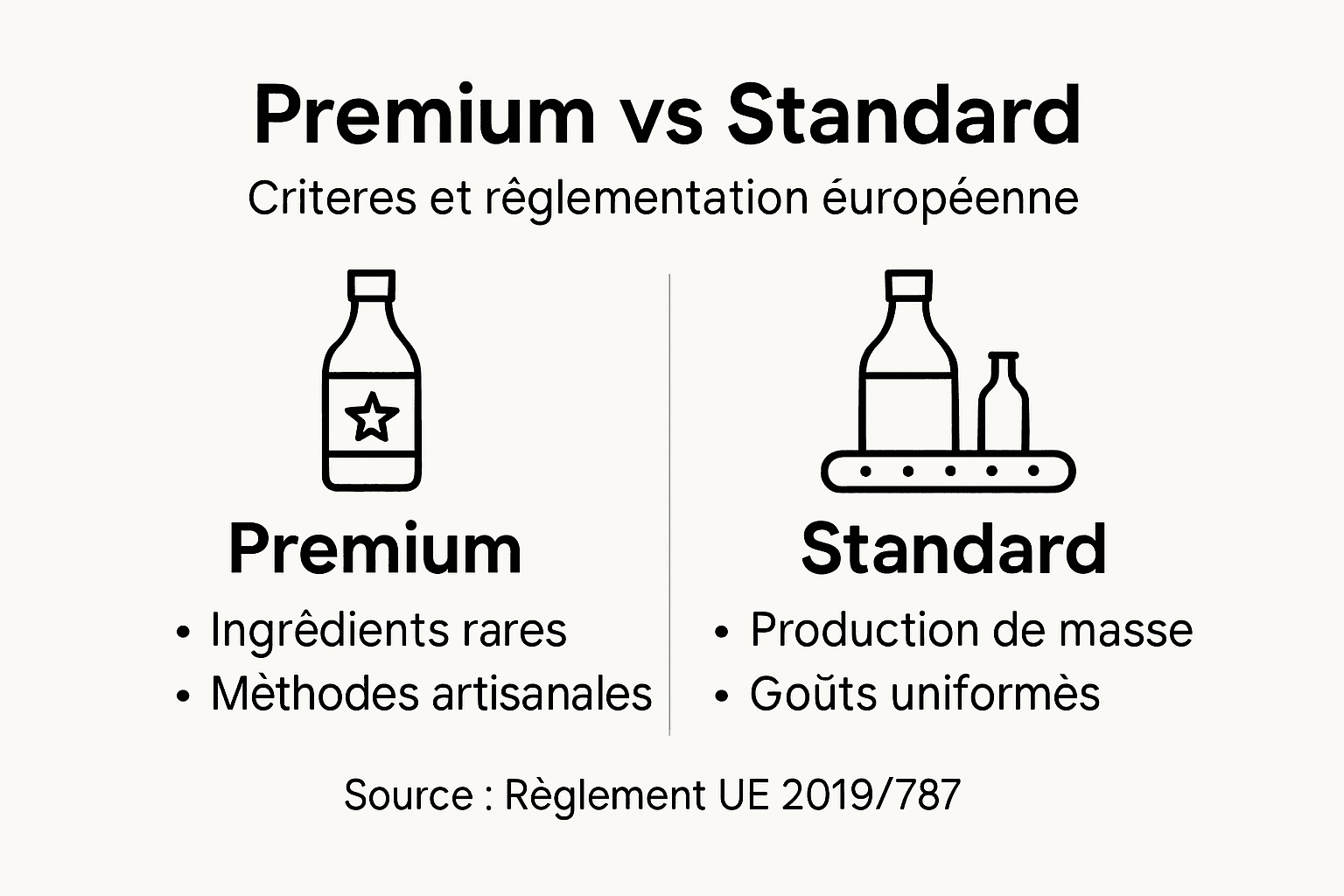
These standards protect your investment in premium spirits and ensure the transparency of every bottle on the market.
Legal Definitions in Europe
A premium spirit is legally defined as an alcoholic beverage obtained by distillation with a minimum alcohol content of 15%. This definition establishes a clear distinction from other alcohols and guarantees a quality threshold.
Regulation (EU) 2019/787 precisely frames the production, categories, and labeling to ensure transparency and consumer protection throughout the European Union.
This regulation harmonizes standards between countries, allowing artisanal producers to market their spirits without confusion or fraud.
What Labeling Must Reveal
The label of a premium spirit must contain precise and verifiable information:
- Origin: clear identification of the country or region of production
- Alcohol content: exact percentage of alcohol by volume
- Ingredients: transparent list of major components
- Protected Geographical Indications (PGIs): when applicable, mention of the appellation of origin
- Producer information: name and address of the distiller or bottler
A true premium spirit displays this information unambiguously. A lack of clarity is a warning sign for the informed collector.
Protected Geographical Indications
Certain categories of spirits benefit from geographical protections. An authentic Cognac comes only from the Cognac region in France. A Jamaican rum must meet specific production criteria.
These PGIs guarantee authenticity and local origin. They play a crucial role in positioning a spirit as premium.
European regulations impose strict rules on appellation, composition, and labeling to guarantee the authenticity and traceability of spirits.
Traceability and Quality Certifications
Artisan producers have voluntary certifications that enhance their credibility. These labels attest to compliance with additional standards beyond minimum regulation.
Traceability allows a spirit to be tracked from its raw materials to its distribution. This transparency is essential to distinguish true artisans from imitations.
Verifying the Authenticity of a Spirit
As a collector, you can verify regulatory compliance by:
- Carefully examining the label for all mandatory information
- Verifying the origin with official registries or European databases
- Contacting the producer directly to authenticate details
- Looking for quality certifications or international awards mentioned
Pro tip: Download the official technical data sheets of the spirits you are interested in from the producers: these documents precisely detail the manufacturing process and certifications, confirming regulatory compliance and premium quality.
Premium vs. Standard: How to Choose?
The difference between a standard spirit and a premium spirit is not just about price. It is based on tangible criteria that you can evaluate yourself before investing in a bottle.
As a collector in Central Europe, you deserve to know exactly what justifies your investment in high-end spirits.
Fundamental Differences
A standard spirit and a premium spirit differ in several distinct ways:
- Raw materials: standard uses generic ingredients; premium selects rare and specialized sources
- Manufacturing process: standard accepts shortcuts; premium invests time in each step
- Aging: standard minimizes duration; premium patiently prolongs in quality casks
- Quality control: standard applies minimal norms; premium far exceeds requirements
- Transparency: standard often hides its methods; premium openly shares its history
These differences accumulate to create a completely distinct taste experience.
Here is a summary of the key differences between premium and standard spirits:
| Criterion | Premium | Standard |
|---|---|---|
| Traceability | Full transparency | Limited details |
| Rarity | Limited edition | Mass production |
| Aromatic profile | Evolving complexity | Uniform flavor |
| Presentation | Refined design | Basic bottle |
The Sensory Experience
When you taste a premium spirit, you immediately notice the aromatic complexity. Layers of flavors are revealed gradually, evolving as the spirit warms in your glass.
A standard spirit offers a linear and predictable experience. You quickly identify the main profile, then little changes.
A true premium spirit is distinguished by its depth: a first tasting reveals dominant aromas, but each subsequent sip unveils new nuances.
Selection Criteria for a Collector
Before buying, ask yourself these precise questions:
Provenance and traceability Can you identify exactly where and how this spirit was produced? Premium brands document everything.
Transparent labeling Does the label mention the origin, major ingredients, and producer? Or does it remain vague?
Justified price Does the cost reflect rare ingredients, long aging, or artisanal production? Or are you simply paying for a brand name?
Cultural narrative Is there an authentic story behind the bottle? A premium spirit always has a soul, not just a formula.
The Price Question
The premium price is never arbitrary for true artisans. It reflects real costs: exceptional ingredients, prolonged aging, limited production, quality certification.
However, price alone does not guarantee quality. Some commercial brands artificially inflate their prices through marketing. This is why verifying the three previous criteria remains essential.
Starting Your Collection Smartly
As a new collector, do not assume that more expensive automatically means better. Visit comparative tastings, contact producers directly, explore specialized guides on artisanal spirits.
Your palate must become your best judge. Every euro invested in a premium spirit should bring you authentic pleasure and enrich your understanding of artisanal excellence.
Pro tip: Before buying a premium-priced spirit, ask the seller to precisely justify what differentiates it: artisanal production, special aging, rare ingredients, or a combination of these factors will reveal a true premium from a mere overpriced commercial brand.
Discover the Excellence of Italian Artisanal Spirits
Are you looking for an authentic premium spirit that combines exceptional quality and captivating storytelling? Our exclusive selection of Italian artisanal spirits precisely meets this need. Each bottle embodies traditional know-how, a unique taste, and a rich narrative inspired by myths and modern cultures to enrich your collection and enhance your tastings.
Explore our catalog on Mezzanotte now and transform each of your tasting experiences into a true sensory adventure. Don't wait any longer to acquire rare spirits combining exclusivity, refined design, and artisanal excellence. Your palate deserves the best of Italian premium.
Frequently Asked Questions
What is a premium spirit?
A premium spirit is an alcoholic beverage distinguished by the quality of its ingredients, artisanal craftsmanship, and a strong cultural narrative. It offers a complete and authentic sensory experience.
What are the main criteria for considering a spirit premium?
Criteria include the quality of raw materials, rigorous manufacturing process, patient aging, and transparency regarding origin and production methods.
How to taste a premium spirit?
To taste a premium spirit, it is recommended to savor it neat to appreciate its complexity. You can also incorporate it into cocktails, but make sure these respect the unique taste profile of the spirit.
What types of premium spirits exist?
The main families of premium spirits include whisky, rum, gin, vodka, cognac, and tequila, each with its own aromatic characteristics and production methods.
Recommendation
- 7 Premium Gins to Try in 2026: Exclusive Picks – Mezzanotte | Distilleria & Spirits
- Mezzanotte Method | How our artisanal spirits are born – Mezzanotte | Distilleria & Spirits
- Why Pop Culture and Spirits Unite? | Mezzanotte Spirits – Mezzanotte | Distilleria & Spirits
- Best Italian Amaro: A Guide to Excellence 2026 – Mezzanotte | Distilleria & Spirits