

Discover what truly makes a quality spirit superior: technical criteria, cultural storytelling, differences from industrial spirits, and mindful drinking.
Why Drink Quality Spirits: Benefits, Culture, and Experience
Apr 23, 2026

TL;DR:
- The premium spirits market is growing at 9% annually, favoring technical and narrative quality.
- True quality is assessed through measurable parameters such as aromas, complexity, and regional stories.
- Cultural storytelling, craftsmanship, and mindful drinking enrich the sensory experience and the relationship with the product.
The premium spirits market is growing by 9% each year, yet many enthusiasts still believe that drinking well simply means spending more. It doesn't work that way. True quality in spirits is not measured by an expensive label, but by precise criteria, an authentic story, and a sensory experience that changes how you perceive each sip. If you are looking for spirits that have something to say, not just to pour into a glass, this article is for you. We will explore what truly makes a spirit superior, the role of cultural storytelling, the real differences from industrial products, and the phenomenon of mindful drinking.
Table of Contents
- What it means to drink quality spirits
- Storytelling and cultural connection in quality spirits
- Artisanal vs. industrial spirits: real differences
- The mindful drinking trend: drink less, drink better
- The true hidden value behind choosing quality spirits
- Where to find quality spirits and experience them
- Frequently Asked Questions
Key Points
| Point | Details |
|---|---|
| Objective quality | Quality spirits are recognized by precise professional criteria. |
| History and culture | Storytelling makes each sip a journey into local traditions. |
| Conscious choice | Drinking better means appreciating smaller quantities and higher value. |
| Artisanal vs. industrial | Artisanal methods ensure greater purity and aromatic richness. |
What it means to drink quality spirits
Clarifying the value of quality spirits means first dismantling a common misconception: quality is not an opinion; it is a sum of measurable technical criteria. Industry professionals evaluate spirits based on well-defined parameters that go far beyond "I like it" or "I don't like it."
Professional evaluation criteria include aromatic precision, balance, complexity, intensity, and expressiveness—all elements built into the raw materials, fermentation, and distillation techniques. A quality spirit features clean aromas, free from unpleasant or artificial notes, with a layered taste structure that evolves in the glass.
During the conscious tasting of an artisanal spirit, the experience is divided into three main phases:
- Olfactory examination: first contact with the aromas, which must be clean and well-defined
- Tasting: perception of the structure, body, and balance between sweet, bitter, acidic, and salty
- Persistence: how long the taste sensations linger after swallowing
Here's a quick comparison of the evaluation parameters:
| Parameter | Quality Spirit | Common Spirit |
|---|---|---|
| Aromatic precision | High, clear | Generic, indistinct |
| Complexity | Multilayered | One-dimensional |
| Persistence | Long, evolving | Short, flat |
| Raw materials | Selected, traceable | Standard, undifferentiated |
| Distillation technique | Artisanal, controlled | Industrial, automated |
If you're wondering how to choose an artisanal spirit, knowing how to interpret these parameters is the first step to orienting yourself without relying on marketing.
Pro Tip: Don't stop at the first olfactory impression. Quality spirits change in the glass as they oxygenate, just like fine wines. Wait a few minutes before making a final judgment.
Storytelling and cultural connection in quality spirits
Beyond technical quality, the value of spirits is also expressed in their history. An artisanal spirit is not just a liquid in a glass: it is the story of a territory, a community, and rituals passed down through time.
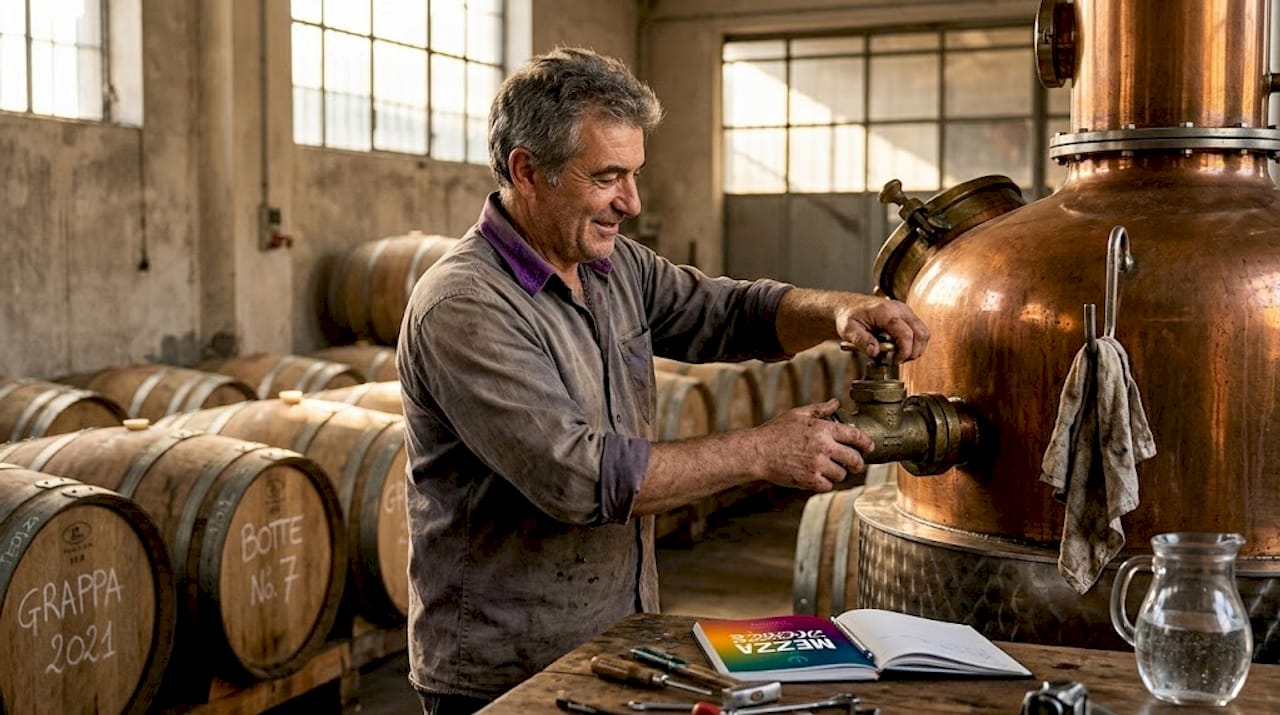
Spirits with authentic storytelling build an emotional connection between producer and drinker. This is particularly true for Italian spirits, where each region carries a centuries-old tradition, medicinal herbs, peculiar techniques, and narratives linked to the land.
The approach of spirits with strong cultural identity is based on precise elements:
- Direct connection with the region of origin and its natural resources
- Use of local botanicals or indigenous ingredients
- References to legends, myths, folklore, or specific historical events
- Bottle design as a narrative extension of the product
- Transparency about the production chain and the people involved
For collectors and enthusiasts like you, these elements are not decorative: they are an integral part of the experience. As the brand philosophy of Spiriti Eroici emphasizes, Italian artisanal spirits leverage deep connections with territory, traditions, and folklore, transforming each bottle into an object with its own cultural identity.
“A spirit without a story is like a book without words: technically it exists, but it tells you nothing.”
This approach radically changes the drinking experience. It is no longer about consuming a product, but about connecting with the history of Italian spirits, their roots, and the creative thinking of those who conceived them. For those who collect spirits or study them carefully, the narrative aspect has tangible value, which is also reflected in the rarity and uniqueness of certain products.
The art in Italian premium spirits is expressed precisely here: in the ability to blend aesthetics, cultural content, and technical quality into a product that is worth much more than the sum of its parts.
Artisanal vs. industrial spirits: real differences
Often, choosing between artisanal and industrial creates doubts. Does the higher price justify the expense? The answer requires an honest comparison, without romanticism or prejudice.
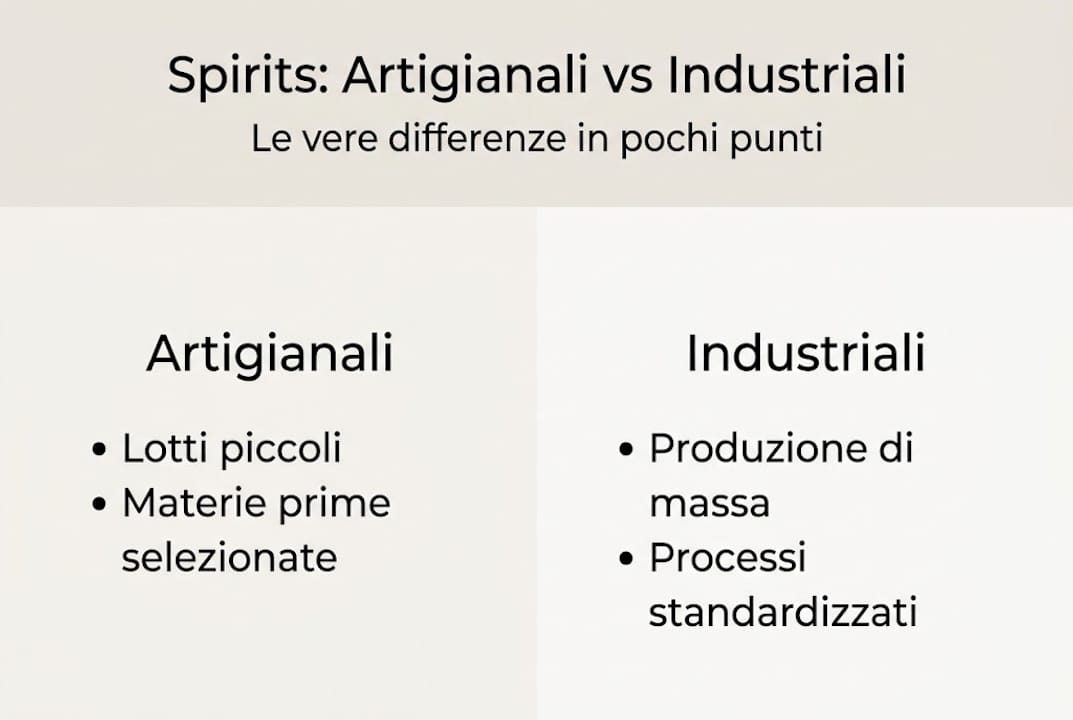
Artisanal distillers work in small batches, control every production phase, and select raw materials with rigorous criteria. This results in products with character, purity, and an aromatic profile that reflects the choices of their creators. Industrial products, on the other hand, aim for standardization: the same taste, the same yield, always and everywhere.
As the analysis of evaluation criteria highlights, price does not automatically equate to quality, but premium artisanal spirits consistently show higher levels of purity and care in production methods. This means there are expensive industrial products and accessible artisanal spirits, and knowing how to distinguish between the two is a real skill.
Here are the main differences clearly:
| Aspect | Artisanal | Industrial |
|---|---|---|
| Production size | Small batches | Large volumes |
| Raw materials | Selected, often local | Standardized |
| Quality control | Manual, phase by phase | Automated |
| Aromatic profile | Unique, variable by vintage | Consistent, standardized |
| Storytelling | Strong, authentic | Absent or constructed |
- Check the label: artisanal spirits often list the distiller, location, and botanicals used.
- Examine the distillery: a real production facility has an identifiable physical location.
- Read the tasting notes: artisanal ones are specific, not generic.
- Look for international technical awards, not just marketing recognition.
If you want to understand why to prefer artisanal spirits over industrial ones, the starting point is always direct experience in the glass, not advertising.
Pro Tip: Be wary of spirits with elaborate bottles that don't specify the distillation method or the origin of the ingredients. Packaging doesn't tell the real quality story.
The mindful drinking trend: drink less, drink better
The new way of understanding drinking perfectly aligns with quality spirits. Mindful drinking is a rapidly growing trend, especially among younger generations, who consciously choose to reduce quantity but radically increase the quality of what they drink.
The concept is simple: instead of consuming large quantities of ordinary alcoholic beverages, one chooses to savor less, but with more attention. This approach promotes sensory pleasure, respect for one's health, and a more mature relationship with drinking.
Key data: The mindful drinking trend favors "drinking less but better," with significant growth among Gen Z, who are reducing alcohol consumption but increasing spending on premium products.
How to concretely apply mindful drinking with quality spirits:
- Choose just one excellent spirit for the evening, instead of drinking multiple mediocre products.
- Take time to observe: color, transparency, viscosity even before smelling.
- Pair the spirit with food or specific moments to enhance its aromas.
- Take notes on what you perceive: this refines the palate and transforms drinking into a cultural practice.
- Learn the product's history before opening the bottle, to contextualize the experience.
This approach transforms every glass into a moment of presence, not evasion. For those who collect spirits or study them, mindful drinking is not a limitation: it is the natural way to relate to products that deserve attention.
The connection with artisanal distillation is direct: only those who have created a product with care and intention can offer you something truly worth savoring slowly.
The true hidden value behind choosing quality spirits
After criteria, comparisons, and data, a more personal look is warranted. There's something statistics don't fully capture: how the pursuit of quality changes one's relationship with drinking.
Those who start choosing quality spirits stop drinking out of habit and begin drinking with intention. Every bottle becomes a conscious choice, every sip a moment of presence. This is a subtle yet profound change, transforming consumption into a ritual.
Drinking quality spirits is also a form of cultural collecting. You don't just collect bottles: you accumulate stories, geographies, traditions, and worldviews. It's a way to get closer to cultures, terroirs, and communities that would otherwise remain distant.
At Mezzanotte, we believe the real challenge isn't finding the most expensive spirit, but developing a taste for the meaning behind each bottle. And this is built with curiosity, patience, and the desire to make a conscious choice every time you approach a spirit.
Where to find quality spirits and experience them
If you're ready to move from theory to practice, here's where to find true quality spirits. At Mezzanotte, you'll find a selection of artisanal Italian spirits built on precise aromatic identities, authentic stories, and international technical awards.
Every product in our catalog stems from a clear vision: to bring you an experience that goes beyond the glass. Whether you're looking for an artisanal Italian gin with selected botanicals or an artisanal Italian vodka with real character and purity, in our shop you'll find spirits designed for those who know what they're looking for. Every bottle tells a story, every sip has a precise reason. Explore the catalog and choose the spirit that speaks your language.
Frequently Asked Questions
What are the criteria for recognizing a quality spirit?
A quality spirit is distinguished by aromatic precision, balance, complexity, intensity, expressiveness, and persistence, built on selected raw materials and accurate distillations.
Does drinking artisanal spirits really make a difference compared to industrial ones?
Yes, artisanal spirits offer greater purity and attention to detail thanks to manual production methods, as confirmed by premium quality criteria that clearly distinguish them from standardized products.
Why is storytelling important in the world of spirits?
Storytelling enhances the connection with territory, tradition, and cultural identity, creating an immersive experience that goes far beyond taste, as demonstrated by the philosophy of brands like Spiriti Eroici.
Does a higher price always guarantee a better spirit?
No, price does not always indicate real quality, although true premium artisanal spirits consistently show higher levels of purity and attention to production methods compared to expensive industrial ones.
Recommendation
- Why Choose Artisanal Spirits in 2026: Unique Quality – Mezzanotte | Distillery & Spirits
- Guide to Buying Authentic Italian Spirits 2026 – Mezzanotte | Distillery & Spirits
- Spirits Distillation Guide 2026: Avoid 40% Common Errors – Mezzanotte | Distillery & Spirits
- Guide to Choosing a Quality Artisanal Spirit – Mezzanotte | Distillery & Spirits