

Discover how to choose Italian craft alcoholic beverages: quality criteria, unique spirits, preparation techniques, and international awards to guide your choices.
Italian Alcoholic Drinks: Unique Spirits and Stories to Savor
Apr 22, 2026

TL;DR:
- The quality of a craft spirit is evaluated based on the origin of botanicals, production technique, and transparency.
- Italian examples like Nemoralia Gin and Piemme Limoncello highlight the importance of territory, seasonality, and traditional methods.
- Awards and recognitions are useful tools, but personal history and curiosity are the real added values.
Choosing a truly special craft spirit from hundreds of options is never easy. The Italian spirits market has exploded in recent years, and today anyone faced with shelves full of bottles with meticulously designed labels asks: where do I start? The answer lies not just in price or the best-known brand, but in the ability to read a story, understand a technique, and recognize a territory. In this article, you'll find criteria for evaluating a craft drink, concrete examples of exceptional Italian spirits, how preparation techniques change the experience, and how to navigate awards and international benchmarks.
Table of Contents
- How to evaluate a craft alcoholic drink
- Examples of truly unique Italian craft spirits
- Alcoholic drinks: preparation techniques that enhance spirits
- Benchmarks and awards: how to recognize quality in alcoholic drinks
- Our point of view: the true value of a drink today
- Discover and purchase true Italian craft drinks
- Frequently asked questions
Key Points
| Point | Details |
|---|---|
| Conscious evaluation | Choose spirits not only based on awards but also on unique techniques and stories. |
| Fundamental techniques | Using shake or stir correctly enhances every spirit. |
| The importance of territories | Discover spirits that speak of local culture and enhance indigenous ingredients. |
| Authoritative recognitions | Awards like IWSC and Alambicco d’Oro help to recognize superior quality. |
How to evaluate a craft alcoholic drink
When talking about craft spirits, quality is not just measured in alcohol content or bottle elegance. There are deeper criteria that distinguish a truly unique spirit from one that is merely well-packaged. Understanding these criteria is the first step to making informed choices, those that will make you say, "this is different," at the very first sip.
The first element to consider is the origin of the botanicals and ingredients. An indigenous spirit uses raw materials closely linked to the production territory: alpine herbs, southern citrus fruits, mountain flowers. This is not just marketing. It means that the spirit carries with it an unrepeatable geographical and sensory identity, almost impossible to replicate elsewhere.
A second fundamental criterion concerns production transparency. The best craft producers openly declare every ingredient, every step of the process. If a label says nothing about the botanicals or the technique used, it's fair to ask why.
Trend 2026: sustainability and ethics in production
Industry data confirms it: sustainability has become a real competitive factor. Producers who use processing waste to create energy, who collaborate with local farmers, who choose recyclable packaging, are increasingly receiving recognition in international competitions. According to the results of Alambicco d’Oro, the awarded Italian indigenous spirits reflect the boom of Italian gin, with 18 references awarded out of 100 and a dominance of Piedmont and Trentino accounting for 62% of national awards. A strong signal, not a coincidence.
Here are some practical criteria to apply immediately:
- Declared botanicals: the more specific and localized they are, the more credible the product is.
- Distillation technique: pot still, column, cold maceration: each leaves a signature.
- Awards and recognitions: they are not the only measure, but they indicate that the product has passed a technical judgment.
- Producer's story: who is behind the bottle? Small family distillery or large group?
- Ethics and supply chain: the origin of ingredients matters as much as the recipe.
Pro Tip: Always read the back label carefully. A serious craft producer indicates specific botanicals, ingredient origin, and often the processing technique. If the label only says "gin with natural botanicals," it's a sign of little transparency.
For those who want to delve into the matter from the root, understanding why choose craft spirits is the ideal starting point. And if you are building your personal selection, a guide to buying Italian spirits helps you navigate with discretion.
Examples of truly unique Italian craft spirits
Having established the criteria, let's move on to some emblematic Italian stories that truly illustrate what makes a spirit unique. Because theory is useful, but concrete examples are what make something click.
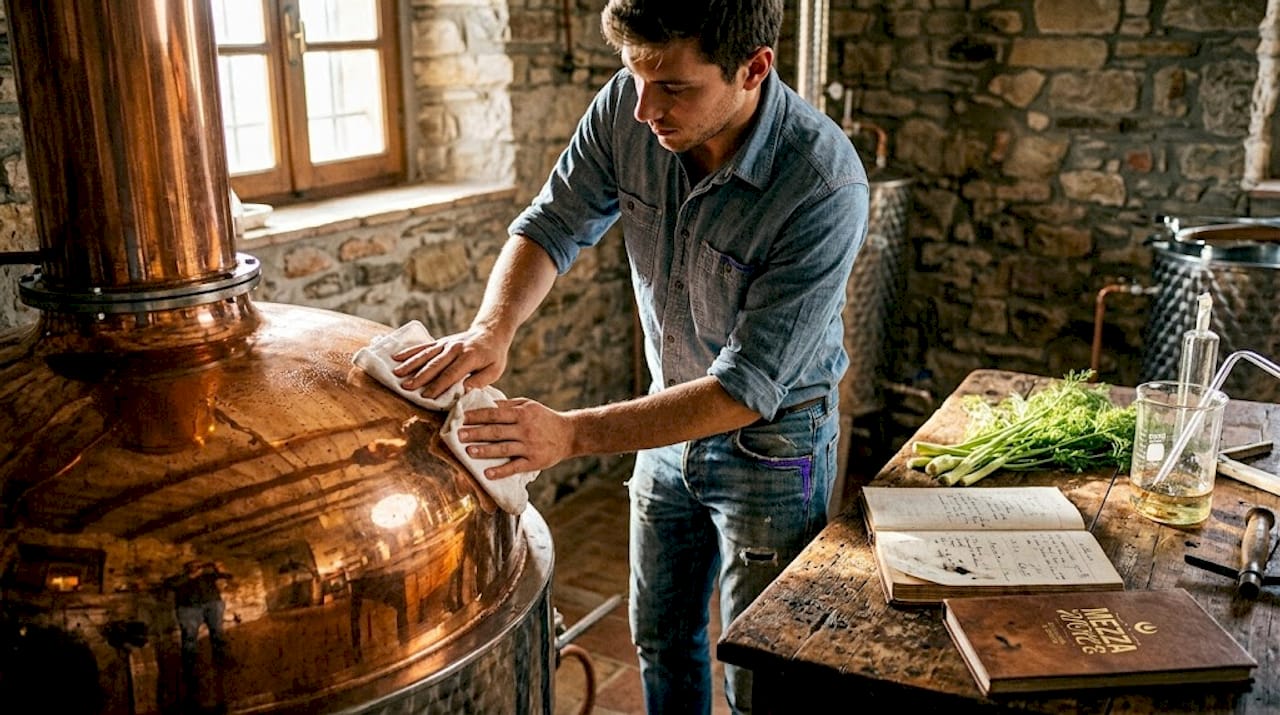
Nemoralia Gin, produced by Matteo Pogliani in the Tuscan Valdarno, is one of the most discussed spirits in recent years. Its signature is the use of Tuscan wild fennel combined with Vinsanto, the renowned sweet wine of the region. The result is a gin that tastes of forest and cellar at the same time, an aromatic profile unlike any other European gin. This is the most precise definition of indigenous.
Another notable case is Piemme Limoncello di Sorrento IGP, which elevates a classic of Neapolitan tradition through the manual infusion of hand-selected peels. This is not just any liqueur: each batch reflects the season of harvest, with variations in aromatic intensity that producers do not hide, but rather value as a characteristic.
Finally, Number One Liquor is a perfect example of the old compounding method: Sicilian almonds infused for six months, without industrial acceleration. Time becomes an ingredient. The result is a roundness and depth that no rapid process can imitate.
“A craft spirit is not just a drink. It is a fragment of territory, season, and human care in a glass.”
What do these three spirits have in common?
- Territorial ingredients with precise geographical identity
- Techniques requiring time and human touch
- Aromatic profiles that do not seek to please everyone, but to be true to themselves
- Producers who tell their story without commercial filters
Pro Tip: When tasting a craft gin or liqueur, try first to read it like a book: learn about the producer's story, the origin of the botanicals, the harvest season. That context will transform your palate.
If you want to understand what truly differentiates Italian gin from its foreign counterparts, the answer lies precisely in these details. And to discover other authentic Italian spirits with this level of character, the options are numerous and surprising.
Alcoholic drinks: preparation techniques that enhance spirits
Having discovered special spirits and their stories, let's now understand how to enhance them in the glass. Because an extraordinary gin prepared poorly is a waste. Technique matters as much as the ingredient.
The question every enthusiast asks sooner or later is: shake or stir? It's not a matter of style; it's a matter of chemistry and respect for the spirit.
Shaking is used when the cocktail contains citrus juices, thick syrups, egg whites, or other ingredients that require emulsification. The shaker breaks down molecules, creates micro-air bubbles, and chills the drink rapidly. According to standard professional mixology techniques, a proper shake brings the drink's temperature between minus 5 and minus 7 degrees Celsius, with dilution and aeration that completely change the texture.
Stirring, on the other hand, is reserved for spirit-forward cocktails, where the spirit is the absolute protagonist: Martini, Negroni, Manhattan. Slowly stirring with a bar spoon maintains the drink's clarity, controls dilution, and preserves the spirit's aromatic structure without altering it.
| Technique | When to use it | Result |
|---|---|---|
| Shake | Citrus, syrups, egg white | Aerated, opaque, intensely cold |
| Stir | Spirit-forward, Martini, Negroni | Clear, silky, controlled dilution |
| Build | Highball, long drinks | Simple, fresh, effervescent |
Steps for a perfect preparation:
- Chill the glass with ice before pouring
- Use quality ice, preferably large blocks
- Choose the right technique based on the drink's ingredients
- Respect the timing: 10-12 seconds of stir, 15-18 of shake
- Strain carefully to remove ice shards
- Add the chosen garnish thoughtfully only at the end
A lemon peel twist on a gin Martini is not just decoration: it releases essential oils that change the drink's aromatic profile. To discover how to most effectively pair Italian spirits with cocktails, it's worth exploring every variable.
Benchmarks and awards: how to recognize quality in alcoholic drinks
To navigate through so many spirits, objective references are needed: here's how to use awards to decide. Not to follow trends, but to have a verified starting point.
International awards like IWSC (International Wine and Spirits Competition) and Alambicco d’Oro evaluate spirits on precise technical parameters: aromatic balance, length of finish, complexity, and consistency with the declared type. A gold medal doesn't guarantee that you'll like the product, but it guarantees that it has passed a rigorous examination by an expert jury.
Among recently awarded Italian gins, it's worth mentioning:
- Leonardelli London Dry Gin Foglia (47% vol.): Best Gold at the Alambicco d’Oro 2025, recognized for its botanical precision
- Borsci Gin Sir Miller (40% vol.): Best Gold in the same competition, awarded for the balance between tradition and modernity
- Jo Ressel Vento Carsico: 98 points at IWSC, one of the highest scores ever awarded to an Italian gin
| Spirit | Award | Score/Medal |
|---|---|---|
| Leonardelli London Dry Gin Foglia | Alambicco d’Oro 2025 | Best Gold |
| Borsci Gin Sir Miller | Alambicco d’Oro 2025 | Best Gold |
| Jo Ressel Vento Carsico | IWSC | 98/100 |
Awards do not replace personal taste, but they are powerful tools to reduce uncertainty, especially when exploring a new category. A gin with 98 points at IWSC is a guarantee of an excellent starting point.
If you want to build a selection of award-winning spirits in Italy, competition data is your map. For those who want to focus on the best Italian gins overall, there are specific guides that cross-reference awards and reviews. And for beginners, tips for gin tasting are the fastest way to develop a critical palate.
Our point of view: the true value of a drink today
We've talked about criteria, awards, techniques, and stories. But there's one element that matters most of all, and that is often overlooked: personal curiosity.
Awards guide, but they don't excite. Technical specifications inform, but they don't tell a story. What distinguishes a true enthusiast from a mere consumer is the ability to be surprised by an unknown gin produced in a village of a hundred inhabitants, by a liqueur that tastes of an autumn forest, by a vodka born from an almost extinct variety of wheat.
We believe that the true value of a drink today is not in IWSC points or designer labels, but in the story you manage to carry with you after tasting it. That story changes the way you perceive it, make others perceive it, and choose it next time.
Allowing yourself to be guided by the conscious choice of spirits means stopping looking for "the absolute best" and starting to look for "the best for me, right now, with this story." It's a subtle difference, but it changes everything.
Discover and purchase true Italian craft drinks
You now have all the tools to navigate Italian craft spirits: selection criteria, concrete examples, preparation techniques, and quality benchmarks. The next step is to find the right products, selected by those who live this passion every day.

On mezzanotte.shop you'll find a curated selection of Italian craft gin and craft vodka with a strong territorial identity and authentic storytelling. Each bottle is chosen for its character, not its commercial notoriety. Explore the catalog, read the stories behind each spirit, and discover your next favorite.
Frequently asked questions
What are the main differences between craft and industrial gin?
Craft gin focuses on local botanicals and traditional processes, such as the wild fennel in Nemoralia Gin, which produce a more complex and distinctive aromatic profile compared to standardized industrial production.
How do you recognize quality spirits?
In addition to awards like the Alambicco d’Oro 2025, it's important to evaluate ingredient transparency, the specificity of production techniques, and the consistency between the producer's story and the final product.
Is it better to choose an award-winning drink or focus on niche products?
Awards are strong indicators, but award-winning indigenous spirits demonstrate that niche products can also achieve top quality, often with flavors and stories that juries don't always fully capture.
What techniques should be used to best taste a gin?
Stirring maintains the transparency and aromatic structure of spirit-forward cocktails, while shaking citrus-based drinks enhances freshness and texture; add an herb garnish to complete the sensory experience.
Recommendation
- Aperitifs and Cocktails: Recipes, Stories, and Italian Spirits – Mezzanotte | Distillery & Spirits
- How to pair Italian spirits for unique cocktails – Mezzanotte | Distillery & Spirits
- Guide to choosing a quality artisanal spirit – Mezzanotte | Distillery & Spirits
- Italian spirits tasting method: practical guide 2026 – Mezzanotte | Distillery & Spirits