

Discover the minimum ABV of gin according to EU regulations, the differences between London Dry, Navy Strength, and sloe gin, and how to choose the right gin for every occasion.
Gin Alcohol Content: A Complete Guide to Types and Rules
Apr 6, 2026

TL;DR:
- The minimum legal alcohol content for gin is 37.5% ABV, according to EU regulations.
- Major categories like London Dry and Distilled Gin require at least 37.5% ABV.
- Gin quality depends on the balance between botanicals, base alcohol, and production process, not just alcohol content.
Many spirit enthusiasts assume that every bottle labeled as gin contains the same alcohol percentage. This is not the case. European rules are precise, and the alcohol content is not just a number: it legally defines what can be called gin and what is something else. Between London Dry, distilled gin, and flavored liqueurs like sloe gin, the differences are substantial. In this guide, you will discover the rules governing minimum alcohol content, the main categories with their respective alcohol percentages, the role of botanicals, and how to choose the right gin for every occasion.
Table of Contents
- EU Regulations and Minimum Gin Alcohol Content
- Gin Categories and Their Alcohol Percentage
- The Role of Botanicals and Base Alcohol
- Practical Applications: Choosing the Right Gin Based on Alcohol Content
- What Most Experts Don't Tell You About Gin Alcohol Content
- Discover Italian Craft Gins: Quality and Perfect Alcohol Content on Mezzanotte Spirits
- Frequently Asked Questions About Gin Alcohol Content
Key Points
| Point | Details |
|---|---|
| EU minimum threshold | Authentic gin must have at least 37.5% ABV according to European regulations. |
| Categories and alcohol content | Among the different types of gin, only those that meet the minimum threshold are legally recognized. |
| Determining botanicals | Botanicals and base alcohol influence the aroma, alcohol content, and quality of gin. |
| Informed choice | The choice of the ideal gin depends on its intended use and personal preferences. |
EU Regulations and Minimum Gin Alcohol Content
To truly understand gin, one must start with the law. In Europe, the production and classification of spirits are governed by EU Regulation 2019/787, which unequivocally establishes the minimum requirements for each spirit category.
The fundamental point is this: a minimum alcohol content of 37.5% ABV is the mandatory requirement for a spirit to be legally called gin. ABV stands for Alcohol By Volume, which is the percentage of pure ethyl alcohol present in the liquid. Below that threshold, the product cannot bear the name gin on the label.
But it's not just a matter of the final percentage. The regulation also requires that the base alcohol used in production has an alcohol content of 96% vol or higher during distillation. This ensures a high purity of the starting distillate, reducing impurities and providing a neutral base on which the botanicals can best express their aromas.
“Juniper must be the predominant flavor in any gin: this is the rule that distinguishes gin from any other flavored spirit.”
The main regulatory conditions for an authentic gin are:
- Minimum alcohol content: 37.5% ABV
- Base alcohol: minimum purity of 96% vol
- Predominant botanical: juniper (Juniperus communis)
- Aromas: natural only, no synthetic flavors
- Coloring: prohibited (with some specific exceptions)
The case of London Dry Gin deserves a separate discussion. This category, among the most well-known in the world, has even stricter rules: botanicals must be added directly during distillation, and no flavors, colorings, or sweeteners are allowed to be added after the process. To learn more about the origins and production of dry gin, it is worth exploring the history of this category that has defined global standards.
| Category | Minimum Alcohol Content | Key Notes |
|---|---|---|
| Gin | 37.5% ABV | Predominant juniper |
| London Dry Gin | 37.5% ABV | No post-distillation additives |
| Distilled Gin | 37.5% ABV | Botanicals in direct distillation |
| Sloe Gin | ~28% ABV | Classified as a liqueur |
These rules are not arbitrary. They protect the consumer and ensure that behind every bottle of gin there is an authentic production process, respectful of tradition and quality.
Gin Categories and Their Alcohol Percentage
Now that you know the minimum threshold and the basic rules, let's see how alcohol contents vary across different types and what this means in practical terms for those who buy and taste.
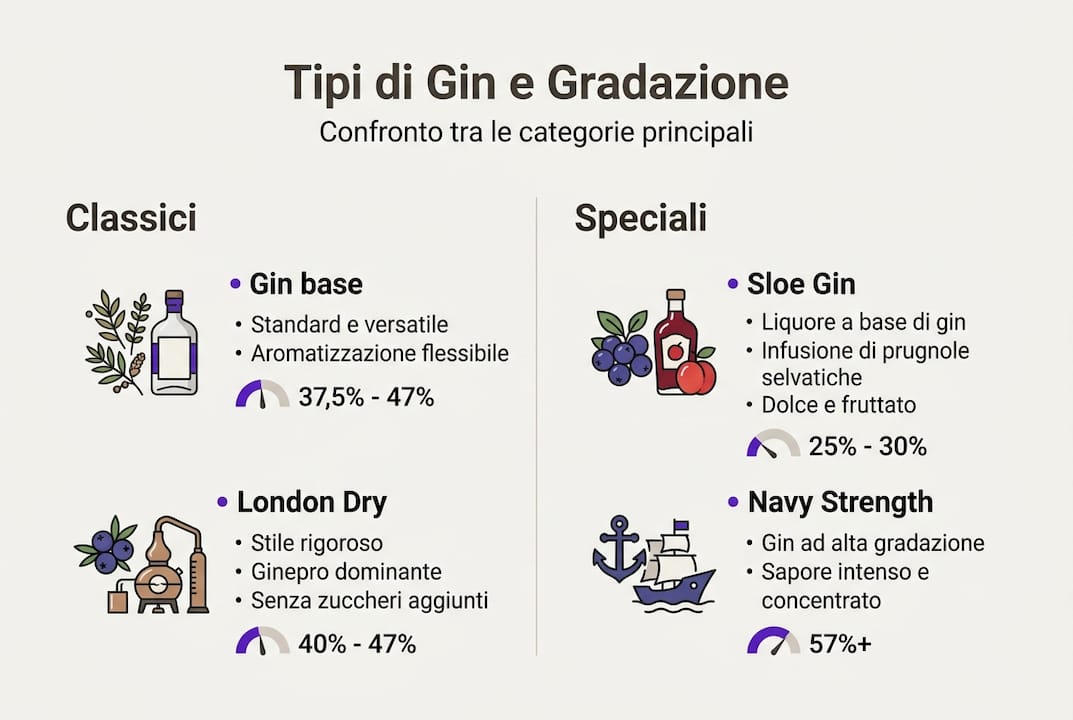
The three main categories recognized by European regulation—London Dry Gin, Distilled Gin, and Gin—all share the minimum threshold of 37.5% ABV. The differences lie not so much in the alcohol content as in the production process and the freedom granted to the distiller.
Here are the typical alcohol contents by category:
- Base Gin: between 37.5% and 40% ABV, often with added flavors after distillation
- Distilled Gin: between 40% and 45% ABV, botanicals present during distillation
- London Dry Gin: between 40% and 47% ABV, more rigid process and no post-distillation additives
- Navy Strength Gin: at least 57% ABV, historically used by the British Navy
- Sloe Gin: approximately 28% ABV, classified as a flavored liqueur and not as gin
This last point is crucial. Sloe gin, produced by macerating wild sloe berries in alcohol, does not reach the 37.5% ABV threshold and therefore cannot be legally defined as gin. It is a liqueur in all respects, with completely different usage characteristics.
For those who want to navigate the differences between vodka and gin, understanding alcohol contents also helps to compare seemingly similar spirits that are profoundly different by law and by palate.
| Type | Typical Alcohol Content | Legal Classification |
|---|---|---|
| Base Gin | 37.5% - 40% | Gin |
| London Dry Gin | 40% - 47% | Gin |
| Navy Strength | 57%+ | Gin |
| Sloe Gin | ~28% | Liqueur |
Pro Tip: If you are buying gin and want to ensure you have a product that complies with European regulations, always check the label. The wording “gin” without further specifications indicates that the product exceeds 37.5% ABV. For a more detailed guide to gin varieties, the differences between categories become even clearer.
The Role of Botanicals and Base Alcohol
After observing the categories, it's time to understand how botanicals and base alcohol together influence the quality and final alcohol content of gin.
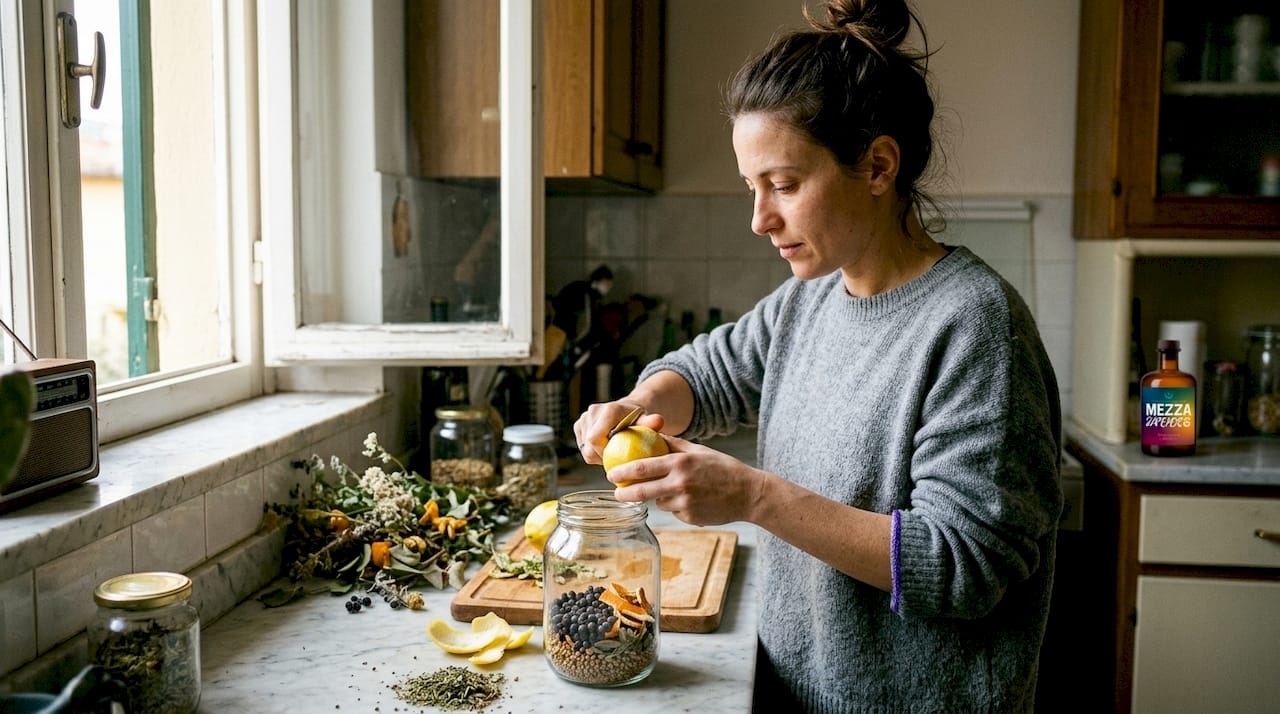
Botanicals are the heart of gin. Juniper is legally mandatory, but around it, the distiller can build a unique aromatic profile using dozens of different ingredients: coriander, angelica, citrus peel, cardamom, pepper, iris, cinnamon, and much more. The choice and dosage of gin botanicals determine not only the flavor but also the complexity of the spirit.
European regulations, as already seen, require that the base alcohol has a minimum purity of 96% vol. This is not a minor technical detail: a purer base alcohol means fewer congeners (secondary fermentation substances) and thus a cleaner aromatic profile, where botanicals can express themselves without interference.
The main botanical infusion techniques are:
- Maceration: botanicals are steeped in the base alcohol for hours or days before distillation
- Direct distillation: botanicals are placed in the still during the process
- Vapour infusion: botanicals are placed in a basket above the liquid, and alcohol vapors pass through them, extracting their aromas
- Cold compounding: botanical extracts are added to the alcohol without distillation (method not allowed for London Dry)
Each technique produces different results. Maceration tends to extract more intense and deep aromas, while vapor infusion yields more delicate and floral profiles. To better understand the meaning of botanical gin and how distiller's choices influence the final result, it's useful to know these differences.
Pro Tip: When tasting a gin, try to identify the main botanicals before reading the label. Training yourself to recognize the aromatic components of craft gin refines your palate and makes every tasting more conscious.
In the Italian landscape, craft distillers often choose local botanicals to create unique profiles. Alpine herbs, Mediterranean citrus, and roots typical of Italian flora give rise to gins with distinctive character. Discovering what differentiates Italian gin means understanding how territory and tradition merge into every bottle.
Practical Applications: Choosing the Right Gin Based on Alcohol Content
In light of the theory, it is essential to understand how to apply it in the daily choice of gin, both for pure tasting and for preparing cocktails.
Alcohol content directly affects the experience in the glass. A gin at 37.5% ABV will be softer and more accessible, while one at 47% will offer greater aromatic intensity and a more pronounced alcoholic presence. Neither is absolutely superior: it depends on the occasion and your palate.
Here's how to navigate:
- For pure tasting: choose gins between 40% and 45% ABV, which offer a good balance between aromatic complexity and drinkability
- For gin and tonic: alcohol contents between 40% and 47% hold up better to tonic dilution without losing personality
- For complex cocktails: a Navy Strength (57%+) maintains its presence even in recipes with many ingredients
- For desserts and sweet pairings: sloe gin at 28% ABV is ideal due to its natural sweetness and low alcohol content
Some practical criteria for choosing:
- Occasion: informal aperitif vs. serious tasting require different gins
- Mixology: for an effective craft gin cocktail guide, alcohol content is a fundamental variable
- Food pairing: softer gins pair better with delicate dishes, while more intense ones go with strong flavors
- Season: floral and light gins in summer, warm and spicy botanicals in winter
Pro Tip: If you are exploring types of Italian craft gins, start with medium alcohol contents (40-43% ABV) to build a sensory reference, then venture towards more intense versions or Navy Strength ones.
For those who love gin and tonic, the perfect gin and tonic recipe takes into account alcohol content as a key variable for balancing tonic, ice, and garnish. A lower alcohol gin requires less tonic, while a higher alcohol one can handle more without losing character.
What Most Experts Don't Tell You About Gin Alcohol Content
There's a mistake we often see repeated: confusing high alcohol content with high quality. It doesn't work that way. A gin at 57% ABV can be extraordinary or mediocre, just like one at 40%. Alcohol content is a technical parameter, not a judgment of value.
What truly matters is the balance between alcohol and botanicals. A well-made spirit at 40% ABV can have an aromatic complexity that a poorly constructed Navy Strength will never achieve. The aromatic components of craft gin are the true indicator of quality, not the number on the bottle.
There's also an often-ignored aspect: the perception of alcohol content changes with serving temperature and glass type. The same gin served at 4°C in a narrow glass will seem more alcoholic than one served at 8°C in a wide goblet. Personal taste, experience, and context almost always outweigh technical parameters. Trust your palate more than the label.
Discover Italian Craft Gins: Quality and Perfect Alcohol Content on Mezzanotte Spirits
If this in-depth look has opened new perspectives on the world of gin, the next step is to explore products that truly embody these principles.
On Mezzanotte Spirits, you'll find a selection of Italian craft gin with certified alcohol content and transparent production stories. Each bottle is the result of conscious choices: selected botanicals, quality base alcohol, and a process that respects the strictest European standards. If you're curious to explore other spirits too, the craft vodka section offers just as many surprises. Each product has its own identity, its own story, and an alcohol content designed to enhance the best of each botanical.
Frequently Asked Questions About Gin Alcohol Content
What is the minimum alcohol content for a spirit to be called 'gin'?
The minimum alcohol content is 37.5% ABV, as established by EU Regulation 2019/787. Below this threshold, the product cannot be labeled as gin.
Is sloe gin considered a true gin?
No. Sloe gin has an alcohol content of approximately 28% ABV and is classified as a flavored liqueur, not as a true gin.
What is London Dry Gin and what alcohol content does it have?
London Dry Gin is a category with a minimum alcohol content of 37.5% ABV and a production process that prohibits any addition of flavors or colorings after distillation.
Is it possible to find gins with alcohol contents higher than 40% ABV?
Yes, many craft and premium gins exceed 40% ABV. Navy Strength, for example, reaches at least 57% ABV, while still meeting the European minimum requirement of 37.5%.
Recommendation
- Types of gin: complete guide to varieties 2026 – Mezzanotte | Distillery & Spirits
- Definition of premium gin: guide for enthusiasts 2026 – Mezzanotte | Distillery & Spirits
- What differentiates Italian gin: complete guide 2026 – Mezzanotte | Distillery & Spirits
- Dry gin: guide to origins, production and tasting – Mezzanotte | Distillery & Spirits