

Discover how to pair gin and food with this practical guide: gin styles, pairings for each course, mistakes to avoid, and expert tips.
Discover how to pair gin and food for unique experiences
Apr 7, 2026

TL;DR:
- Choosing the right gin depends on the desired style and flavor profile.
- The right tools and ingredients are essential for successful pairings.
- Personal experience and creativity enhance pairings, going beyond classic rules.
You've uncorked an extraordinary artisanal gin, prepared a meticulously crafted dinner, yet something isn't working: the spirit overpowers the dish, or the food completely masks the gin's aromas. It's a frustration many enthusiasts know well. Pairing gin and food isn't an art reserved for professional bartenders: with the right guidance, you can transform every meal into a memorable sensory experience. This guide will walk you through it step by step, from choosing the right gin to desserts, with practical examples, mistakes to avoid, and a few surprises along the way.
Table of Contents
- Choosing the Right Gin for Pairing
- How to Prepare: What You Need for the Perfect Food Pairing
- Step by Step: Practical Guide to Gin and Food Pairings
- What to Avoid and How to Perfect Your Pairings
- Beyond the Rules: My Personal Experience with Gin at the Table
- Add Flavor to Your Experience: Mezzanotte Italian Artisanal Gin
- Frequently Asked Questions about Gin and Food Pairings
Key Points
| Point | Details |
|---|---|
| Choose the right gin | Each gin style requires a specific pairing to enhance aromas and flavors. |
| Avoid wrong pairings | Very spicy or intensely sweet foods can compromise gin tasting. |
| Follow a thoughtful sequence | From aperitif to dessert, each course can enhance the gin if paired correctly. |
| Experiment with creativity | Customize pairings according to your taste and dare to use local ingredients. |
Choosing the Right Gin for Pairing
The first step to a successful pairing is understanding that there isn't just one gin. Each style carries a different aromatic profile, and this radically changes what you can put on the plate next to your glass.
The three main styles to know are:
- London Dry: dominated by juniper, with citrus and spicy notes. Dry, clean, decisive.
- Contemporary: more liberal with botanicals, often floral, fruity, or herbaceous. Less juniper, more personality.
- Navy Strength: over 57% alcohol. Intense, powerful, suitable only for equally bold foods.
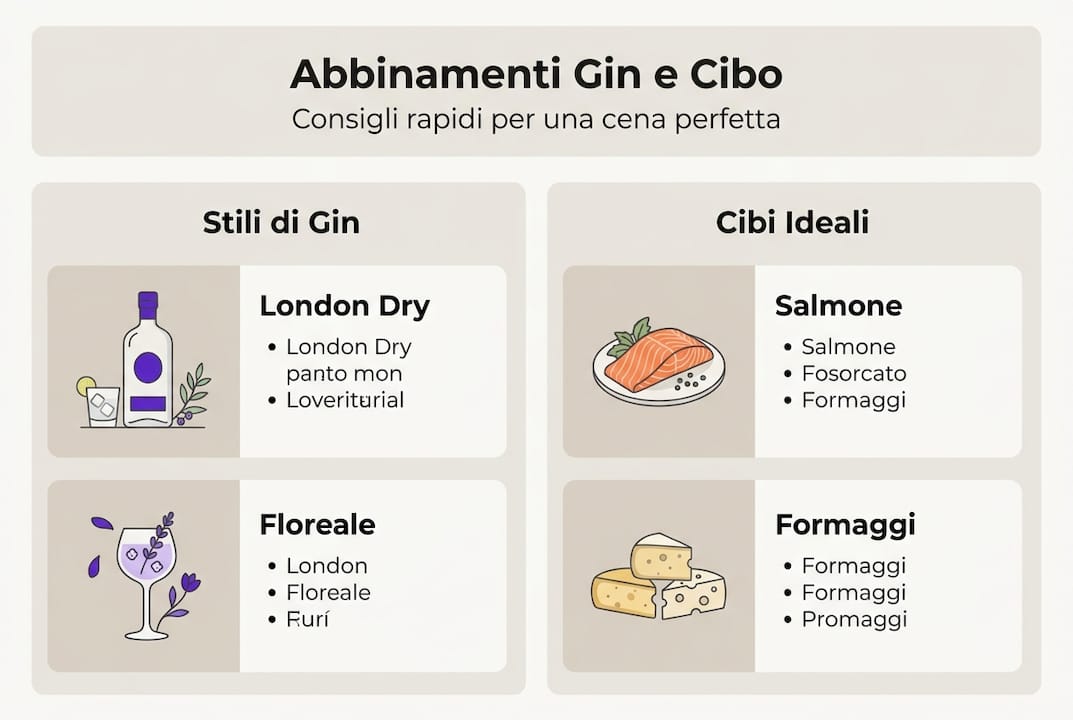
Pairing logic is divided into two approaches: by congruence (gin and food share similar notes, amplifying each other) and by contrast (gin and food balance each other, creating equilibrium). London Dry gin pairs by contrast with rich and fatty foods like oysters, smoked salmon, charcuterie, and aged cheeses, while contemporary floral gin works by congruence with light seafood, vegetables, and salads.
If you want to delve into the origins and characteristics of this style, the dry gin guide is an excellent starting point. For those who prefer to discover how to enhance London Dry in mixed drinks, cocktails with London Dry offer interesting ideas to bring to the table as well.
| Gin style | Aromatic profile | Recommended foods |
|---|---|---|
| London Dry | Juniper, citrus, spices | Smoked salmon, aged cheeses, cured meats |
| Contemporary/Floral | Flowers, fruit, herbs | Raw fish, grilled vegetables, salads |
| Navy Strength | Intense, alcoholic, spicy | Braised meats, blue cheeses, bold dishes |
| Mediterranean | Aromatic herbs, citrus | Seafood, carpaccios, light appetizers |
Before sitting down to eat, it's worth taking a few minutes to taste the gin neat: smell it, taste it plain, identify the dominant notes. The tips for tasting artisanal gin help you develop this critical sense, essential for building truly personal pairings.

How to Prepare: What You Need for the Perfect Food Pairing
Once the gin style is defined, you need to organize what's needed for successful pairing. It's not just about ingredients: the right tools also make the difference between an impromptu tasting and a true experience.
Essential tools:
- Balloon or copa glasses, which concentrate aromas towards the nose
- Quality ice, preferably in large blocks that melt slowly
- Tongs and cutting board for garnish
- Quality tonic water, preferably neutral so as not to overpower the botanicals
- Small plates for accompanying dishes
Basic ingredients to always have on hand:
- Green and black olives
- Low-spiced cured meats (bresaola, prosciutto crudo)
- Semi-aged and aged cheeses
- Fresh citrus fruits (lemon, grapefruit, orange)
- Fresh aromatic herbs (rosemary, thyme, basil)
On pairings with Italian spirits, you'll find further ideas for building a complete table consistent with the chosen gin's profile.
A very common mistake is to serve overly spicy or excessively sugary sweet foods. As problematic pairings confirm, hot curries, excessive chili, and very sweet desserts amplify the bitterness of gin, creating an unpleasant clash instead of balance.
| Tool/Ingredient | Why it's useful |
|---|---|
| Balloon glass | Concentrates aromas, improves aromatic perception |
| Block ice | Dilutes less, maintains ideal temperature |
| Fresh garnishes | Add aromatic notes consistent with the gin |
| Neutral tonic water | Does not overpower the gin's botanicals |
| Aged cheeses | Contrast the dryness of London Dry |
For garnish, the choice is never random: a sprig of rosemary on an herbaceous gin, a slice of grapefruit on a citrusy one. Discover the most effective gin garnishes for each style.
Pro Tip: Set the table with small portions of three or four different foods, so you can test multiple pairings simultaneously and understand which works best with the gin you've chosen.
Step by Step: Practical Guide to Gin and Food Pairings
Now that you have everything you need, follow these steps to enhance every tasting experience, from aperitif to dessert.
-
Aperitif: Start with a classic gin and tonic and non-sweet, non-spicy finger foods. Cured meats, olives, and light finger foods are the ideal combination to open the meal without tiring the palate. Choose a gin with citrus or floral notes to maintain freshness.
-
Appetizer: Opt for fish carpaccio, tartare, or marinated vegetables. A Mediterranean gin with aromatic herbs pairs perfectly. Avoid very acidic dressings that can alter the gin's perception.
-
First Course: With rich ragù and sauces, choose a rounder, softer gin-based cocktail, perhaps with a touch of vermouth. The perfect gin and tonic recipe can be adapted with less tonic and more botanicals to accompany structured dishes.
-
Main Course: Here, gin marinade comes into play. Use the spirit directly in preparation: white meats marinated with gin, citrus, and rosemary acquire extraordinary aromatic complexity. For fish main courses, an Italian-style gin and tonic with Mediterranean botanicals is the most coherent choice.
-
Dessert: Focus on dry desserts, almond biscuits, tarts with citrus jams, or lemon sorbets. Avoid cream and very sugary sweets. The gin cocktail pairing with dessert works best when there is an acidic or bitter note in the dessert that balances the gin.
| Course | Recommended Gin | Ideal Pairing |
|---|---|---|
| Aperitif | London Dry or citrusy | Cured meats, olives, dry cheeses |
| Appetizer | Mediterranean or floral | Carpaccio, tartare, vegetables |
| First Course | Soft contemporary | Light ragù, pesto pasta |
| Main Course | Navy Strength or spicy | Marinated meats, baked fish |
| Dessert | Floral or citrusy gin | Tarts, sorbets, dry biscuits |
Pro Tip: Also use gin in marinades: mix 50 ml of gin with lemon juice, extra virgin olive oil, and aromatic herbs. Let the meat or fish marinate for at least two hours. The result will surprise even the most experienced palates.
For those who want to build complete cocktails to pair with each course, cocktails with artisanal gin offer detailed and easily adaptable recipes.
What to Avoid and How to Perfect Your Pairings
Some pairings can be disappointing: let's see how to avoid the most common mistakes and how to correct course when something isn't working.
Frequent mistakes to avoid:
- Pairing gin with very spicy foods: curry, chili, and aggressive spices clash with juniper, creating an unpleasant burning sensation
- Serving overly sweet desserts: sugar amplifies the bitterness of gin, making the sip almost unpleasant
- Using poor-quality ice: tap water ice brings chlorine and foreign odors that alter the gin's profile
- Choosing tonic that is too sweet or flavored: it masks the botanicals instead of enhancing them
- Ignoring the alcohol content: a Navy Strength paired with a light salad completely overwhelms the dish
- Serving gin at the wrong temperature: too warm, it loses freshness; too cold, it blocks aromas
When a pairing doesn't work, the solution is often simple: change one element at a time. If the gin overpowers the food, switch to a more delicate style. If the food masks the gin, reduce the amount of seasoning or choose a Navy Strength.
"Navy strength gin, with an ABV above 57%, should be reserved exclusively for bold and structured foods. With delicate dishes, the alcohol dominates all other sensory perceptions."
An important note concerns high-proof gins: they are not suitable for everything. The in-depth guide on gin pairing explains how to calibrate the choice based on the dish's intensity, a parameter often underestimated even by the most experienced enthusiasts.
Remember that perfecting your pairings takes practice. Every mistake is valuable information: note what didn't work and why, and thus build your personal pairing vocabulary.
Beyond the Rules: My Personal Experience with Gin at the Table
After years spent exploring Italian artisanal gins, I've learned one fundamental thing: rules are a starting point, not an end point. The most surprising pairings I've experienced came from combinations that, on paper, seemed wrong. A very herbaceous gin with aged Pecorino Romano. A delicate floral gin with beef tartare seasoned with capers. Combinations that no manual would have suggested, but which worked extraordinarily well on the palate.
The secret ingredient is seasonality. A gin with lavender notes in summer pairs differently than in winter, when aromas are perceived with less intensity and dishes tend to be richer. Using local and seasonal ingredients, both in the glass and on the plate, creates a coherence that general rules cannot capture.
Developing this sensitivity takes time, but the tips for the sensory experience of artisanal gin are excellent training to refine the palate and learn to read each bottle like a story.
Add Flavor to Your Experience: Mezzanotte Italian Artisanal Gin
Every pairing you've discovered in this guide becomes even more interesting when the gin in the glass has a true story to tell. An artisanal spirit with selected botanicals, produced with care and internationally awarded, transforms a simple meal into something memorable.

On Mezzanotte Spirits, you'll find a selection of Italian artisanal gin designed for those who want to go beyond the usual. Each bottle carries a precise aromatic identity, perfect for building the pairings you've learned today. Explore the catalog, choose your next gin, and bring something truly unique to your table.
Frequently Asked Questions about Gin and Food Pairings
What are the best foods to pair with gin and tonic?
Cured meats, olives, and dry cheeses are perfect with gin and tonic because their savory flavor balances the spirit's freshness without masking its botanicals.
Does gin go well with fish dishes?
Yes, especially with floral or Mediterranean gins: contemporary floral gin works by congruence with light seafood, raw fish, and vegetables, amplifying the fresh notes of both.
What types of gin are not recommended for delicate dishes?
Navy strength gin, with an ABV above 57%, overpowers any subtle dish: for delicate dishes, it's preferable to stay below 47% alcohol content.
Can gin also be paired with desserts?
It's best to choose dry or citrusy desserts: very sugary desserts amplify the bitterness of gin and make the sip unpleasant, while a lemon sorbet or a fruit tart works very well.
Recommendation
- Tips for tasting gin: 57% more sensory experience – Mezzanotte | Distillery & Spirits
- Discover the main types of gin botanicals and how to use them – Mezzanotte | Distillery & Spirits
- Artisanal Gin Types Guide: Informed Choice 2026 – Mezzanotte | Distillery & Spirits
- How to prepare the perfect Italian-style gin and tonic – Mezzanotte | Distillery & Spirits
- 7 Ways To Enjoy Pata Negra For A Gourmet Experience