

Discover how to prepare a perfect gin and tonic with Italian artisanal gins: measurements, ice, garnish, and pairings for an authentic experience.
How to prepare the perfect Italian-style gin and tonic
Apr 5, 2026

TL;DR:
- Italian gin and tonic stands out for local botanicals and territorial innovation.
- The quality of gin, tonic, and garnish is essential for a balanced and aromatic drink.
- It is a cultural act that celebrates biodiversity, sustainability, and territorial creativity.
How many times have you ordered a gin and tonic only to end up with a flat, characterless drink where the gin seems almost an unwelcome guest? If you are passionate about artisanal Italian spirits, you know that the difference between a simple long drink and a true sensory experience lies in the details. Selected botanicals, quality tonic, abundant ice, and a well-thought-out garnish: everything matters. This guide will accompany you step-by-step in preparing a gin and tonic that respects the richness of Italian tradition, enhancing every element in the glass.
Table of Contents
- Understanding the origins and evolution of gin and tonic
- Choosing ingredients: artisanal Italian gins, tonics, and botanicals
- Perfect technique: proportions, ice, glasses, and preparation
- Personalization: garnish, pairings, and trends
- The truth no one tells you about Italian gin and tonic
- Discover unique artisanal Italian gins for your next gin and tonic
- Frequently Asked Questions
Key Points
| Point | Details |
|---|---|
| Perfect balance | Proportions of 1:2 or 1:3 between gin and tonic are key for a harmonious taste. |
| Choose artisanal | Preferring artisanal Italian gins and quality tonics enhances aromas and uniqueness. |
| Professional technique | Preparation is as important as the ingredients, especially temperature and ice. |
| Personalize and experiment | Garnish and gastronomic pairings give character and reflect the territory. |
Understanding the origins and evolution of gin and tonic
History helps us understand why gin and tonic is much more than just a drink today. It originated as a British colonial remedy in India, where soldiers mixed bitter quinine with gin to make antimalarial prophylaxis more palatable. A medical ploy that, over the centuries, became one of the world's most beloved cocktails.
In Italy, the transformation has been even more radical. The Italian gin market has grown by 25% in the last five years, with artisanal producers making local biodiversity their strong point. Alpine juniper, Dolomite herbs, Sicilian citrus, and Sardinian flowers: each region brings its own botanical signature.
To fully understand the history of gin and tonic and how it evolved in Italy, it is useful to know the key moments of this transformation:
- British colonial origins: quinine dissolved in sparkling water and gin was medicine, not pleasure.
- Global spread in the 20th century: gin and tonic becomes a symbol of style in European bars.
- Italian revival in the 2010s: gin bars multiply, cocktail culture grows.
- Current artisanal boom: over 800 Italian labels, each with a story and a territory.
“Gin and tonic has never been just a drink. It's a story of cultures meeting, of ingredients that speak of places far and near at the same time.”
Today, gin sustainability trends push producers towards zero-km botanicals, recyclable packaging, and low-impact distillation. This is not just a trend: it is a concrete response to an increasingly attentive and aware public.
Choosing ingredients: artisanal Italian gins, tonics, and botanicals
Once you understand the history, it's essential to know the ingredients that make a difference. Choosing well means already doing half the work.
The landscape of Italian gins and biodiversity is incredibly rich: the over 800 Italian labels use unique local ingredients, from Alpine juniper to Sicilian citrus, creating aromatic profiles ranging from floral to fruity, herbaceous, and spicy. The differences of Italian gin compared to classic British ones lie precisely in this territorial variety.
Comparison between gin styles
| Style | Aromatic profile | Tonic pairing |
|---|---|---|
| London Dry | Dry, dominant juniper | Classic neutral tonic |
| Contemporary | Floral, fruity, delicate | Lightly flavored tonic |
| Italian Style | Herbaceous, citrusy, territorial | Tonic with citrus or floral notes |
For tonic water, quality matters as much as gin. A cheap tonic can ruin even the finest spirit. Look for products with natural quinine, low residual sweetness, and good effervescence. Flavored versions (grapefruit, bergamot, lavender) work well with contemporary or Italian-style gins.
Garnish botanicals deserve equal attention. Here's what to consider:
- Consistency with gin: choose garnishes that recall the main botanicals of the spirit.
- Freshness: herbs and peels must be fresh, not dry or old.
- Size: a garnish that is too small won't add aroma; one that is too large will overpower.
Pro Tip: Before preparing the drink, lightly rub the garnish on the rim of the glass to release essential oils. This simple gesture amplifies the olfactory experience from the first sip.
To delve deeper into the types of Italian gin and better guide your choice, also consult our guide to artisanal gins, which analyzes each category with concrete examples.
Perfect technique: proportions, ice, glasses, and preparation
Careful ingredient selection requires equally meticulous preparation. Even the best gin, poorly prepared, will disappoint.
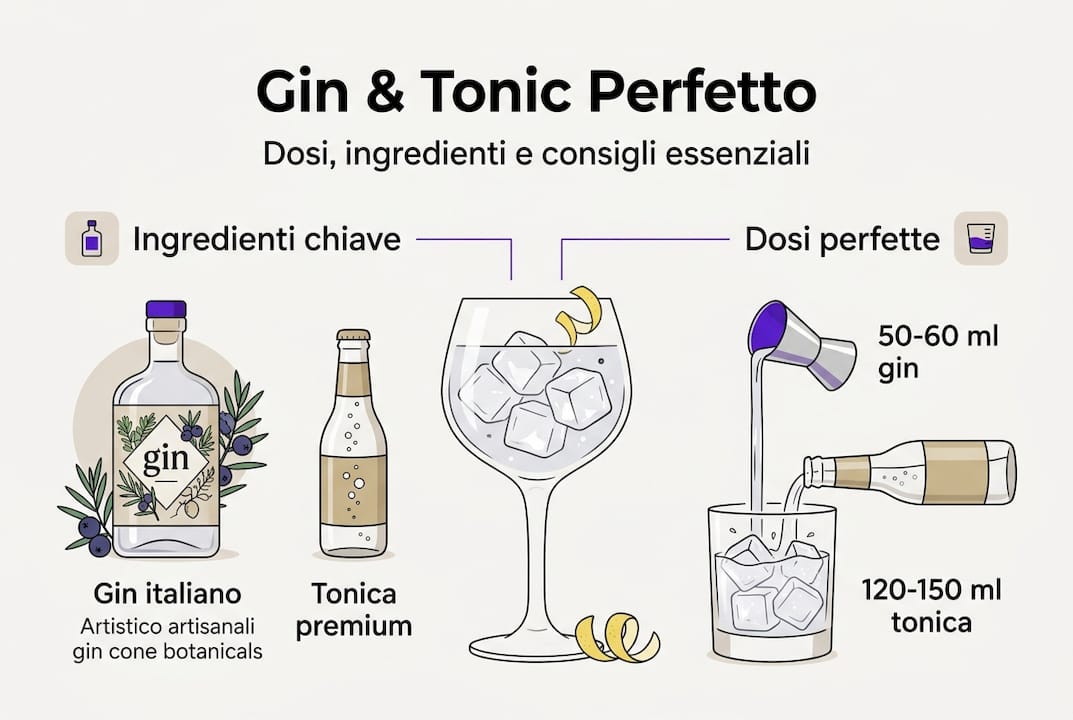
The ideal gin:tonic ratio is between 1:2 and 1:3, or about 50-60 ml of gin to 120-150 ml of tonic. Going below this means an overly alcoholic and unbalanced drink. Going above risks diluting the gin's aromatic profile.
Reference quantities for a perfect gin and tonic
| Element | Recommended quantity | Notes |
|---|---|---|
| Gin | 50-60 ml | Measure with a jigger for precision |
| Tonic water | 120-150 ml | Pour cold, freshly opened |
| Ice | To fill the glass | Large cubes, not crushed |
| Garnish | 1-2 elements | Fresh and consistent with the gin |
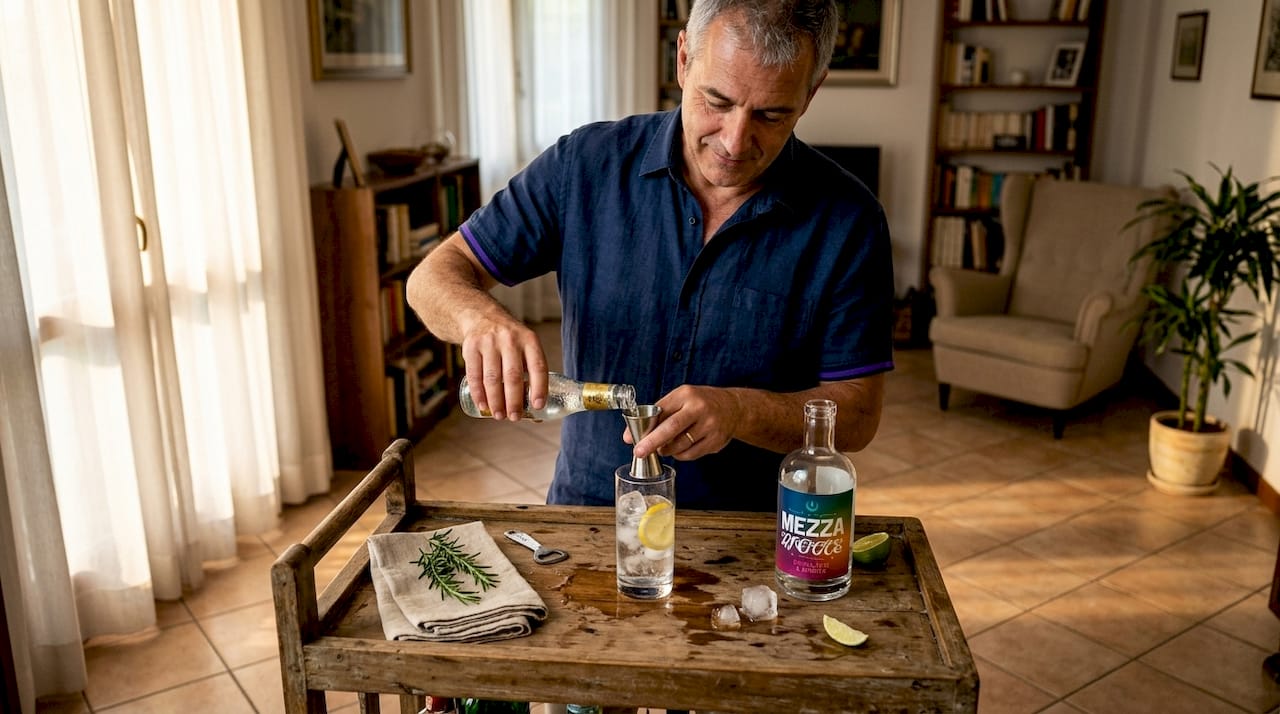
Ice is often underestimated. Large cubes melt slower, keeping the drink cold without diluting it too much. Crushed ice is the enemy of gin and tonic: it dilutes quickly and lowers the drink's quality in minutes.
Regarding the glass, the debate is open. The balloon (the wide, rounded glass) concentrates aromas towards the nose, enhancing the gin's complexity. The highball (the classic tall, narrow glass) maintains temperature and effervescence better. For artisanal Italian gins with complex profiles, the balloon is often the best choice.
Here's the step-by-step procedure for the perfect gin and tonic recipe:
- Chill the glass by placing it in the freezer for at least 10 minutes or filling it with ice for a few seconds.
- Add ice to fill the glass with large cubes.
- Pour the gin measured precisely.
- Add the tonic slowly, pouring it over a bar spoon to preserve the bubbles.
- Stir gently with a single circular motion from bottom to top.
- Add the garnish and serve immediately.
Pro Tip: Never stir vigorously. The tonic's bubbles are an integral part of the drink's texture and should be preserved as long as possible.
Personalization: garnish, pairings, and trends
Technique aside, the true personal signature lies in the details and the culture of tasting. A well-made gin and tonic can be further elevated with creative yet thoughtful choices.
The garnish is not just decoration: it's an active aromatic element. Current trends focus on a botanical-themed garnish that reflects the gin's personality. Some practical examples:
- Fresh rosemary: ideal for herbaceous and Mediterranean gins.
- Lemon or orange peel: perfect for citrusy gins from the Sicilian tradition.
- Pink peppercorns: adds spicy complexity to floral gins.
- Cucumber slice: classic pairing for fresh and delicate contemporary gins.
- Juniper berries: recalls the main botanical and intensifies the aroma.
Food pairings are a still largely unexplored but incredibly rich area in Italy. The most interesting gin tasting tips concern pairing with food: a citrusy gin and tonic goes well with raw fish and oysters, while an herbaceous one stands up to robustly flavored aged cheeses.
Regarding trends, the most innovative secrets of Italian gin point in two specific directions. The first is low-ABV: gins with reduced alcohol content (below 30 degrees) that allow you to enjoy the drink without sacrificing aromatic profile. The second is no-alc: non-alcoholic spirits that replicate the botanical complexity of gin, designed for those who want to participate in cocktail culture without alcohol.
Pro Tip: When pairing a gin and tonic with food, think about the drink's structure as you would with wine. A light, floral gin calls for delicate dishes; a spicy, intense one stands up to more robust flavors.
The truth no one tells you about Italian gin and tonic
After exploring every step, it's time to look at this experience with fresh eyes. There's one thing you rarely hear: Italian gin and tonic is not a copy of the British model. It's something completely different.
Italian producers don't pursue a consolidated style. They experiment, break rules, use botanicals that no distillation manual would ever have predicted. This is a huge strength, but also a responsibility. Those who buy an artisanal Italian gin are not buying a standardized product: they are entering into a relationship with a territory, a philosophy, a vision.
True innovation is not in replicating London Dry with Italian ingredients. It's in asking what it means to make gin in Italy in 2026, with all the weight of biodiversity, gastronomic culture, and sustainability. Those who understand this, as explained in our guide on the origins and tasting of dry gin, will never again look for a generic gin.
Italian gin and tonic is a cultural act. And as such, it deserves attention, curiosity, and respect for every single ingredient in the glass.
Discover unique artisanal Italian gins for your next gin and tonic
Now that you have all the basics, you can aim for the best for your next gin and tonic. Theory is important, but the real difference is made by the gin you choose.

On Mezzanotte Spirits, you'll find a curated selection of artisanal Italian spirits, each with a unique story, territory, and aromatic profile. From Alpine gins to citrusy ones from the South, including labels inspired by myths and pop culture: every bottle is designed for those who want to experience gin and tonic as an event, not an automatic ritual. Explore the catalog, discover artisanal Italian gins, and find your next favorite.
Frequently Asked Questions
What is the ideal proportion of gin and tonic for a perfect balance?
A ratio of 1:2 or 1:3 is recommended, meaning about 50-60 ml of gin to 120-150 ml of tonic, for a balanced and aromatic drink.
Which glasses are best for serving gin and tonic?
The balloon enhances aromas due to its wide shape that concentrates scents, but the highball is a classic choice that maintains effervescence better over time.
How to choose the right garnish for an Italian gin?
The ideal garnish reflects the botanicals of the chosen gin: rosemary for an herbaceous gin, orange peel for a citrusy one, pink peppercorns for a spicy one.
How to pair gin and tonic with food?
Mediterranean gin and tonics pair well with fish and aged cheeses, choosing the drink's structure based on the intensity of the dish.
Recommendation
- Step by step cocktail with artisanal gin: easy guide – Mezzanotte | Distillery & Spirits
- Gin cocktail pairing guide: enhancing artisanal Italian gin – Mezzanotte | Distillery & Spirits
- What differentiates Italian gin: complete guide 2026 – Mezzanotte | Distillery & Spirits
- Types of Italian gins 2026: complete guide for demanding enthusiasts – Mezzanotte | Distillery & Spirits