

Discover what dry gin really is: origins, production rules, distillation techniques, and practical tips for tasting and choosing the best craft gins.
Dry Gin: A Guide to Its Origins, Production, and Tasting
Mar 30, 2026

Many people think that dry gin is simply the driest gin on the palate. This is a common misconception, and understanding it changes the entire way you choose and taste a bottle. The term "dry" doesn't describe the taste, but rather the technical process without added sugars during production. This means you are drinking a pure distillate, where every aroma is the direct result of the botanicals and the distiller's skill. In this guide, we explore the origins, production rules, distillation techniques, and practical tips for tasting and choosing the dry gin that's right for you.
Table of Contents
- What dry gin really is: definition and origin
- The fundamental rules and evolution of the style
- Production techniques: maceration, infusion, and vacuum distillation
- Dry gin botanicals: the role of juniper and new interpretations
- Examples of excellence: from classic London Dry to modern craft
- Dry gin in cocktails: balance, pairings, and tasting
- Discover and taste the best craft gins
- Frequently asked questions about dry gin
Key Points
| Point | Details |
|---|---|
| Technical definition | Dry gin follows precise rules: no sweeteners, flavors, or colorings after distillation. |
| Influential techniques | Maceration, infusion, and vacuum distillation determine the final aromatic profile. |
| Role of juniper | Juniper is the mandatory botanical, but new ingredients create infinite variations. |
| Award-winning gins | Both classic and Italian craft gins receive awards and satisfy the most demanding palates. |
| Ideal tasting | Dry gin performs best in balanced cocktails and refined culinary pairings. |
What dry gin really is: definition and origin
Dry gin is not a style invented as a fad. It is a regulated category with precise criteria: no sweeteners, no colorings, no artificial flavors added after distillation. Everything you taste in the glass must come exclusively from the botanicals and the base alcohol.
"London Dry Gin represents the global benchmark for purity of the distillation process, with rules that do not allow compromises on ingredients."
London Dry Gin is the most rigorous version of this category. Despite its name, it doesn't have to be produced in London: it's an internationally recognized quality standard. Its history is rooted in the 18th century, when British distillers sought to eliminate impurities and sweeteners used to mask production flaws.
For serious collectors and tasters, understanding the London Dry Gin criteria provides a concrete tool for evaluating the quality of a bottle. It's not about snobbery, but about knowing what you're looking for.
Here are the fundamental characteristics that define this category:
- No additives after final distillation
- Juniper must be the dominant aromatic note
- Minimum alcohol content of 37.5% ABV
- No artificial coloring
- The use of dry gin in gin and tonic is enhanced precisely by this purity
The fundamental rules and evolution of the style
Not all gins are created equal, and the differences between styles are not just about taste but also about regulation. Understanding these distinctions helps navigate an increasingly rich market.
| Style | Sweeteners | Post-distillation additions | Aromatic profile |
|---|---|---|---|
| London Dry | No | No | Dominant juniper, dry |
| Old Tom | Yes (slight) | Possible | Softer and sweeter |
| Plymouth | No | No | Earthy, slightly floral |
| Contemporary | Variable | Variable | Experimental, local botanicals |
Production standards require that the base alcohol exceeds 96% ABV before redistillation with botanicals, and that juniper is predominant in the final profile. These constraints may seem restrictive, but in reality they free the distiller: without shortcuts, every bottle must truly be good.
Here are the key regulatory steps for a certified London Dry:
- Neutral grain spirit at over 96% ABV as a base
- Redistillation with natural botanicals in a traditional still
- No added flavors, colorings, or sweeteners after distillation
- Final alcohol content not less than 37.5% ABV
- Only water and neutral alcohol can be added after distillation
In the last decade, the growth of the craft movement has led hundreds of new producers to reinterpret tradition. They explore varieties of gin with local botanicals and innovative techniques, while respecting the fundamental principles of purity.
Pro Tip: When evaluating a craft gin, check if the label says "London Dry." If it does, you already know that the producer has adhered to the industry's strictest rules.
Production techniques: maceration, infusion, and vacuum distillation
The production technique is not a technical detail for insiders only. It radically changes the aromatic profile in the glass, and knowing how to recognize it allows you to choose gins based on your actual tastes.
"The technique chosen by the distiller is the invisible signature of every bottle: maceration intensifies, vapor infusion lightens, vacuum distillation preserves."
| Technique | Aromatic profile | Botanicals enhanced |
|---|---|---|
| Hot maceration | Intense, evident juniper | Spices, roots, woods |
| Vapor infusion | Fresh, light, aromatic | Citrus, flowers, delicate herbs |
| Vacuum distillation | Delicate, innovative | Heat-sensitive ingredients |
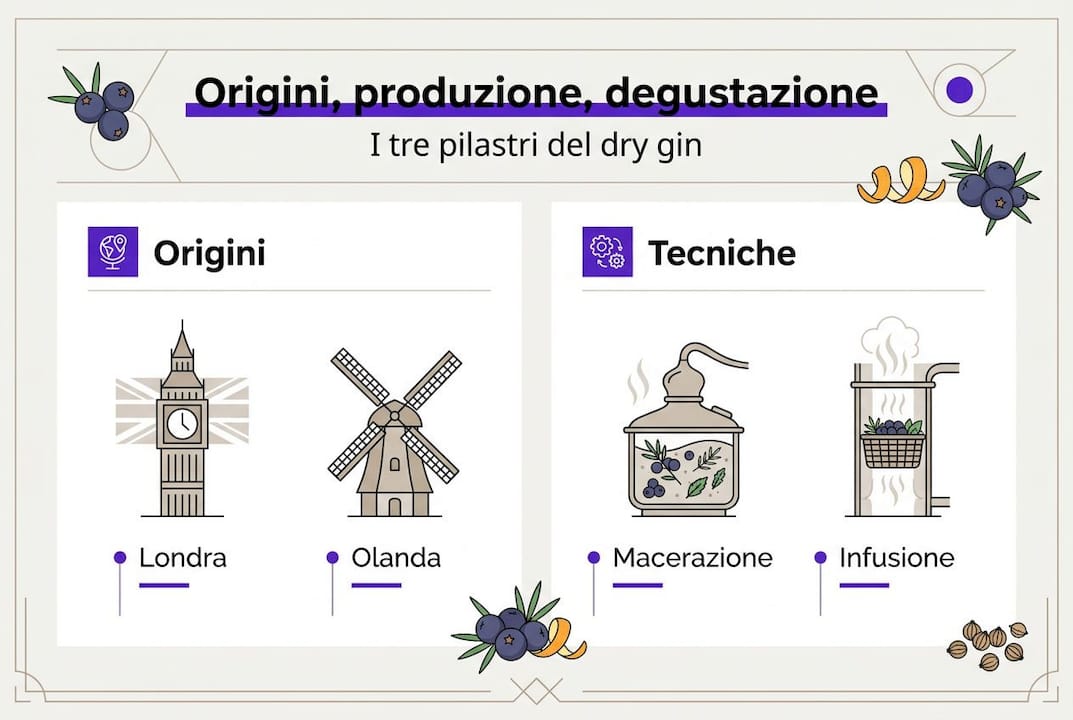
Maceration produces intense notes of juniper, while vapor infusion gives lighter and more aromatic profiles, and vacuum distillation preserves the most delicate notes that heat would destroy. This explains why two dry gins with the same botanicals can have completely different characteristics.
To better understand how botanicals and methodologies intertwine, it's useful to know that vacuum distillation occurs at temperatures below 40°C. This allows for the use of ingredients like fresh cucumber, green tea, or delicate flowers without losing their volatile aromas.
The choice of botanicals always interacts with the technique: a distiller who wants to enhance citrus notes will choose vapor infusion, while one who aims for a spicy and structured profile will prefer prolonged maceration.
Pro Tip: On the nose, a macerated gin is more "heavy" and resinous. A vapor-infused gin is brighter and more immediate. Try to recognize it before reading the label: it becomes a very informative tasting exercise.
Dry gin botanicals: the role of juniper and new interpretations
Without juniper, there is no dry gin. It's not a matter of style; it's the law. But juniper is just the starting point of an aromatic universe that craft distillers have made extraordinarily varied.
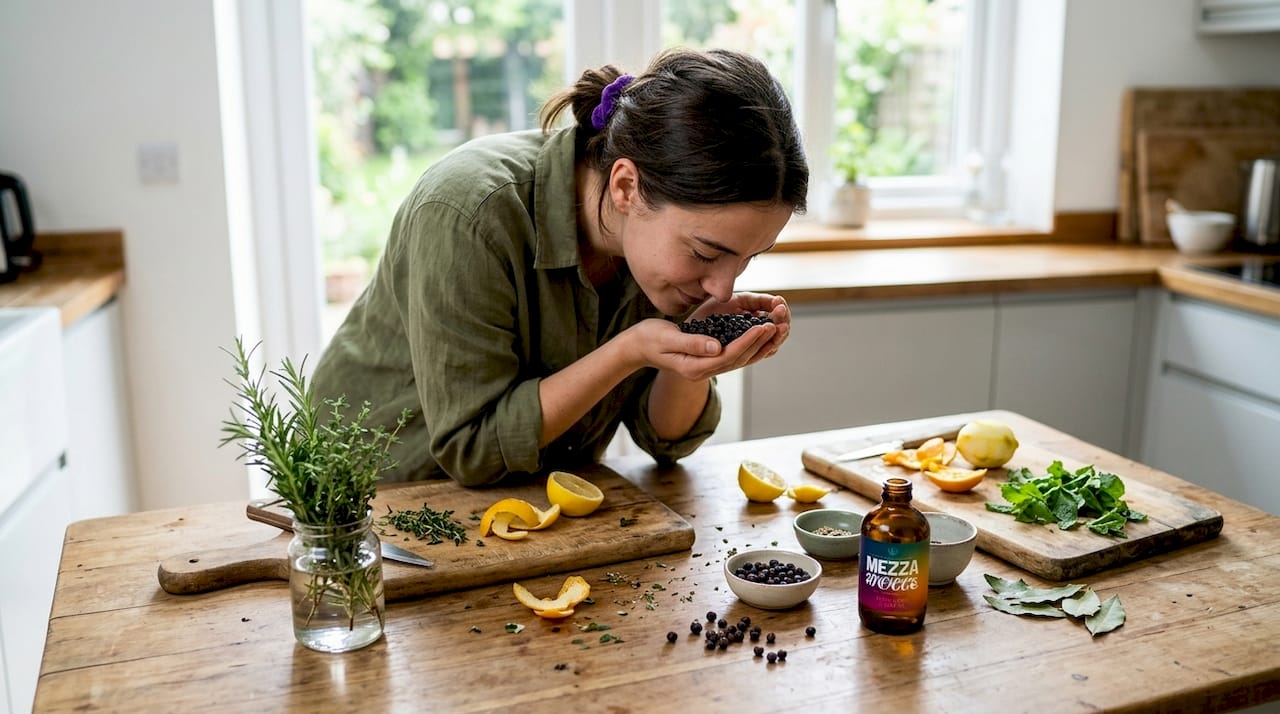
Juniper must be predominant by law, but the choice of other botanicals is what characterizes each distillate and tells the producer's story. An alpine gin will have mountain herbs. A Mediterranean gin will focus on citrus and rosemary. A Japanese gin inspired by Italian culture might use yuzu and shiso.
The most commonly used botanicals in quality dry gins include:
- Coriander: adds spicy and slightly citrusy notes
- Angelica root: fixes aromas and provides an earthy structure
- Lemon and orange peel: immediate freshness and vibrancy
- Cardamom: spicy warmth with floral undertones
- Florentine iris: powdery and elegant notes, typical of classic gins
- Cinnamon and pepper: depth and complexity in the finish
Contemporary producers experiment with increasingly unusual botanicals: lavender, chamomile, fig leaves, bergamot, rare alpine herbs. Understanding what botanicals are and how they interact is key to truly appreciating the complexity of a craft gin.
Examples of excellence: from classic London Dry to modern craft
Theory is useful, but bottles tell the story better than any definition. Comparing a historical classic with an award-winning contemporary craft gin is the most direct way to understand where the world of dry gin is heading.
| Gin | Style | Score | Key notes |
|---|---|---|---|
| Gordon’s | Classic London Dry | Historic since 1769 | Clean juniper, dry, versatile |
| Ramsbury Single Estate | Contemporary Craft | 94/100 BTI 2025 | Own grains, local botanicals |
| Freeland Forest Gin | American Craft | 94 pt Wine Enthusiast 2024 | Forest botanicals, unique profile |
Internationally awarded craft gins demonstrate that quality is no longer the exclusive domain of large historical distilleries. Ramsbury Single Estate, for example, uses grains grown on its own agricultural estate: a "field to bottle" approach that brings transparency and territorial identity to the glass.
For collectors, international ratings are a useful guide but not the only criterion. Exploring the differences between classic and innovative gin helps build a balanced collection, with bottles that tell different stories.
Award-winning Italian craft gins are gaining ground in international competitions, showcasing Mediterranean botanicals and a unique aesthetic sensitivity that is also reflected in the design of the bottles.
- Look for gins with clear botanical indications on the label
- Prefer producers who state their distillation technique
- International awards are a signal, not an absolute guarantee
- Bottle design often reflects the producer's attention to detail
Dry gin in cocktails: balance, pairings, and tasting
A quality dry gin deserves to be tasted neat at least once before ending up in a cocktail. Only then can you truly understand what you are mixing and why certain pairings work better than others.
The three rules for a perfect gin and tonic:
- Choose a tonic water that doesn't overpower the gin: neutral tonics enhance complex gins, while flavored ones pair better with simpler gins.
- Garnish should amplify, not cover: a lemon peel for citrusy gins, a sprig of rosemary for herbaceous gins, pink peppercorns for spicy gins.
- Temperature is everything: plenty of ice and a cold glass maintain carbonation and preserve aromas.
A proof between 40 and 47% ensures structure and balance in cocktails: enough alcohol to hold the mix, enough moderation not to mask the botanicals. Gins below 40% tend to get lost in more elaborate cocktails.
To pair dry gin with food, think in terms of contrast and complementarity. A gin with citrus and floral notes pairs well with raw fish and oysters. A spicy and earthy gin stands up wonderfully next to aged cheeses. For those who love cured meats, pairing ideas with Ibérico ham show how the fattiness of the ham surprisingly enhances the resinous notes of juniper.
Also explore the possibilities of gin cocktail pairings with Mediterranean cuisine: tomatoes, olives, and aromatic herbs create natural synergies with Italian-inspired dry gins.
Pro Tip: Before adding the tonic, smell the neat gin in the glass. Then smell it again after adding ice. The difference will tell you which aromas emerge with cold and which diminish: valuable information for choosing the right garnish.
Discover and taste the best craft gins
Now that you know the rules, techniques, and botanicals that define an excellent dry gin, the next step is to find the bottles that embody these principles with a story to tell. Not all gins are created equal, and not all collections are equal.

On Mezzanotte, you'll find a curated selection of craft gins for those seeking spirits with a strong identity, refined botanicals, and a design worth displaying. Each bottle has a story, a defined aromatic profile, and often international recognition behind it. Whether you're looking for your next collectible gin or a bottle to open for a special evening, here you'll find options that go beyond the usual shelf.
Frequently asked questions about dry gin
What is the real difference between dry gin and London dry gin?
London Dry Gin has stricter regulations than generic dry gin: all London Dry gins are dry gins, but not all dry gins meet London Dry standards. The difference lies in the rigidity of the constraints on ingredients and process.
Why is dry gin ideal for cocktails like gin and tonic?
A proof between 40 and 47% ensures structure in cocktails, and the absence of sweeteners allows the bartender to perfectly control the final balance of the drink without unexpected variables.
Are there any internationally renowned Italian craft dry gins?
Yes, several Italian producers have gained international recognition, bringing Mediterranean botanicals and a craftsmanship approach that wins over even the most demanding foreign markets.
What are "botanicals" in a dry gin?
These are the herbs, spices, flowers, and peels used to flavor the spirit. Juniper must be predominant by law, but the other botanicals define the unique character of each gin.
Recommendation
- What makes Italian gin different: complete guide 2026 – Mezzanotte | Distillery & Spirits
- Types of gin: complete guide to varieties 2026 – Mezzanotte | Distillery & Spirits
- Guide to types of craft gin: informed choice 2026 – Mezzanotte | Distillery & Spirits
- Italian spirits tasting method: practical guide 2026 – Mezzanotte | Distillery & Spirits