

Discover Italian plain vodka, how to recognize artisanal quality, and taste the nuances of unique territories. A complete guide for enthusiasts.
Straight Vodka: Authentic Purity and Artisan Stories
Mar 31, 2026

Italian smooth vodka is not just a neutral spirit for cocktails. Behind each artisanal bottle lie unique territories, local ingredients, and innovative processes that transform purity into character. You will discover what smooth vodka truly is, how it is born in Italian distilleries, and how to taste it to grasp its subtle nuances, dispelling the myth that it is just “flavorless alcohol”. Get ready to explore the difference between flavored and smooth versions, regional peculiarities, and practical tips for conscious tasting.
Table of Contents
- What is smooth vodka: definition and main characteristics
- Ingredients and artisanal methods: the soul of Italian smooth vodka
- How much does the alcohol content matter? The strength and smoothness of smooth vodka
- Sensory notes and tasting: smooth vodka in practice
- Smooth vodka between Italy and international tradition: stories and comparisons
- Smooth vodka in mixology and Italian cuisine: innovative uses
- Promo: discover the excellence of Italian artisanal vodka
- Frequently asked questions about smooth vodka
Key Points
| Point | Details |
|---|---|
| Definition of smooth vodka | It is pure, unflavored vodka, appreciated for its smoothness and balanced neutrality. |
| Italian raw materials | The best Italian artisanal smooth vodkas use spring water and local grains or potatoes. |
| Balanced alcohol content | An alcohol content between 37.5% and 40% enhances the silkiness and clean finish of smooth vodka. |
| Conscious tasting | Sip slowly to discover subtle notes of grain, potato, or wine even in the most neutral products. |
| Refined mixology | Smooth vodka enhances cocktails and gastronomic pairings thanks to its clean and versatile profile. |
What is smooth vodka: definition and main characteristics
To understand how smooth vodka enhances Italian raw materials, it is essential to start from its definition and basic composition. Smooth vodka refers to a pure, unflavored, and neutral vodka, ideal for drinking neat or as a base for sophisticated cocktails. The term "liscia" in Italian means "smooth" or "plain," distinguishing it from flavored versions like peach or licorice vodka.
The typical alcohol content ranges between 37.5% and 60%, with most premium bottles around 40%. On the palate, a quality smooth vodka offers silky and velvety sensations, with a clean finish that does not burn the throat. This smoothness is the result of multiple distillations and accurate filtrations that remove impurities without eliminating the subtle character of the raw material.
Distinctive characteristics of smooth vodka:
- Neutral profile without added flavors
- Smooth and velvety entry on the palate
- Clean finish free from aggressive aftertastes
- Versatility in pure or mixed tasting
The difference between vodka and gin lies precisely in the production philosophy: while gin celebrates botanical aromas, smooth vodka enhances the purity and quality of the alcoholic base. This apparent neutrality, however, conceals nuances that only careful tasting can reveal.
“Smooth vodka represents the essence of distillation: absolute purity that reveals the quality of the starting ingredients.”
Ingredients and artisanal methods: the soul of Italian smooth vodka
Having clarified the definition, let's explore what makes the artisanal Italian variations of smooth vodka truly unique. Italian artisanal vodkas use local ingredients such as Tuscan spring water, wine alcohol, alpine potatoes or Italian grains, with unique processes such as filtration on Carrara marble or cold distillation for a distinctive purity and regional character.
Tuscan spring water, for example, brings a delicate minerality that influences the final texture of the spirit. Its natural purity reduces the need for aggressive chemical treatments, preserving the organoleptic integrity of the vodka. Some distilleries use water from protected alpine springs, ensuring a constant and high-quality mineral composition.
The choice of the alcoholic base determines the sensory profile: wine alcohol confers a unique creaminess, alpine potatoes give a more full-bodied texture, while Italian grain offers an elegant lightness. These types of artisanal vodka represent different interpretations of purity, each with its own identity.
Innovative processes in Italian production:
- Filtration on Carrara marble for crystalline purity
- Cold distillation to preserve delicate notes
- Use of discontinuous stills for artisanal control
- Short rests in steel for stabilization without altering the profile
Pro Tip: When choosing an artisanal smooth vodka, check the origin of the water and the alcoholic base used. These two elements determine over 70% of the final character of the spirit, even in an apparently neutral product.
The Italian artisanal tradition intertwines with technological innovation, creating smooth vodkas that tell stories of ancient territories and knowledge reinterpreted in a contemporary key.
How much does the alcohol content matter? The strength and smoothness of smooth vodka
In addition to ingredients and processes, the alcohol content plays a decisive role in the tasting experience. The typical alcohol content ranges from 37.5% to 60%, with the standard at 40%. Empirical benchmarks show that premium Italian vodkas emphasize palate feel (velvety, silky) rather than aroma, with a clean finish.
A lower alcohol content (37.5-40%) makes the vodka more accessible and smooth, ideal for neat drinking or delicate cocktails. Higher alcohol content versions (45-60%) are preferred by connoisseurs seeking intensity and persistence, but require exceptional quality to avoid aggressive sensations.
| Alcohol content | Characteristics | Ideal use |
|---|---|---|
| 37.5-40% | Smooth, accessible, delicate finish | Neat tasting, classic cocktails |
| 40-45% | Balanced, medium body, versatile | Sophisticated mixology, pure tasting |
| 45-60% | Intense, persistent, requires quality | Connoisseurs, gastronomic pairings |
The characteristics of artisanal Italian vodkas are distinguished by their ability to maintain smoothness even at high alcohol contents, thanks to multiple distillations and accurate filtrations. The silkiness on the palate is the result of a perfect balance between alcohol, water, and traces of congeners that give body without compromising cleanliness.
Interesting fact: Premium Italian vodkas achieve a smoothness comparable to spirits with 5-7 degrees less alcohol, thanks to advanced filtration techniques and controlled resting periods.
Sensory notes and tasting: smooth vodka in practice
To truly distinguish a quality smooth vodka, it is essential to be able to recognize and enhance its sensory notes. Although neutral, expert tasters detect subtle notes of grain or potato. Vodkas made from wine (like Impavid) or potatoes offer a nuanced creaminess compared to the lightness of grain.
How to properly taste a smooth vodka:
- Serve at room temperature (18-20°C) to grasp the nuances, or slightly chilled (8-10°C) to emphasize smoothness.
- Use a tulip glass to concentrate subtle aromas.
- Observe the viscosity: a quality vodka forms slow "tears" on the sides of the glass.
- Gently sniff to detect notes of grain, potato, or wine.
- Take a small sip, allowing it to coat the entire tongue.
- Evaluate the entry (smooth or aggressive), body (light or creamy), and finish (clean or persistent).
The sensory nuances vary based on the raw material: grain vodkas present herbaceous and light notes, potato vodkas offer a more creamy and enveloping texture, while wine versions provide a subtle sweetness and unexpected complexity.

Pro Tip: To train your palate, compare three smooth vodkas from different bases (grain, potato, wine) at the same temperature. The differences, though subtle, will become evident after the third taste.
The guide to tasting Italian spirits offers advanced techniques for recognizing quality and flaws even in seemingly neutral products like smooth vodka.
Smooth vodka between Italy and international tradition: stories and comparisons
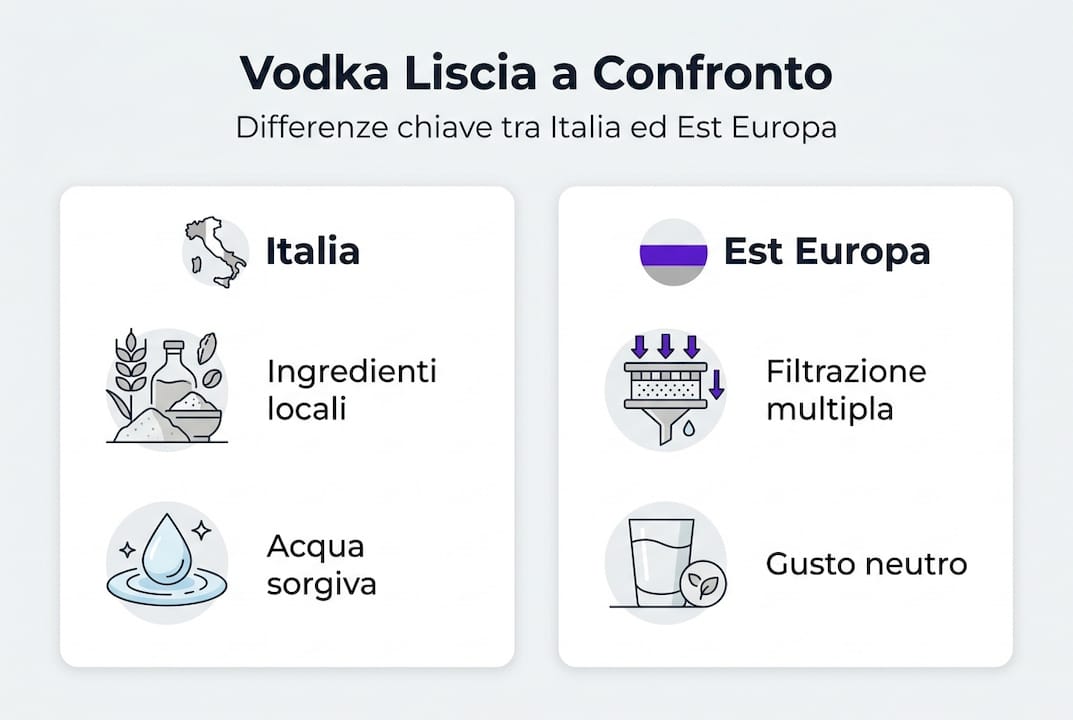
Let's delve into the story of the origins and traditions of smooth vodka to grasp the richness of Italian interpretations compared to the international landscape. Traditional Eastern European vodkas prioritize absolute neutrality, while artisanal Italian versions blend heritage and innovation (local water, marble), creating "cultural stories" linked to regions like Tuscany or the Alps.
Russian and Polish vodkas pursue technical perfection through multiple distillations (up to 10-12 passes) and charcoal filtration, aiming to eliminate all traces of character. This philosophy reflects centuries of tradition in which vodka represented a mass-produced, accessible, and standardized product.
Italian interpretations overturn this paradigm: instead of hiding the raw material, they enhance it. The use of local spring water, filtration on Carrara marble, and the Italian peasant heritage transform smooth vodka into a territorial narrative. Each bottle becomes a sensory journey connecting the Alps, Tuscany, or the Piedmont hills.
| Aspect | Eastern European Vodka | Italian artisanal Vodka |
|---|---|---|
| Philosophy | Absolute neutrality | Regional identity |
| Distillations | 10-12 passes | 3-5 controlled passes |
| Filtration | Birch charcoal | Marble, quartz, innovative methods |
| Water | Standardized | Certified local springs |
| Goal | Technical purity | Purity with character |
The examples of Italian artisanal vodka demonstrate how it is possible to maintain the typical cleanliness of the spirit while telling a story. Regional artisanal vodkas represent a bridge between tradition and innovation, offering a culturally rich alternative to industrial productions.
This philosophy can also be found in other Italian spirits, such as in the types of Italian Spritz that enhance local ingredients and regional traditions reinterpreted in a contemporary key.
Smooth vodka in mixology and Italian cuisine: innovative uses
After exploring its history, let's discover the most surprising applications of smooth vodka in Italian mixology and cuisine. Smooth vodka is ideal for drinking neat but also in drinks, with its silkiness and cleanliness standing out in contemporary Italian cocktails.
The apparent neutrality of smooth vodka makes it a blank canvas for creative bartenders. Unlike aromatic spirits that impose their own character, vodka allows other ingredients to shine, creating delicate balances impossible with gin or whiskey. In signature cocktails, an artisanal smooth vodka brings body and texture without overpowering citrus, herbs, or liqueurs.
Why prefer an artisanal smooth vodka in cocktails:
- Superior smoothness that eliminates the aggressive alcoholic sensation
- Silky texture that improves the overall perception of the drink
- Absence of unwanted notes that could conflict with other ingredients
- Consistent quality that guarantees predictable results
Gastronomic pairings with Italian smooth vodka open up surprising scenarios. Served chilled, it perfectly accompanies raw fish, oysters, and carpaccios, thanks to its ability to cleanse the palate without interfering with delicate flavors. Potato-based versions pair well with aged cheeses and cured meats, while wine versions create unexpected harmonies with dark chocolate desserts.
Contemporary vodka cocktails enhance the purity of the spirit through minimalist combinations: vodka, fresh citrus, and a touch of Italian amaro create elegant drinks that highlight the quality of the ingredients without masking them.
Promo: discover the excellence of Italian artisanal vodka
Now that you know the nuances of smooth vodka and how to recognize artisanal quality, it's time to explore the most fascinating interpretations of the Italian scene. On Mezzanotte.shop you will find a curated selection of artisanal spirits that tell stories of territories, passion, and innovation.

Each bottle in our catalog represents a unique sensory journey, where the purity of smooth vodka meets Italian cultural heritage. From vodkas filtered on Carrara marble to wine-based interpretations from Tuscany, you will discover how artisanal tradition can transform an apparently neutral spirit into a memorable experience. Explore artisanal vodkas and let yourself be guided by the stories each label tells, celebrating the art of Italian distillation with internationally awarded products.
Frequently asked questions about smooth vodka
What is the main difference between smooth and flavored vodka?
Smooth vodka is free of added flavors and offers a neutral profile, while flavored vodka is infused with specific tastes such as fruit or spices.
What is the usual alcohol content of artisanal smooth vodka?
The typical alcohol content ranges from 37.5% to 60%, with premium Italian bottles around 40%.
What is the most typical raw material for Italian smooth vodka?
Italian craft vodkas use wheat, alpine potatoes, or wine alcohol, as in the case of Impavid, each with distinctive characteristics.
How to recognize a quality plain vodka by tasting it?
Look for a velvety entry, no burning sensation, a clean finish, and possible subtle notes of grain, potato, or wine.
Can Italian plain vodka be used in cocktails?
Yes, the purity of craft plain vodka makes it ideal as a base for sophisticated drinks.
Recommendation
- Découvrez les types de vodka italienne artisanale – Mezzanotte | Distilleria & Spirits
- Vodka Italiana Artesanal: 5 Tipos con 40% Más Aroma – Mezzanotte | Distilleria & Spirits
- Storia dei distillati italiani: tradizione artigianale 2026 – Mezzanotte | Distilleria & Spirits
- Perché scegliere spirits artigianali nel 2026: qualità unica – Mezzanotte | Distilleria & Spirits