

Discover how to choose, taste, and evaluate first-class Italian spirits step-by-step with our distilled spirits guide.
Distilled Spirits Guide: Mastering Italian Distillates
Feb 24, 2026

Anyone who wants to not just enjoy but truly understand Italian distillates faces an exciting challenge. Selecting and evaluating unique spirits requires genuine sensory knowledge and a trained eye for regional origin, quality, and craftsmanship. With sound methods and authentic Italian tradition, you will discover aromas and subtleties that go far beyond ordinary taste experiences.
Table of Contents
- Step 1: Select high-quality Italian distillates
- Step 2: Prepare the ideal tasting setup
- Step 3: Taste distillates like an expert
- Step 4: Evaluate aromas and quality specifically
Quick Summary
| Key Point | Explanation |
|---|---|
| 1. Choose high-quality raw materials | Look for authentic ingredients from defined regions of origin to guarantee high-quality distillates. |
| 2. Professional tasting setup | Prepare your tasting room with optimal temperature and a neutral environment to properly assess the distillates. |
| 3. Use systematic tasting methods | Use a sequence of visual inspection, olfactory examination, and taste testing to specifically identify aromas. |
| 4. Specifically evaluate aromas and quality | Use standardized criteria to evaluate intensity, harmony, and complexity to identify quality differences. |
| 5. Take notes and make comparisons | Document your tasting experiences and compare different distillates to expand your taste vocabulary. |
Step 1: Select high-quality Italian distillates
Selecting a high-quality Italian distillate requires more than just taste. You need to understand what to look for to distinguish authentic craftsmanship from mass-produced spirits.
High-quality Italian distillates are characterized by three essential features:
- Raw material quality – Use only spirits made with carefully selected, authentic ingredients from defined regions
- Artisanal production methods – Distillation is carried out using traditional methods, not industrially
- Sensory purity – The aroma and taste should be clear, balanced, and characteristic
The training to become a Distillate Sommelier provides profound knowledge about such quality characteristics. Professional sommeliers know: a true distillate reveals the care of its production through its aromatics.
A high-quality Italian distillate speaks for itself – not through marketing, but through authentic taste and artisanal precision.
Start by checking the region of origin. Italy has traditional distillation regions with protected designations of origin. A clear indication of origin is a strong sign of quality.
Next, check the list of raw materials. Quality providers are transparent about their base ingredients. Avoid products with generic or imported ingredients of low quality.
Also pay attention to the bottle presentation. Not as a superficial criterion, but because reputable manufacturers clearly communicate their production methods and regional origin.
Pro-Tip: Start with well-known regions of origin like Piedmont for Grappa or Emilia-Romagna for traditional brandies to develop a feel for regional differences and quality standards.
For a better overview, here is a comparison of typical Italian distillation regions and their characteristic distillate types:
| Region | Distillate Type | Special Aromas |
|---|---|---|
| Piedmont | Grappa | Nutty, grape, floral |
| Emilia-Romagna | Fruit Brandy | Fruity, spicy, mild |
| Trentino | Grappa Riserva | Wood, vanilla, mature |
| South Tyrol | Herb Brandy | Herbs, resin, citrus |
Step 2: Prepare the ideal tasting setup
A professional tasting setup determines whether you recognize the true characteristics of a distillate or overlook important nuances. The right preparation transforms a casual tasting into a sensory experience that will reveal quality differences.

Temperature control and room climate are particularly important. Your tasting room should be neutral, without disturbing odors such as perfume, coffee, or food aromas. The ideal temperature is between 18 and 22 degrees Celsius, and humidity should be around 50 to 60 percent.
The right glass category is crucial. Use tulip-shaped tasting glasses that concentrate the aroma and optimally utilize the nose opening. This shape allows you to hold your nose directly into the glass without coming into contact with the liquid.
Here is your checklist for the setup:
- Standardized portion size – Fill each glass about one-third with the distillate
- Clean glasses – Rinse all glasses with distilled water and let them air dry
- Sample temperature – Allow the distillate to come to room temperature before tasting
- Water on hand – Provided still water helps neutralize your palate between samples
- Notebook – Document your impressions immediately to be able to trace your observations later
A consistent tasting setup is not a luxury, but the basis for reliable sensory judgments about Italian distillates.
Ensure that the room is well-ventilated. Open windows can be distracting, but poor air circulation leads to a stuffy atmosphere that impairs your sense of smell. Ideally, use a room that is flooded with natural light during the day so you can also assess the color of the distillate.
Also avoid noisy environments. Conversations and distractions significantly hinder concentrated sensory perception. Silence allows you to focus your senses entirely on the distillate.
Pro-Tip: Prepare your setup at least 30 minutes before tasting and test the room yourself – breathe deeply in and out to ensure there are no disturbing foreign odors.
Step 3: Taste distillates like an expert
Expert tasting is not magic, but a systematic method that helps you fully understand each distillate. With the right techniques, you will discover aromas and nuances that others miss.
The tasting takes place in five clearly defined phases. Start with the visual inspection – hold the glass up to the light and assess clarity, color, and viscosity. A clear, bright appearance signals careful processing and quality.
Next comes the olfactory examination. Hold the glass under your nose and gently inhale to capture the initial aromas. This is orthonasal perception. Then swirl the glass lightly and smell again – new aromas appear. This is called retronasal perception and reveals more complex layers.
The methodical analysis of aromas and sensory properties is the core of expert tasting. Read typical scent profiles such as fruits, herbs, spice, or wood. Italian distillates often possess characteristic notes shaped by their region of origin and production method.
Now for the taste test. Take a small sip and let it glide gently over your tongue. Pay attention to the balance between sweetness, acidity, and warmth. Ask yourself: Is the distillate harmonious, or does a single flavor dominate?
Here are the four steps of systematic tasting:
- Visual inspection – Evaluate clarity, color, and consistency
- Analyze aroma – Use orthonasal then retronasal perception
- Taste test – Explore balance and complexity
- Evaluate finish – Note the persistence of aromas after swallowing
The finish is often the distinguishing feature of great distillates. Pay attention to how long the aromas linger after swallowing and how they develop. A long, pleasant finish indicates quality and careful maturation.
The difference between casual drinking and true tasting is attention – you must actively listen to what the distillate tells you about its origin and production.
Jot down your observations immediately. Write down which aromas you recognized, how the mouthfeel was, and what the finish was like. These notes will help you identify patterns later and compare different distillates.
Pro-Tip: Never taste several distillates in a row – take a 10-minute break between samples, drink neutral-tasting water, and eat a neutral food like dry bread to cleanse your palate.
Step 4: Evaluate aromas and quality specifically
The targeted evaluation of aromas separates beginners from true connoisseurs. With structured methods, you learn to recognize quality characteristics that make the difference between average and excellent distillates.
Sensory evaluation works best with standardized aroma wheels and trained taste profiles. An aroma wheel helps you translate vague impressions into concrete descriptions. Instead of just "it smells good," you can say: "I detect notes of bergamot, juniper, and fine wood."
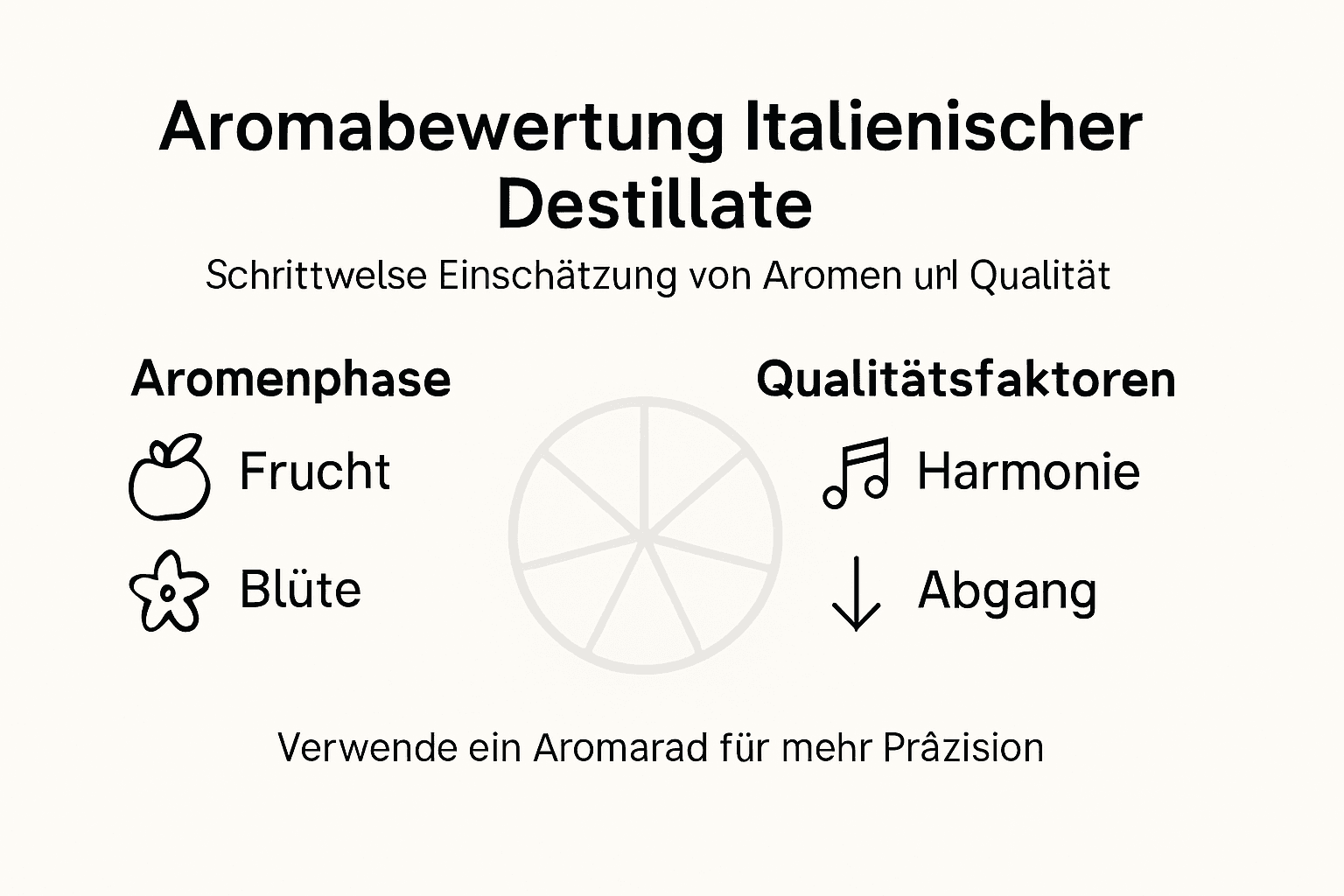
The olfactory and aroma training with standardized methods is the foundation of objective evaluations. You learn to systematically distinguish volatile aromatic compounds through orthonasal and retronasal perception. This is not an art, but a trainable craft.
Evaluate specifically according to these criteria:
The following table summarizes important criteria and their impact on the sensory evaluation of Italian distillates:
| Criterion | Impact on Quality | Typical Indications |
|---|---|---|
| Intensity | High intensity indicates fresh raw materials | Clearly discernible fragrance notes |
| Harmony | Harmony results in balanced flavor profiles | No disturbing individual aromas |
| Complexity | Complexity enhances enjoyment | Multi-layered aromatic experiences |
| Finish | Long finish indicates top quality | Persistent aromatic traces |
- Intensity – How strong are the aromas present? Weak, medium, or intense?
- Harmony – Do the different notes fit together, or do they seem disharmonious?
- Complexity – Do new aromas reveal themselves over time, or does it remain monotonous?
- Typicity – Does the aroma correspond to the expected profile of Italian distillates from this region?
- Faults – Are there unpleasant notes such as sulfur, vinegar, or rancid aromas?
Every evaluation should be documented. Write down which specific aromas you identified, how intense they were, and whether they harmonized. Over time, your notes will develop into a personal taste vocabulary that allows for comparisons.
Pay particular attention to the palate impression, not just taste. Is the distillate soft and round, or does it seem aggressive? A high-quality Italian distillate should feel pleasant, not harsh.
Systematic evaluation with standardized criteria transforms subjective feelings into objective quality judgments that you can replicate and communicate.
Compare several distillates side by side. Quality differences become clearer when you test two or three samples in direct succession. The contrast reveals details that remain hidden when tasting individually.
An important point: trust your trained palate. After a few tastings using this method, you will recognize patterns and develop confidence in your judgments. What initially seems difficult will become routine.
Pro-Tip: Use a standardized aroma wheel as a tool – keep it next to your glass and mark the aromas you identify to help you recall your evaluation later.
Master Italian Distillates with Unique Craft Spirits from Mezzanotte
The art of tasting and evaluating Italian distillates requires not only knowledge but also the right selection of high-quality spirits. If you are looking for authentic Italian distillates that combine artisanal passion and characteristic aromas, then discover an exclusive selection at Italian Craft Spirits | Gin Vodka Bitters – Mezzanotte Spirits. Each product tells a story full of tradition, innovation, and sensory diversity – perfect for sharpening your senses and perfecting your entry into the world of Italian distillates.

Dive in now and expand your tasting repertoire with unique spirits from Mezzanotte. Benefit from lovingly distilled vodkas and amari with intense aromas that exhibit exactly the quality you expect in your tasting process. Take the next step and experience Italian distilling art that will uniquely accompany you – start directly at Italian Artisan Amaro | Tradition and Innovation – Mezzanotte Spirits or discover pure varietal subtleties at Italian Artisan Vodka | Distilled Purity – Mezzanotte Spirits. Take the chance and order today at https://mezzanotte.shop to elevate your personal distillate experience to a new level.
Frequently Asked Questions
What are the most important characteristics of high-quality Italian distillates?
High-quality Italian distillates are characterized by the quality of their raw materials, artisanal production methods, and sensory purity. When purchasing, look for regional ingredients and traditional production processes to promote quality.
How do I prepare the ideal tasting setup for Italian distillates?
An ideal tasting setup includes a neutral environment, the correct temperature, and suitable glasses. Ensure the room is free of disturbing odors and the temperature is between 18 and 22 degrees Celsius to optimally perceive the aromas.
What steps should I follow when tasting Italian distillates?
When tasting, you should evaluate the distillates in five phases: visual inspection, aroma analysis, taste test, assessment of the finish, and finally, documentation of your observations. Begin with visual assessment to recognize clarity and color, and take ample time for each step.
How can I specifically evaluate the aromas and quality of Italian distillates?
Use standardized aroma wheels and flavor profiles for targeted evaluation. Assess the intensity, harmony, complexity, and finish of the distillates. Document your results to develop a personal taste vocabulary over time.
What should I consider between tastings?
Take breaks of at least 10 minutes between tastings and drink still water to neutralize your palate. This improves your ability to recognize and differentiate the subtleties of each distillate.
What significance does the origin of an Italian distillate have for its quality?
Origin significantly influences the ingredients and production method, which directly impacts quality. Only buy products with a clear indication of origin to ensure authentic and high-quality distillates.
Recommendation
- The Complete Guide to Gin Italy: Explore Flavors and Tradition 2026 – Mezzanotte | Distilleria & Spirits
- Italian Bitter Liqueurs: History and Tradition of Italian Bitters – Mezzanotte | Distilleria & Spirits
- Italian Gin Guide: Discover the Secrets of 2026 – Mezzanotte | Distilleria & Spirits
- Italian Bitter Liqueurs: A Guide to Traditions and Innovations 2026 – Mezzanotte | Distilleria & Spirits