

Discover the technical and sensory criteria for evaluating artisanal spirits: aromatic profile, balance, persistence, and premium parameters for informed choices.
Criteria for Evaluating a Spirit: Complete Guide 2026
Mar 20, 2026

Many enthusiasts believe that the quality of a spirit is judged solely by taste or price. In reality, evaluation involves extremely detailed sensory and scientific criteria that go far beyond first impressions. This guide will take you through the technical parameters used by experts to analyze gin, vodka, and craft spirits. You will discover how to recognize excellence in a premium spirit, applying the same methodologies used in international competitions. Whether you are a collector or simply looking for unique spirits with a strong cultural narrative, understanding these criteria will transform the way you choose and appreciate spirits.
Table of Contents
- Key Points
- The Fundamentals of Sensory Evaluation of Spirits
- Methodologies and Parameters for In-depth Sensory Analysis
- Unique Aspects and Craft Parameters for High-Quality Spirits
- How to Apply Evaluation Criteria to Choose Unique Spirits
- Discover Unique Craft Spirits from Mezzanotte
- Frequently Asked Questions about Criteria for Evaluating a Spirit
Key Points
| Point | Details |
|---|---|
| Comprehensive sensory evaluation | Includes aroma, taste, balance, and finish to judge overall quality |
| Multiple analytical methods | Discriminant, descriptive, and affective provide a complete picture of quality |
| Advanced craft parameters | Distillation purity and fermentation complexity distinguish premium products |
| International award standards | Evaluate dozens of sensory and scientific parameters to ensure excellence |
| Informed choice | Knowing these criteria allows you to select unique and high-quality spirits |
The Fundamentals of Sensory Evaluation of Spirits
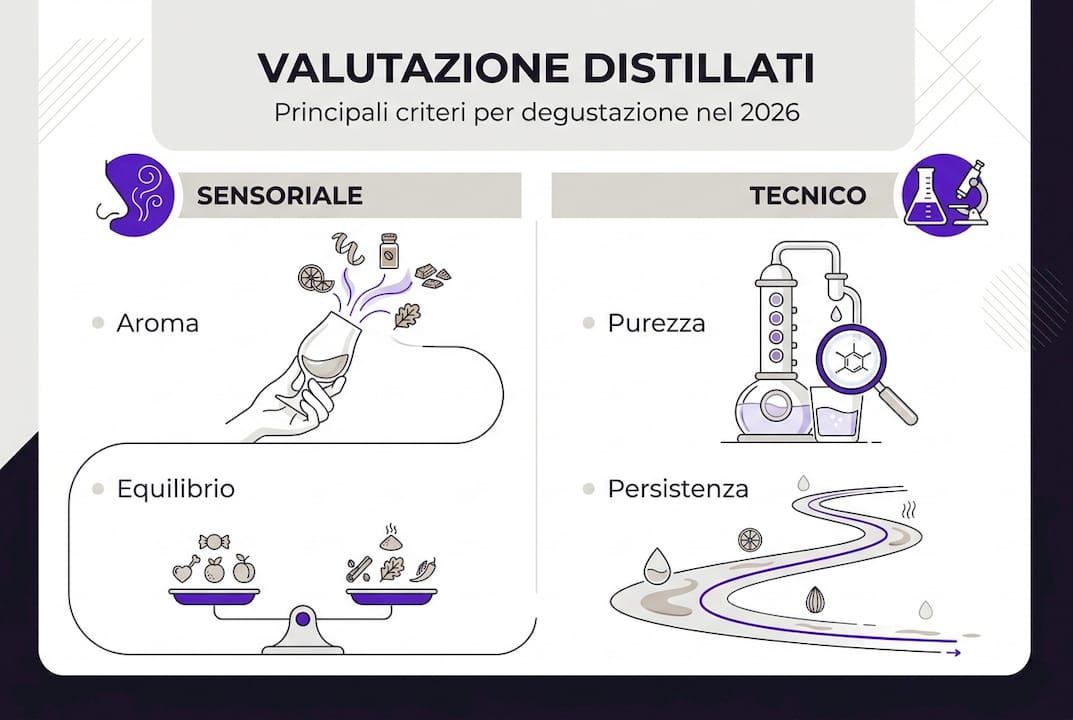
The aromatic profile represents the combination of fragrances you perceive when you bring the glass to your nose. Each spirit has distinctive notes derived from raw materials, fermentation, and the distillation process. Sensory evaluation is based on aromatic profile, intensity, balance, and persistence as fundamental criteria.
Aromatic intensity measures how perceptible and pervasive the fragrances are. A quality spirit has clear and defined aromas, never confused or too weak. The intensity must be proportionate to the alcohol content, without the alcohol masking the more delicate notes. Experts evaluate whether the aromas reveal themselves immediately or require time to develop in the glass.
Gustatory balance represents the harmony between sweetness, bitterness, acidity, and alcohol on the palate. No element should dominate the others unpleasantly. A well-balanced craft gin, for example, integrates botanicals without juniper completely overpowering the other ingredients. This balance determines whether the spirit is pleasant or unbalanced during tasting.

Persistence indicates how long and with what quality the sensations linger after swallowing. A premium spirit leaves a long and pleasant finish, with aromas that gradually evolve. Poor persistence manifests as flavors that disappear quickly or leave unpleasant sensations like excessive burning. These four criteria work together to determine the overall perceived quality.
When tasting a craft spirit, consider these elements in sequence:
- Observe the color and clarity in the glass
- Evaluate the intensity and complexity of the aromas on the nose
- Taste small quantities to perceive the gustatory balance
- Note the persistence and evolution of the finish
Pro Tip: Allow the spirit at least five minutes to breathe in the glass after pouring. Oxygenation allows more volatile aromas to dissipate and reveals hidden aromatic nuances that radically change sensory perception.
To delve deeper into practical techniques, explore the Italian spirit tasting method that will guide you step by step.
Methodologies and Parameters for In-depth Sensory Analysis
Sensory analysis methodologies are divided into three main categories, each with specific objectives. Sensory analysis methodologies include discriminant methods for perceptible differences, descriptive for characterizing sensory attributes, and affective for acceptability. Understanding these distinctions allows you to evaluate spirits with greater precision and awareness.
Discriminant methods are used to identify whether perceptible sensory differences exist between two or more samples. These tests are used to verify if a change in the production process has altered the spirit's profile. For example, a producer might test if changing botanical suppliers affects the final result. Tasters simply respond whether they perceive differences, without describing them in detail.
Descriptive methods require evaluators to precisely characterize specific aromatic and gustatory properties. A trained panel identifies and quantifies attributes such as floral, spicy, citrus, or earthy notes. This methodology creates a detailed sensory profile that can be objectively compared between different products. International competitions often use descriptive panels to evaluate competing spirits.
Affective methods measure the product's liking and acceptability among consumers. Unlike descriptive methods, which require expert evaluators, affective tests involve ordinary consumers who express personal preferences. This data helps producers understand if a spirit meets the tastes of the target market, even if it does not provide detailed technical information.
“Professional sensory analysis combines discriminant methods to detect minute differences, descriptive methods to map the complete profile, and affective methods to validate commercial acceptability, creating a comprehensive evaluative framework.”
To apply these methodologies in personal evaluation, follow this numbered sequence:
- Compare the spirit with a reference sample to identify differences (discriminant approach)
- Precisely describe the aromatic and gustatory characteristics you perceive (descriptive approach)
- Evaluate how well the spirit matches your personal preferences (affective approach)
- Document your observations to build a personal reference archive
- Repeat the tasting at different times to verify the consistency of your perceptions
Combining these three approaches offers a much more comprehensive evaluation than a superficial judgment based solely on immediate liking. Discover the sensory art in tasting to further refine your skills.
Unique Aspects and Craft Parameters for High-Quality Spirits
Premium craft spirits are distinguished by advanced technical parameters that go beyond standard evaluations. The concept of heads and tails in distillation represents a fundamental parameter of purity. Heads contain undesirable volatile compounds that evaporate first, while tails include heavy oils that emerge at the end. Controlling heads and tails in distillation ensures purity, while long fermentations develop superior aromatic complexity.
Prolonged fermentations allow yeasts to develop more articulate and nuanced aromatic profiles. While industrial productions complete fermentation in 24 hours, craft distillers can extend the process up to a week or more. This additional time generates complex esters and aromatic compounds that give the final product distinctive character.
International awards such as Monde Selection use over 30 parameters that combine sensory evaluation and scientific analysis. These parameters include chemical measurements of purity, detailed organoleptic tests, and evaluations of consistency between different batches. An awarded spirit has passed rigorous checks that attest to consistent quality and technical excellence.
| Parameter | Standard Evaluation | Advanced/Awarded Evaluation |
|---|---|---|
| Distillation purity | Absence of obvious flaws | Precise control of heads and tails, chromatographic analysis |
| Aromatic complexity | 3-5 perceptible notes | 8+ layered notes with temporal evolution |
| Balance | Absence of marked imbalances | Mathematical harmony between components, golden ratios |
| Persistence | 10-20 second finish | Over 60 second finish with continuous evolution |
| Batch consistency | Acceptable variability | 95% reproducible sensory identity |
Pro Tip: Do not judge the quality of a spirit based solely on perceived alcohol intensity. A strong burn does not necessarily indicate high proof, but often reveals poor quality in fraction separation during distillation. Premium craft spirits have well-integrated alcohol that does not attack the palate.
Recognizing a craft spirit with a high-quality approach requires attention to specific details. Look for transparency in information about the production process, including fermentation times and distillation methods. Quality craft producers openly communicate their technical choices because they represent distinctive strengths. Check for international awards that attest to independent evaluations according to rigorous standards.
To avoid common evaluation errors, focus on technical parameters as well as subjective impressions. Delve into what premium spirit means to understand the standards that define excellence.
How to Apply Evaluation Criteria to Choose Unique Spirits
Applying evaluation criteria in practice requires a systematic approach that combines technical analysis and personal preferences. Evaluating a spirit from aromatic profile to aftertaste requires method and attention to detail. Following a structured sequence helps you not to overlook important aspects that might escape a superficial tasting.
To fully evaluate a spirit, proceed through these steps:
- Visually examine the liquid for clarity, color, and viscosity
- Smell from a distance before bringing the glass to your nose
- Identify the main and secondary aromatic notes
- Taste a small quantity, letting it rest on the palate
- Evaluate the balance between the different flavors perceived
- Observe the persistence and evolution of the finish
- Repeat after a few minutes to catch changes due to oxygenation
Comparing and recognizing balance and persistence requires experience, but you can accelerate learning by creating personal references. Taste the same spirit at different times, noting your perceptions. Compare similar products side-by-side to highlight subtle differences. Over time, you will develop a sensory memory that will allow you to evaluate new spirits with greater precision.
To combine technical evaluation and personal preferences effectively:
- First establish objective quality parameters using the sensory criteria described
- Identify which technical characteristics correspond to your personal tastes
- Consider the intended consumption context, whether neat or mixed
- Evaluate the quality-price ratio based on verified technical standards
- Research information on cultural narrative and design that add perceived value
The cultural narrative and bottle design significantly contribute to the perceived value of a craft spirit. A product that tells an authentic story, inspired by myths, pop culture, or local traditions, creates a richer and more memorable experience. The curated design of the bottle and label communicates the attention to detail that the producer also applies to the content. These elements do not replace intrinsic quality but complement it by creating a superior overall experience.
Recognizing craft spirits with controlled processes means verifying the transparency of the producer. Look for detailed information on the origin of raw materials, fermentation and distillation methods, and implemented quality controls. Serious craft producers gladly document their processes because they represent their distinctive value compared to industrial productions.
The recommended approach for conscious and collectible purchasing combines preliminary research and direct experimentation. Study the producers that interest you, check the awards received, and read expert reviews. Then personally taste the products that pass this first selection, applying the learned sensory criteria. Gradually build a collection that reflects both technical excellence and your personal preferences.
Discover why choose craft spirits in 2026 and deepen your gin tasting tips to further refine your skills.
Discover Unique Craft Spirits from Mezzanotte
Now that you know the criteria for evaluating a quality spirit, it's time to apply this knowledge to products that embody Italian craft excellence. Mezzanotte offers an exclusive selection of craft gin and craft vodka that meet all the technical and sensory parameters described in this guide.
Each spirit in the Mezzanotte catalog features a strong cultural identity inspired by myths, anime, and pop culture, combined with a curated design that reflects meticulous attention to detail. The products have won international awards that attest to technical quality verified according to the most rigorous standards. The narrative behind each bottle transforms tasting into a cultural adventure that goes beyond mere consumption.
Explore the collections to discover spirits with complex aromatic profiles, impeccable balance, and memorable persistence. Each product is the result of controlled craft processes, prolonged fermentations, and careful distillation that precisely separates heads and tails. Learn more about why pop culture and spirits come together to understand the philosophy that guides each creation.
Frequently Asked Questions about Criteria for Evaluating a Spirit
How to recognize a quality craft spirit?
Check the producer's transparency regarding raw materials and the fermentation and distillation methods used. A quality artisanal spirit has a complex aromatic profile with at least 6-8 discernible notes, a harmonious taste balance without aggressive dominance, and a persistence longer than 60 seconds. Look for international awards that attest to independent evaluations according to rigorous standards such as those of Monde Selection.
Which parameters are most important for a beginner taster?
Initially, focus on balance and persistence, which are easier to perceive than complex aromatic nuances. Evaluate whether the spirit presents excessive burning or unpleasant sensations that indicate poor distillation quality. With experience, you will develop the ability to identify specific aromatic notes and assess the complexity of the overall sensory profile.
How does cultural narrative influence the evaluation of a spirit?
Cultural narrative does not change the intrinsic technical quality, but it significantly enriches the overall consumption experience. A spirit with authentic storytelling inspired by myths, pop culture, or traditions creates emotional connections that increase perceived value. This element becomes particularly important for collectors and enthusiasts looking for unique products with a distinctive identity beyond mere technical excellence.
How much does bottle design count in the perception of value?
Careful design communicates the attention to detail that the producer also applies to the content, creating expectations of high quality. A well-designed bottle with a distinctive label facilitates brand recognition and adds aesthetic value to the collection. However, design should never compensate for deficiencies in the quality of the spirit itself, but rather complement a product that is already excellent from a technical and sensory point of view.
What errors should be avoided during the personal evaluation of a spirit?
Do not base your judgment solely on perceived alcohol intensity, which often indicates poor quality in fraction separation rather than high proof. Avoid tasting too many samples consecutively, as it fatigues the palate and reduces the ability to discriminate nuances. Do not neglect the importance of oxygenation, allowing the spirit time to breathe in the glass. Discover other common mistakes to avoid to improve your evaluations.
Recommendation
- Spirits Distillation Guide 2026: Avoid 40% Common Errors – Mezzanotte | Distillery & Spirits
- Italian Spirits Tasting Method: Practical Guide 2026 – Mezzanotte | Distillery & Spirits
- What does premium spirit mean: complete guide 2026 – Mezzanotte | Distillery & Spirits
- History of Italian spirits: artisanal tradition 2026 – Mezzanotte | Distillery & Spirits