

Discover original Negroni and Spritz recipes, stories of award-winning Italian artisanal spirits, and practical tips for creating the perfect aperitivo.
Aperitifs and cocktails: recipes, stories, and Italian spirits
Apr 2, 2026

Italy boasts over 200 artisanal spirits awarded annually in international competitions, yet many enthusiasts still believe that a good aperitivo depends solely on the right recipe. The truth is different: it is the chosen spirit, with its history and botanicals, that makes the difference between an ordinary Negroni and an extraordinary one. Negroni and Spritz, recognized as top global cocktails by the IBA, are just the starting point. In this guide, you will discover the historical roots of Italian aperitivi, original recipes with professional techniques, the most awarded artisanal spirits, and a practical framework for creating unique and memorable pairings.
Table of Contents
- History and Evolution of Italian Aperitivi and Cocktails
- Negroni and Spritz: Techniques, Original Recipes, and Artisanal Insights
- Italian Artisanal Spirits: Stories, Awards, and Trends in Cocktails
- How to Choose and Pair Ingredients to Create the Perfect Aperitivo
- Why the Art of Aperitivo is More Than Just a Recipe: The Value of Stories and Signature Spirits
- Discover, Experiment, and Create with Italian Artisanal Spirits
- Frequently Asked Questions about Aperitivi and Cocktails
Key Points
| Point | Details |
|---|---|
| Art of the Italian Aperitivo | Authenticity arises from the combination of tradition, innovation, and the choice of signature spirits. |
| Perfect Negroni and Spritz | Techniques, composition, and spirit balance are at the core of memorable experiences. |
| Value of Artisanal Spirits | Choosing award-winning and regional products brings uniqueness and narrative to every cocktail. |
| Practical Tips and Pairings | Expertly pairing gin, bitters, and vermouth enhances aromas, flavors, and the conviviality of the aperitivo. |
History and Evolution of Italian Aperitivi and Cocktails
After introducing the importance of Italian products, it is essential to understand their roots and evolution over time.
The Italian aperitivo has never been just a drink. It is a social ritual, a shared moment of pause rooted in the 19th century, when pharmacists and distillers began creating bitter herbal infusions to stimulate the appetite. The word itself comes from the Latin aperire, to open. To open the stomach, of course, but also conversation, the evening, the mind.
Throughout the 20th century, this ritual transformed into culture. Bars like Caffè Casoni in Florence and Camparino in Milan became stages where legends were born. It was in this context that the Negroni took shape, attributed to Count Camillo Negroni, who asked to strengthen his Americano with gin. Today, the Negroni is among the top drinks according to Drinks International, a recognition that confirms how this cocktail has endured decades without losing its appeal.
The Spritz, on the other hand, has Venetian and Austro-Hungarian origins. Born as wine diluted with sparkling water by Habsburg soldiers, it evolved into the modern version with Aperol or Campari, Prosecco, and soda. Its simplicity is deceptive: each regional variation tells a different story.
"An aperitivo is never just a glass. It's an invitation to pause, to look at the world with more open eyes."
The innovative role of artisanal spirits in this landscape has grown enormously in the last twenty years. Small Italian distilleries have begun to rediscover forgotten local botanicals, family recipes, and traditional infusion techniques, bringing new life to classic cocktails. Competitions like the Spirito Autoctono awards have helped to give international visibility to these products.
Here are some key moments in the evolution of Italian aperitivi:
- 1786: Carpano invents vermouth in Turin, the base of many classic cocktails
- 1860: Campari is born, destined to become a global symbol of Italian bitterness
- 1919: The Negroni is created in Florence, according to the most accredited legend
- 1950s: The Spritz spreads throughout Northeastern Italy as a popular aperitivo
- 2000s: Explosion of Italian artisanal gins with native botanicals
To delve deeper into the roots of this tradition, the history of Italian amari offers a detailed and fascinating account of how bitterness became a cultural value in our country.
Negroni and Spritz: Techniques, Original Recipes, and Artisanal Insights
Having understood how much Italy has influenced global aperitivo culture, let's now discover how to make iconic cocktails in an authentic and creative way.
The classic Negroni recipe calls for 30ml of gin, 30ml of bitter, and 30ml of red vermouth, built directly over ice in an old-fashioned glass. The 1:1:1 ratio is a starting point, not a dogma. Replacing industrial gin with an artisanal gin featuring alpine botanicals, for example, completely changes the drink's aromatic profile.
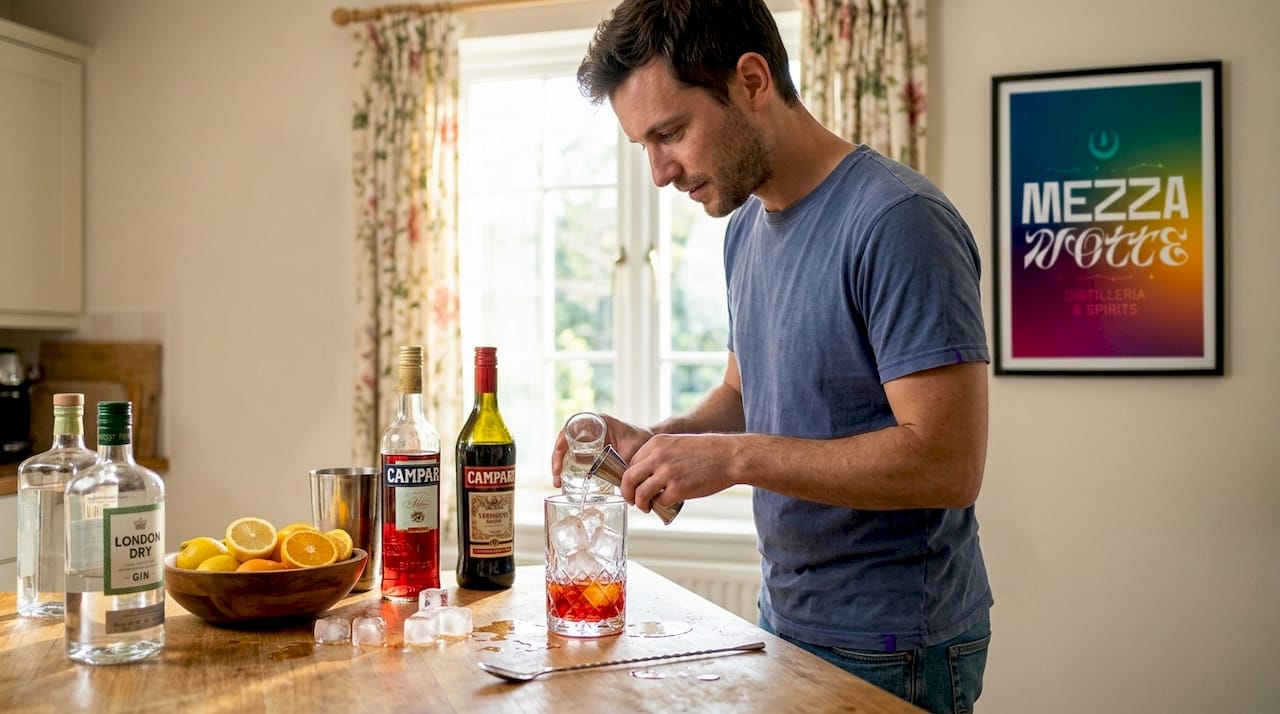
For the Spritz, the IBA 3:2:1 ratio is the most common: 3 parts Prosecco, 2 parts bitter, and 1 part soda. The pouring order matters: first ice, then Prosecco, then bitter, finally soda. This preserves the bubbles and distributes the flavors evenly.
| Characteristic | Negroni | Spritz |
|---|---|---|
| Alcohol content | ~25% vol | ~8% vol |
| Ideal glass | Old fashioned | Large wine glass |
| Occasion | Evening aperitivo, after dinner | Afternoon aperitivo |
| Complexity | High | Medium |
| Garnish | Orange peel | Orange slice, olive |
To make a high-quality artisanal Negroni, follow these steps:
- Chill an old-fashioned glass with ice and cold water for at least one minute
- Discard the chilling ice and add a large ice cube or sphere
- Pour artisanal gin, bitter, and vermouth in equal parts directly over the ice
- Stir with a bar spoon for 20 seconds, without shaking
- Garnish with an orange peel expressed over the rim of the glass
The most interesting artisanal insight is the choice of gin. A gin with Mediterranean botanicals will yield herbaceous and floral notes, while an alpine one will bring resin and freshness. To delve into the differences, the guide on what distinguishes Italian gin explains how each region expresses distinct characteristics. For step-by-step preparation techniques, you can follow the step-by-step artisanal gin cocktails or explore the Negroni 1:1:1 preparation.
Pro Tip: Always use a separate mixing glass for the Negroni if you want precise control over dilution. Stir in the mixing glass with ice, then pour into the already chilled glass. You'll get a cleaner, less watery drink with a silky texture.
For a perfect Negroni, artisanal bitter makes a huge difference: look for products with botanicals like gentian, Chinese rhubarb, or Italian citrus peels.
Italian Artisanal Spirits: Stories, Awards, and Trends in Cocktails
Having explored the recipes and techniques, let's discover how artisanal spirits bring personality and narrative to every aperitivo.
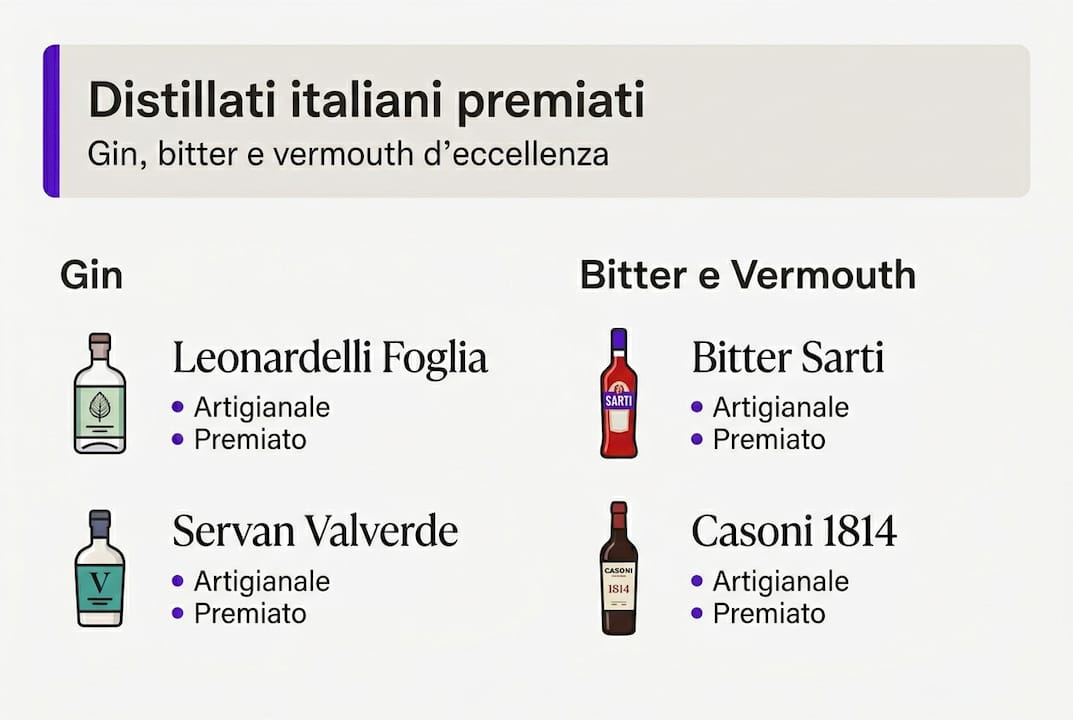
Italy is currently one of the most dynamic countries in the artisanal spirits landscape. Gins, bitters, and vermouths produced by small independent realities have won international palates and prestigious awards. The Alambicco d'Oro 2025 results highlight Gin Leonardelli Foglia and Gin Servan Valverde as Best Gold, two products that tell precise stories through carefully selected botanicals.
| Category | Product | Region | Recognition |
|---|---|---|---|
| Gin | Leonardelli Foglia | Trentino | Best Gold Alambicco d’Oro 2025 |
| Gin | Servan Valverde | Veneto | Best Gold Alambicco d’Oro 2025 |
| Bitter | Redentore | Venice | International Competitions |
| Bitter | Casoni 1814 | Emilia | Historical Tradition |
| Vermouth | Carpano Antica Formula | Turin | Global Icon |
Italian artisanal bitters like Bitter Sarti, Redentore, and Casoni 1814 represent some of the most influential expressions in the contemporary cocktail scene. Each brings a different aromatic signature: Casoni 1814 with its Emilian roots and historical recipe, Redentore with Venetian lagoon botanicals.
Current trends in the world of Italian artisanal spirits include:
- Cold infusions with seasonal botanicals to preserve delicate aromas
- Special batches in limited editions, often linked to specific regions or times of year
- Low-ABV variations that maintain aromatic complexity while reducing alcohol content
- Collaborations between distilleries to create unique blends and shared stories
To discover the variety of available expressions, the guide on types of Italian bitters offers a comprehensive overview. If you want to delve into botanicals and the characteristics of artisanal bitters, you will find valuable information on how 30 different botanicals can build a unique aromatic profile. To understand how these spirits fit into cocktails, the section on how to pair Italian spirits is an essential reference.
The Spirito Autoctono competitions have contributed to creating a virtuous ecosystem where small producers are valued and the end consumer has access to true stories, not manufactured marketing.
How to Choose and Pair Ingredients to Create the Perfect Aperitivo
You've learned about award-winning spirits: now let's see how to enhance each ingredient for a unique experience.
Choosing the right ingredients for an aperitivo is not a matter of luck. It's a matter of listening: listening to the spirit, understanding its dominant notes, and building a harmonious dialogue around them. The synergy between gin, bitter, and vermouth profoundly influences the final result of the cocktail, and ignoring this principle often leads to unbalanced drinks.
Some practical guidelines for pairings:
- Pair by contrast: a floral gin is enhanced by a very bitter and earthy bitter
- Pair by region: gin and bitter from the same region often share compatible botanicals
- Consider alcohol content: high-proof spirits require more structured vermouths
- Experiment with seasonality: in summer, prefer citrus and fresh botanicals; in winter, spicy and resinous ones
- Avoid overlaps: if the gin is already very spicy, choose a more neutral vermouth
The most common mistakes to avoid are using small ice cubes that dilute too quickly, choosing vermouth that has been open for weeks without refrigeration, and pairing spirits with identical aromatic profiles that result in a flat, monotone drink.
Pro Tip: Create seasonal regional pairings. In spring, try a Ligurian gin with lemon and basil botanicals paired with a Piedmontese white vermouth. In autumn, an alpine gin with notes of fir and a bitter with gentian root creates a Negroni that tastes of the mountains.
To develop a more structured approach, pairing strategies and gin tasting tips will help you build a precise sensory vocabulary. If you want to explore more creative pairings, the guide to artisanal gin pairing offers original ideas for every season. For a complete technical reference, the technical Negroni guide remains an invaluable tool.
Why the Art of Aperitivo is More Than Just a Recipe: The Value of Stories and Signature Spirits
After so many technical suggestions, it's time to reflect on what truly makes every Italian aperitivo unique.
We believe that the real difference lies not in the perfection of the 1:1:1 ratio or the exact temperature of the ice. It lies in the story that accompanies each glass. When you choose a gin produced by a Trentino family that hand-picks juniper berries at 1,800 meters, you are bringing a story into your aperitivo that no recipe can replicate.
Italian artisanal spirits are vehicles of cultural identity. Each bottle carries a region, a tradition, often a challenge overcome against the homogenization of the global market. This is why choosing small excellences radically changes the dialogue between those who prepare the drink and those who enjoy it.
Our perspective is clear: a mediocre aperitivo with extraordinary ingredients is always more interesting than a technically perfect aperitivo with anonymous products. Technique can be learned in a few months. The taste for discovery, the curiosity for a little-known bitter or a niche vermouth—that requires an open mind and a desire to explore.
We invite you to make room for creativity, to experiment with pairings with artisanal spirits you've never tried, and to make the aperitivo a moment of authentic discovery, not just consumption.
Discover, Experiment, and Create with Italian Artisanal Spirits
If you want to add value to your choices and experience truly special aperitivi, you can start experimenting right away.
Mezzanotte.shop was created precisely for those who want to go beyond the usual shelf. The catalog collects Italian artisanal gins selected from the most awarded and original, each with a precise story and aromatic profile. You will also find a selection of Italian artisanal vodkas for those who want to explore beyond the boundaries of gin.

Every product in the Mezzanotte spirits catalog is chosen for its narrative and qualitative value. You won't find anonymous products: you'll find spirits with a strong identity, often inspired by myths, cultures, and stories that make every aperitif an adventure. Explore, compare, build your ideal aperitif with ingredients that have something to tell.
Frequently Asked Questions about Aperitifs and Cocktails
Which Italian gins are ideal for a craft Negroni?
Gin Leonardelli Foglia, Gin Servan Valverde, and Sibillini are among the best for a craft Negroni: all awarded Alambicco d’Oro with distinct aromatic profiles and local Italian botanicals.
How to prevent Spritz or Negroni from becoming watery?
Use large ice cubes for slower dilution, pour Prosecco first into the Spritz, and stir the Negroni in an already chilled glass to limit heat dispersion.
Which Italian craft bitters are most recommended for cocktails?
Bitter Sarti, Redentore, and Casoni 1814 are among the most suitable for balanced aromas, territorial scents, and a complexity that enriches any classic cocktail.
How to choose the right vermouth for Negroni or Spritz?
Prefer sweet and structured vermouths like Carpano, Cocchi, or Del Professore: their complex aromas enhance both the Negroni and more creative Spritz variations.
Recommendation
- How to pair Italian spirits for unique cocktails – Mezzanotte | Distillery & Spirits
- Guide to flavored liqueurs: flavors, stories, and uses – Mezzanotte | Distillery & Spirits
- History of Italian spirits: craft tradition 2026 – Mezzanotte | Distillery & Spirits
- Italian spirits tasting method: practical guide 2026 – Mezzanotte | Distillery & Spirits
- Custom glasses for celebrations: the complete guide – Shotglass24