

Discover the best Italian craft vodkas: local ingredients, production techniques, international awards, and tips for optimal tasting.
Italian vodka: a guide to artisanal excellence
Apr 3, 2026

TL;DR:
- Italian craft vodka highlights local ingredients and unique cultural stories.
- Carefully chosen distillation techniques and ingredients make Italian vodka a complex product.
- Italian vodka offers aromatic profiles suitable for both neat tasting and sophisticated cocktails.
Vodka is neutral by definition. At least, that's what they say. But anyone who has tasted an Italian craft vodka knows that this statement is simply wrong. Italian vodka is not neutral: it celebrates local ingredients and the territory, and carries cultural stories that no industrial production could tell. From historic distilleries in the North to experimental laboratories in Tuscany, each bottle is the result of precise choices, exceptional raw materials, and an artisanal vision that transforms a spirit into an experience. In this guide, you will discover the origins, techniques, products, and how to best enjoy the excellence of Italian vodka.
Table of Contents
- Origins and Tradition of Italian Vodka
- Ingredients and Production Techniques: Quality Comes from the Land
- The Main Italian Vodkas: Products and Stories to Discover
- Tasting and Pairings: Enhancing Italian Vodka
- What's Missing (and What No One Says) About Italian Vodka
- Discover the Best Italian Craft Vodkas on Mezzanotte
- Frequently Asked Questions About Italian Craft Vodka
Key Points
| Point | Details |
|---|---|
| Unique Tradition | Italian vodka comes from historic distilleries with deep roots and authentic narratives. |
| Excellent Ingredients | The use of ancient grains, spring water, and unique techniques like Carrara marble elevate product quality. |
| Awards and Recognition | Vodkas like Statuaria and Verità have received international scores and awards, confirming their artisanal superiority. |
| Versatile Tasting | Italian vodka is suitable for neat tasting and mixology, enhancing every convivial moment. |
Origins and Tradition of Italian Vodka
Talking about Italian vodka might seem like a paradox. Vodka is historically linked to Eastern Europe, Russia, and Poland. Yet Italy has developed its own identity in this sector, built on centuries of distilling culture and a deep connection to the territory. It's not about imitating something foreign, but reinterpreting it with Italian tools and sensibility.
The history of Italian spirits is rooted in the production of grappa, acquavite, and regional liqueurs. Many distilleries that now produce craft vodka started out producing grappa. This transition is no accident: mastery of distillation, care for raw materials, and sensitivity to aromatic profiles naturally transfer from one spirit to another.
Distilleria Schiavo and Distilleria Collesi boast over a hundred years of history, and this heritage is palpable in every bottle. These are not companies born to follow a trend, but established entities rooted in the territory that have chosen to apply their expertise to a new format. Collesi Vodka is produced alongside the grappa tradition, using methods that enhance local raw materials and artisanal control at every stage.
What makes this tradition special? Here are the key points:
- Connection to the territory: each distillery chooses ingredients from its region, creating unique and unrepeatable profiles.
- Grappa heritage: Italian distillation culture translates into vodka with character and complexity.
- Cultural narrative: each product carries a story, a visual identity, and a message.
- Artisanal control: small-scale production, meticulous attention to detail, no industrial shortcuts.
- Rooted innovation: experimenting without forgetting one's origins.
Italian craft spirits stand out precisely for this ability to credibly and authentically combine tradition and innovation. It's not marketing; it's substance.
Ingredients and Production Techniques: Quality Comes from the Land
Knowing the tradition, it's essential to discover which ingredients and methods make Italian vodka unique. The short answer is: it all starts from the land. Ingredients are not interchangeable; they are not anonymous. They are carefully selected, often exclusive, and define the final character of the spirit.
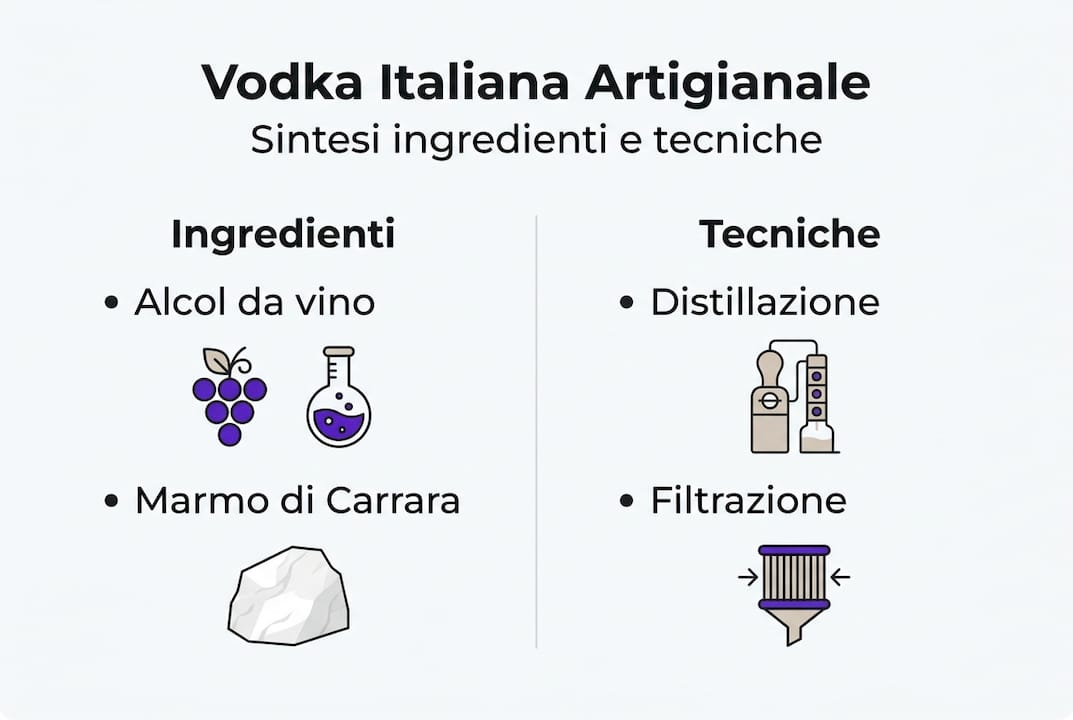
Impavid uses wine alcohol, Tuscan water, and Carrara marble: a perfect example of how the territory can become an ingredient. Carrara marble is not just a globally famous architectural material but a natural filter that gives the spirit softness and minerality. This process is rare, difficult to replicate, and profoundly Italian.

Statuaria uses Statuario marble powder and organic grains, taking this philosophy even further. The result is a vodka with a silky texture and an aromatic profile that surprises those who expect neutrality. Cabiria Premium uses slow distillation and black cumin, adding a spicy and distinctive note that speaks to the product's Venetian roots.
Distillation techniques vary significantly among producers. Here's a useful comparison:
| Technique | Raw Material | Aromatic Profile | Example |
|---|---|---|---|
| Wine Distillation | Italian grapes | Soft, slightly fruity | Impavid |
| Grain Distillation | Ancient local grains | Clean, with cereal notes | Statuaria |
| Slow Distillation | Various | Complex, spicy | Cabiria Premium |
| Triple Distillation | Local grain and alpine water | Elegant, balanced | Verità |
Verità Italian Vodka, produced with local grain and alpine water, scored 92/100 by VinePair, confirming that ingredient quality translates into tangible scores and international recognition.
How to recognize a quality craft vodka?
- Transparency about ingredients and origin
- Indication of the distillation method
- Small production with a limited number of bottles
- Carefully designed bottle that is consistent with the product's story
Pro Tip: When tasting an Italian craft vodka for the first time, always try it at room temperature, not chilled. Cold blocks aromas and flattens the texture. Let the spirit speak to you before deciding how to serve it.
The Main Italian Vodkas: Products and Stories to Discover
After understanding the production techniques, it's time to get to know the vodkas that best embody Italian craftsmanship. This is not an absolute ranking, but a guide to navigating products with very different characteristics.
"Italian vodka doesn't try to be Russian or Polish. It tries to be Italian, and in this, it succeeds extraordinarily."
Here's an overview of the most relevant products:
| Vodka | Distillery | Key Ingredients | Score/Award |
|---|---|---|---|
| Statuaria | Italian | Statuario marble, organic grains | Gold World Vodka Awards |
| Verità | Italian | Local grain, alpine water | 92/100 VinePair |
| Impavid | Tuscan | Wine alcohol, Carrara marble | National Recognition |
| Cabiria Premium | Collesi | Black cumin, slow distillation | International Mention |
Statuaria received Gold at the World Vodka Awards and Silver at the London Spirits Competition: a result that demonstrates how Italian vodka can compete at the highest global levels. Verità Italian Vodka achieved 92/100 from VinePair, a score that few craft spirits receive upon first international evaluation.
How to choose among the available types of Italian vodka? Here's a recommended path:
- Start with Verità if you want a clean and balanced profile, ideal for those new to Italian craft vodka.
- Move on to Impavid to explore the complexity of wine distillation and the minerality of Tuscan marble.
- Discover Statuaria when you're ready for a more intense sensory experience and a powerful visual and cultural story.
- Try Cabiria Premium if you love spicy notes and want to understand how black cumin can transform a spirit.
Each Italian craft vodka tells a different story. It's not about finding the absolute best, but the one that resonates with your taste and curiosity.
Tasting and Pairings: Enhancing Italian Vodka
Knowing the main products, let's now look at how to best enjoy and pair Italian craft vodka. Conscious tasting is not a ritual reserved for experts. It is simply the way to get the most out of a product that deserves attention.
Italian craft vodka has aromatic profiles suitable for both neat tasting and advanced mixology. This means you don't have to choose between drinking it neat or using it in cocktails: you can do both, and in both cases, you will get excellent results.
How to properly taste Italian vodka:
- Temperature: serve between 10 and 15 degrees Celsius, never frozen.
- Glass: use a tulip glass or a tasting glass to concentrate the aromas.
- Observation: check clarity and viscosity by pouring slowly.
- Nose: bring the glass to your nose slowly, do not plunge your nose in immediately.
- Palate: hold the spirit in your mouth for a few seconds before swallowing.
For food pairings, Italian vodka behaves surprisingly well:
- Raw fish appetizers: the minerality of vodka cleanses the palate and enhances the freshness of the fish.
- Aged cheeses: cereal notes pair well with the complexity of hard cheeses.
- Creamy risottos: the smoothness of the spirit balances the richness of the dish.
- Dark chocolate: for the more curious, an unexpected pairing that works with more structured vodkas.
In Italian vodka cocktails, craft vodka adds complexity without overpowering other ingredients. To delve deeper into Italian vodka pairings and understand the differences compared to other spirits, it is also worth exploring the comparison between vodka vs gin to understand how to choose based on the occasion.
Pro Tip: If you use an Italian craft vodka in a cocktail, reduce the quantity of other aromatic ingredients. The spirit already has character; it doesn't need to be covered up, but enhanced.
What's Missing (and What No One Says) About Italian Vodka
After exploring tasting and pairings, it's helpful to reflect on what is left unsaid in the industry. Italian vodka is still undervalued. Not because it lacks quality, but because the market struggles to shake off the prejudice that vodka should be neutral, anonymous, and interchangeable.
This is the most damaging myth for Italian producers. Those looking for a vodka "that you can't taste" will never understand why Statuaria is worth every penny of its price. But those willing to listen to a spirit, to give it time to express itself, will discover a world that industrial vodkas cannot offer.
Italian versions are ideal for enthusiasts seeking unique products, not just neutral ones. This is the starting point for re-evaluating the entire category. Italian craft vodka does not compete with mass-produced vodka: it appeals to those who want something different, authentic, and memorable.
The problem is also cultural. In Italy, wine, grappa, and gin are celebrated. Vodka is still perceived as a foreign spirit, not our own. But the distilleries we have mentioned prove otherwise every day. Discovering neat vodka and craft stories means changing perspective and recognizing that Italy can do great things in this field too.
Pro Tip: Invest in at least three different bottles of Italian craft vodka before forming a definitive opinion. Variety is part of the message.
Discover the Best Italian Craft Vodkas on Mezzanotte
If this guide has opened your eyes to the complexity and beauty of Italian vodka, the next step is to find and taste them. On Mezzanotte, you'll find a curated selection of Italian craft vodka chosen for quality, history, and character. Each product in the catalog has its own identity, a precise aromatic profile, and a story worth knowing.

We don't limit ourselves to vodka. If you want to explore the world of Italian craft spirits comprehensively, you'll also find a selection of Italian craft gin with the same level of care and attention. Every bottle on Mezzanotte is a conscious choice, not a random purchase. Start your exploration today.
Frequently Asked Questions About Italian Craft Vodka
What are the main differences between Italian vodka and Russian or Polish vodka?
Italian vodka emphasizes local ingredients, innovative techniques, and cultural stories, while foreign varieties focus on neutral flavors and industrial production. Italian vodka celebrates local quality instead of hiding behind neutrality.
What role do Carrara marble and spring water play in production?
Carrara marble provides softness and minerality, while spring water enhances the purity and final taste of the vodka. Statuaria uses Statuario marble powder and local water to achieve this result.
Can Italian vodka be enjoyed neat, or is it recommended for cocktails?
Italian vodka is excellent for neat tasting due to its aromatic profiles, but it is also ideal for sophisticated cocktails. Its aromatic profiles make it versatile in both contexts.
What are the main international awards received by Italian vodkas?
Statuaria won Gold at the World Vodka Awards and Verità Vodka Italiana received 92/100 from industry critics. Statuaria also received Silver at the London Spirits Competition, while Verità achieved 92/100 on VinePair.
Recommendation
- Discover the types of artisan Italian vodka – Mezzanotte | Distillery & Spirits
- Smooth vodka: authentic purity and artisan stories – Mezzanotte | Distillery & Spirits
- Artisan Italian Vodka: 5 Types with 40% More Aroma – Mezzanotte | Distillery & Spirits
- Italian spirits tasting method: practical guide 2026 – Mezzanotte | Distillery & Spirits
- Where Vermentino is born