

Discover how to choose high-quality gin: quality criteria, artisanal production, botanicals, and tasting tips for gin lovers.
How to Choose High-Quality Gin: 2026 Guide
Mar 22, 2026

The world of gin is fascinating, yet also overwhelming. Hundreds of brands, countless botanicals, and diverse production methods make choosing difficult. For gin lovers who value artisanal quality and authentic stories, it's crucial to know the right criteria. This guide will show you step-by-step how to identify and select high-quality gins that match your personal preferences. You will learn what matters in production, how to identify quality characteristics, and the role of tradition and storytelling.
Table of Contents
- Key Insights at a Glance
- The Basics: What Makes a Gin High Quality
- Well-known Brands and Test Winners as a Guide
- The Story Behind the Gin: Recognizing Culture and Tradition
- Experiencing Gin: Tips for Tasting and Suitability Assessment
- Discover High-Quality Artisanal Gin Offers at Mezzanotte
- Frequently Asked Questions About Gin Selection
Key Insights
| Point | Details |
|---|---|
| Artisanal Production | Quality comes from artisanal production using regional ingredients and long maceration, allowing aromas to develop deeply and harmoniously. |
| Regional Botanicals Define | Regional ingredients give each gin a unique identity and tell the story of the distillery's origin. |
| Stories and Traditions | The narratives behind distilleries build trust and provide guidance for buyers. |
| Test Winners as Guidance | Well-known brands and awards like IWSC or San Francisco World Spirits Competition help identify objective quality. |
| Tasting Clarifies Preferences | By tasting, you identify personal preferences and find the right gin. |
The Basics: What Makes a Gin High Quality
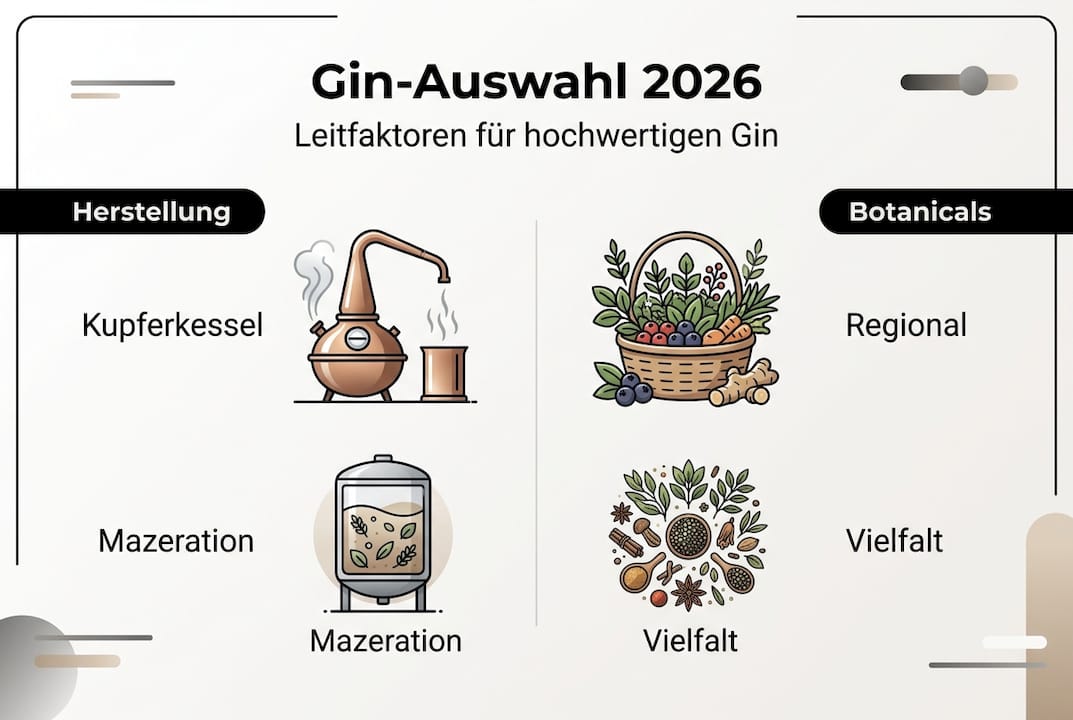
The quality of a gin begins with its production. Artisanal gin is made with regional ingredients and long maceration, with Black Forest Gin, for example, undergoing 7 days of maceration. This time allows the botanicals to fully develop their aromas and create a harmonious flavor profile. Copper stills are at the heart of traditional production, as copper binds undesirable sulfur compounds and ensures a pure, clean taste.
Regional botanicals give each gin its unique identity. A gin from the Alps, for example, uses alpine herbs and gentian root, while Mediterranean gins focus on citrus fruits and olive leaves. These regional ingredients not only create authentic flavors but also tell the story of their origin. Small distilleries can often use ingredients from their immediate surroundings, which guarantees freshness and quality.
The number of botanicals varies greatly among different gins. While classic London Dry Gins work with 5 to 10 botanicals, modern craft gins use significantly more. Dresdner Feingeist, for example, uses 43 different botanicals, allowing for exceptional complexity. However, quantity alone is not a quality criterion. What matters is the interplay of aromas and the balance between dominant and subtle notes.
When assessing quality, you should pay attention to the following characteristics:
- Small batches guarantee personal attention and control at every step of production.
- Transparent information about botanicals and production methods demonstrates confidence and a commitment to quality.
- International awards such as IWSC or San Francisco World Spirits Competition prove objective quality.
- Clear, brilliant color without cloudiness indicates careful filtration.
- Harmonious aroma profile without a dominant alcohol note suggests proper distillation.
Pro Tip: Pay attention to the alcohol strength. While 40% is standard, many premium gins offer 42-47% alcohol. This higher strength carries more essential oils and intensifies the aroma profile without being overpowering. A well-made gin at 45% should feel smooth and well-rounded despite its strength.
Maceration time is another quality indicator. While industrial production often only takes a few hours, artisanal distilleries let their botanicals steep for several days or even weeks. This patience pays off in depth and complexity. Some distilleries even use different maceration times for different botanical groups to achieve optimal aroma extraction.
Well-known Brands and Test Winners as a Guide
If you're unsure where to start, established brands and test winners offer reliable guidance. Monkey 47 scores 89/100 points with 47 botanicals in tests and is considered a benchmark for complex, balanced gins. This exceptionally high number of botanicals from the Black Forest creates a multi-layered taste experience, ranging from juniper to citrus and floral notes. The score reflects not only the taste but also the processing, mouthfeel, and sustainability of the finish.
Thoralm Dry Gin won a gold medal at the International Wine & Spirit Competition (IWSC). This award is particularly significant because the IWSC is one of the most prestigious spirits competitions worldwide. A gold medal means that the gin performed above average in all categories and was blind-tasted by an international panel of experts. Such awards are objective quality indicators that can help you make a decision.
GINSTR was recognized as a test winner with an excellent rating. What makes this gin special is the combination of traditional distillation art and a modern flavor profile. Test winners are evaluated not only on taste but also on price-performance ratio, availability, and versatility in cocktails. A test winner is therefore suitable for both pure enjoyment and use in classic drinks like Gin & Tonic or Martini.
The Falstaff Trophy is another important quality seal in German-speaking countries. Falstaff rates spirits using a strict point system, where only products above 90 points receive the Trophy. This award shows that a gin not only convinces with its taste but also excels in craftsmanship and innovation. For gin lovers seeking premium quality, such seals are valuable guides.
Here's a comparison of important benchmark brands:
| Brand | Botanicals | Award | Special Feature |
|---|---|---|---|
| Monkey 47 | 47 | 89/100 points | Black Forest herbs, highest complexity |
| Thoralm Dry Gin | 12 | IWSC Gold | Alpine botanicals, crystal clear purity |
| GINSTR | 8 | Test Winner | Balanced profile, versatile |
| The Botanist | 22 | 90+ points | Islay herbs, hand-foraged ingredients |
Use these rating systems as a starting point for your own exploration:
- Point ratings above 85/100 indicate exceptional quality.
- Gold medals in international competitions guarantee world-class level.
- Multiple awards show consistency across different vintages.
- Regional seals like the Falstaff Trophy consider local taste preferences.
Test reports and reviews can be found in trade magazines, on specialized websites, and in spirits forums. Make sure that the reviews come from independent experts and were not funded by the manufacturers themselves. Blind tastings are particularly informative, as brand image plays no role.
The Story Behind the Gin: Recognizing Culture and Tradition
A high-quality gin tells a story. Prioritize distilleries with family tradition or regional inspiration for authentic products. These stories create an emotional connection to the product and make enjoyment a cultural experience. When you know that your gin is made by a third-generation family following traditional recipes, it tastes different from an industrially produced mass product.
Family distilleries often cultivate traditions over generations. This continuity not only guarantees consistent quality but also the transfer of expertise that is not found in any textbook. Many of these establishments still use their grandfathers' original copper stills and swear by recipes that have been perfected over decades. This artisanal tradition is a quality feature that you can find on the distillery's label or website.
Regional inspiration shapes the unique style of a gin. A gin from Scotland will use different botanicals than one from Italy or Japan. These regional differences reflect not only the available ingredients but also cultural drinking traditions and taste preferences. A Mediterranean gin with olive leaves and bergamot tells the story of sun-drenched coastal regions, while a Nordic gin with cloudberries and pine needles captures the rugged beauty of Scandinavian forests.
You can recognize authenticity by several characteristics:
- Detailed information about the distillery's history on the website or label.
- Personal signature or batch number indicate individual responsibility.
- Use of local, often hand-picked botanicals.
- Transparency about the production process and techniques used.
- Commitment to sustainable production and regional value creation.
Pro Tip: If possible, visit the distillery in person or take virtual tours. Many craft distilleries offer tastings and workshops where you can meet the master distiller and learn more about the philosophy behind the gin. This personal experience deepens your understanding and makes selecting future gins much easier.
Storytelling is an important part of gin culture today. Some distilleries are inspired by historical figures, myths, or cultural movements. These narrative elements make gin more than just a drink. They become part of a larger story that you can share with friends. However, make sure that there is real substance behind the marketing. A good story should complement quality, not replace it.
Experiencing Gin: Tips for Tasting and Suitability Assessment
The best way to identify high-quality gin is through personal tasting. You can recognize sensory characteristics with targeted tasting steps to find hand-picked gins. A structured approach helps you perceive nuances that would be missed in a fleeting taste. Professional tasters follow a proven scheme that you can easily apply yourself.
Follow these steps for a thorough tasting:
-
Examine appearance: Hold the glass against the light and assess its clarity. A high-quality gin should be crystal clear and brilliant, without cloudiness or particles. Swirl the glass gently and observe the viscosity. Thicker tears on the rim of the glass indicate a higher alcohol content or more essential oils.
-
Analyze aroma: First, smell with your mouth closed, then with it slightly open. This activates different receptors and reveals various aromas. Identify the dominant notes: Is it juniper, citrus, herbs, or spices? High-quality gins show several layers of aroma that unfold gradually.
-
Explore taste: Take a small sip and let it coat your entire tongue. Different areas of the tongue perceive different tastes. Pay attention to the development: How does the gin start, what happens in the middle, how does it finish? A balanced gin shows a clear progression without abrupt breaks.
-
Evaluate finish: The finish is often the hallmark of quality. A high-quality gin leaves a long, pleasant aftertaste without a burning sharpness or bitter notes. The aromas should fade harmoniously and make you want another sip.
For a professional evaluation, you can use the following criteria:
| Criterion | Description | Point Scale |
|---|---|---|
| Clarity | Visual purity and brilliance | 1-5 points |
| Aroma Diversity | Number and distinguishability of scent notes | 1-10 points |
| Balance | Harmonious interplay of botanicals | 1-10 points |
| Complexity | Depth and development of flavor | 1-10 points |
| Finish | Length and quality of aftertaste | 1-10 points |
| Overall Impression | Subjective evaluation of drinking pleasure | 1-5 points |
Important terms you will encounter during tasting:
- Botanicals: Plant-based ingredients like juniper, coriander, angelica root, which give gin its aroma.
- Maceration: Soaking botanicals in alcohol to extract flavor.
- Distillation: Heating and condensing to separate and purify the alcohol.
- Head, Heart, Tail: The three phases of distillation, with only the heart being used.
- Finish: The lingering taste after swallowing.
For optimal tasting conditions, note the following:
- Use tulip-shaped glasses that concentrate aromas.
- Room temperature is ideal; too cold dulls the aromas.
- Neutralize between samples with water and unsalted bread.
- Avoid strong perfumes or odors in the room.
- Taste in the morning when your senses are fresh.
- Write down your impressions immediately before they fade.
Pro Tip: Dilute the gin for tasting with a little still water in a 1:1 ratio. This opens up the aromas and makes subtle notes more perceptible. Many professional tasters swear by this method, as it reduces the alcohol and brings the botanicals to the forefront. After the diluted sample, you can taste the gin neat to experience its full intensity.
Discover High-Quality Artisanal Gin Offers at Mezzanotte
Now that you know what to look for when choosing, we'd like to introduce our collection. Mezzanotte offers a curated selection of Italian artisanal gins with unique botanicals and fascinating stories. Every gin in our range has been chosen according to the criteria you learned in this guide: artisanal production, regional ingredients, authentic storytelling, and exceptional quality.

Our gins come from small Italian distilleries that combine tradition with innovation. You will find products inspired by cultural themes such as myths, anime, and pop culture, giving each gin a unique identity. This narrative depth makes the experience a cultural journey that goes beyond pure taste. Perfect for connoisseurs who are looking for more than just a drink, but want to experience a story.
In addition to our gin collection, we also offer high-quality Italian Artisan Vodka. These spirits share the same philosophy: highest quality, artisanal production, and unique design. Visit our shop and discover distillates that have won international awards and represent the art of Italian distillation.
Frequently Asked Questions about Gin Selection
What are the most important quality criteria for gin?
Artisanal distillation in copper pot stills, high-quality regional botanicals, and long maceration times are the cornerstones. Additionally, look for international awards and transparent information about the production process on the label.
How do regional gins differ in taste?
Regional gins reflect the available botanicals and cultural traditions of their origin. Alpine gins use gentian and mountain herbs for spicy notes, Mediterranean gins use citrus and olive leaves for fresh, fruity profiles, while Nordic gins work with berries and conifers.
Why are many botanicals important?
A higher number of botanicals allows for more complex flavor profiles with multiple layers of aroma. However, balance is more crucial than sheer quantity. A well-composed gin with 10 botanicals can be more harmonious than one with 40 poorly matched ingredients.
How do I recognize genuine artisanal production?
Look for small batch sizes, copper pot stills, transparent information on botanicals and origin, as well as personal signatures or batch numbers. Family-owned distilleries with generations of experience are often a reliable sign of authentic craftsmanship.
What role does the history of a distillery play?
History creates an emotional connection and often guarantees authenticity. Distilleries with a long tradition have perfected proven recipes and pass on expertise through generations. Regional inspiration and cultural storytelling make gin more than just a drink and significantly enrich the tasting experience.
Recommendation
- How to Taste Gin: Comprehensive Enjoyment Guide 2026 – Mezzanotte | Distilleria & Spirits
- Gin Trends 2026: 72% Prefer Sustainable Premium Products – Mezzanotte | Distilleria & Spirits
- Traditional Gin Production: Craftsmanship and Character – Mezzanotte | Distilleria & Spirits
- Types of Gin: 4 Types and 57% Alcohol for Intense Enjoyment – Mezzanotte | Distilleria & Spirits