

Does gin go in the fridge? Find out the ideal temperature (13-20°C), when to use the freezer, and how to best store and serve each artisanal bottle.
Should gin be refrigerated? Your guide to optimal storage
Apr 13, 2026

TL;DR:
- Gin should be stored between 13 and 20°C, away from heat and light.
- The freezer would ruin the gin's aromas and character, not recommended for premium craft gins.
- Use it chilled only for cocktails, never for neat tasting or long-term storage.
Should gin go in the fridge or not? It's one of those questions that divides tables, embarrasses even those who consider themselves experts, and ultimately influences every evening. The answer isn't as simple as it seems, and getting it wrong can truly change the experience in your glass. We're not talking about subtle differences: we're talking about aromas that fade, botanical nuances that flatten, or, conversely, a perfectly balanced cocktail. In this guide, you'll find everything you need to store gin correctly, serve it at the ideal temperature, and understand when the fridge is your ally and when it's your worst enemy.
Index
- Origin of the dilemma: should gin go in the fridge?
- What happens to gin in the fridge and freezer: practical effects
- Temperature and gin culture: what to pay attention to
- How and when to put it in the fridge: recommended practices
- Our expert opinion on gin storage
- Explore craft gin and discover new rituals
- Frequently asked questions about gin storage
Key Points
| Point | Details |
|---|---|
| Not all gins go in the fridge | Only certain situations require refrigeration to properly preserve aromas and flavors. |
| Cold isn't always good | Temperatures that are too low can flatten the aromatic richness of gin. |
| Tradition and personal taste matter | Gin culture suggests different approaches, but everyone can choose their own style. |
| Follow good storage practices | Keep gin in a cool, dry place away from light. |
Origin of the dilemma: should gin go in the fridge?
The question arises from a very common habit: keeping bottles in the fridge for convenience. Vodka, bitters, various liqueurs often end up together on the fridge door shelf. But gin is not vodka, and treating it the same way is one of the most common storage mistakes for spirits among those new to the world of spirits.
Gin is a complex spirit, rich in botanicals like juniper, coriander, citrus peels, roots, and spices. Each bottle tells a precise aromatic story, carefully crafted by the distiller. Temperature variations, even seemingly innocuous ones, can irreversibly alter the balance of these volatile compounds.
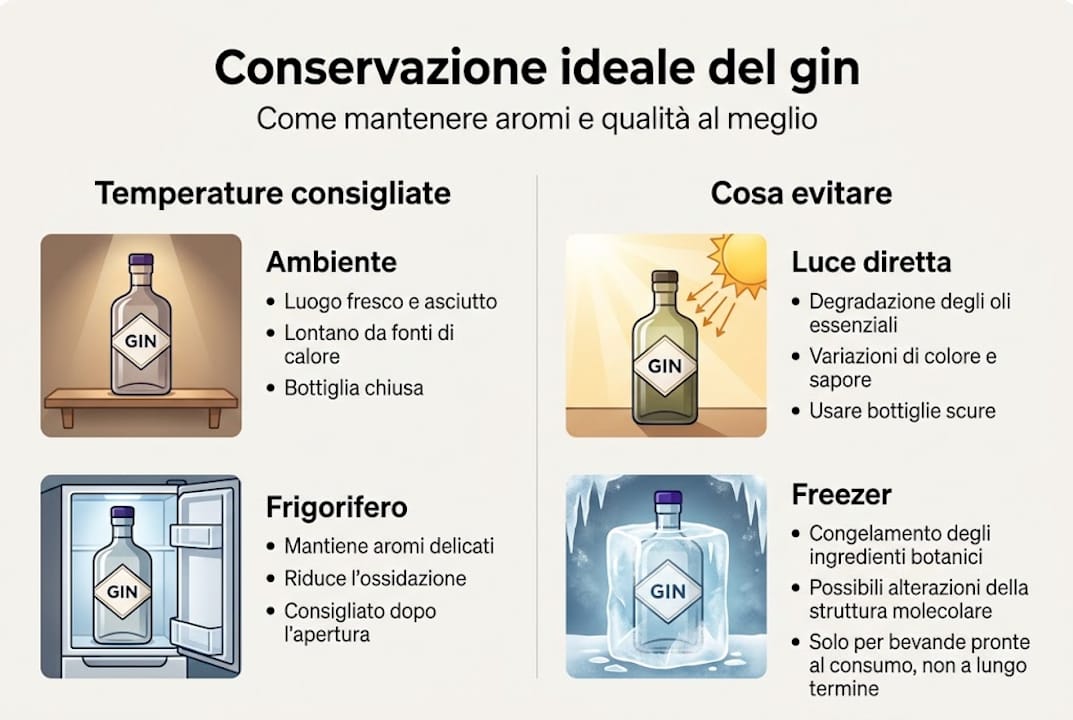
The belief that all spirits should be refrigerated stems from practical reasons: people want everything cold at the time of serving, it saves cellar space, and they think cold "preserves" better. In reality, for unopened and intact gin, the situation is different.
Here's what good storage practices suggest:
- Keep gin away from direct heat sources like stoves or radiators
- Avoid exposure to intense sunlight or artificial light
- Store the bottle upright to protect the cork
- Choose a stable temperature environment, without frequent fluctuations
- Prefer dark places like cellars, cabinets, or closed shelves
«Ideal storage temperature: 13-20°C in a cool, dark, and dry place, bottle upright to prevent cork degradation.»
This temperature range is not random. Between 13 and 20°C, the aromatic compounds remain stable, the cork does not deteriorate due to excessive humidity or dryness, and the bottle maintains its complexity intact. A standard home refrigerator operates at around 4-7°C: too cold for optimal long-term storage.
Having clarified the initial doubt, let's analyze how the fridge does or doesn't change the quality of the gin.
What happens to gin in the fridge and freezer: practical effects
Putting gin in the fridge for a few hours before a cocktail is one thing. Keeping it there for weeks, or even worse, in the freezer, is a whole other story. The effects change significantly depending on the situation.
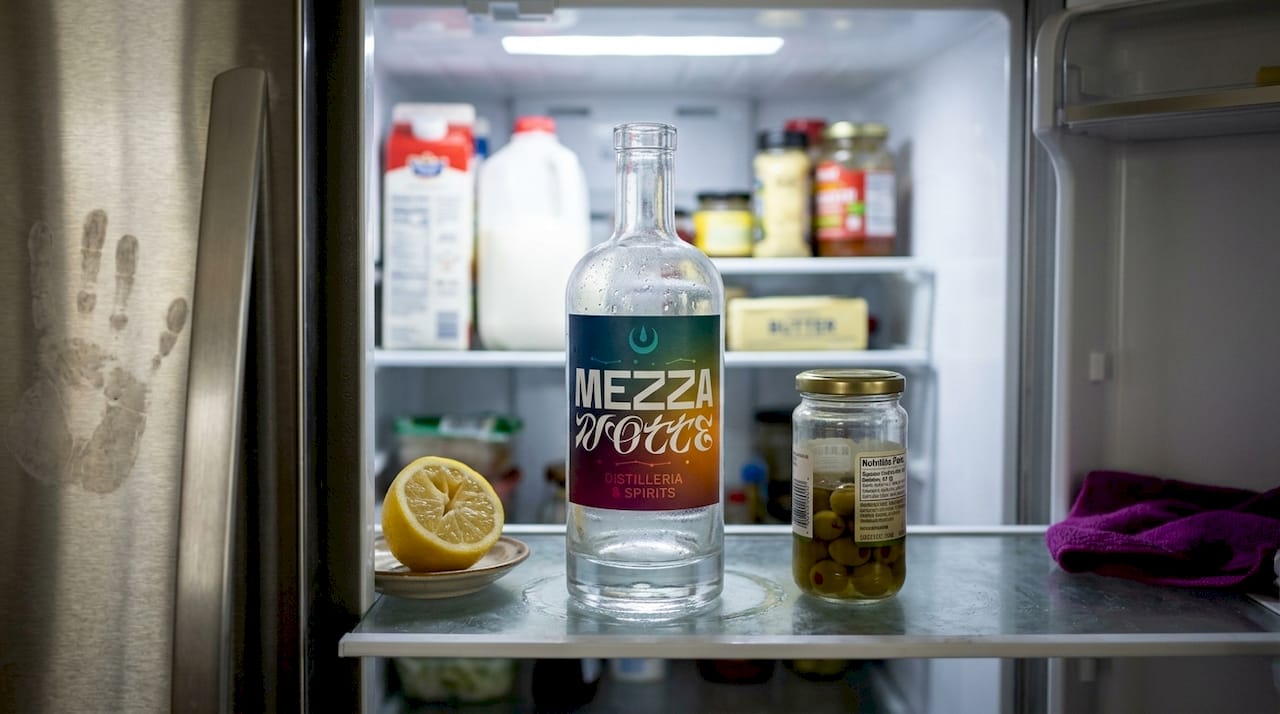
Cold has an interesting effect on nearly empty bottles. When less than 20% of the original volume remains, the oxygen in the bottle accelerates the oxidation of the aromas. In this case, refrigeration slows down the loss of volatile compounds by reducing vapor pressure, helping to preserve what remains.
The freezer, on the other hand, is a different case. At sub-zero temperatures, gin doesn't freeze thanks to the alcohol, but the aromatic molecules "fall asleep." The result is a spirit that seems almost odorless to the nose and flat on the palate, lacking the vivacity that makes it special. For more complex types of craft gin, this is a real waste.
| Condition | Effect on aromas | Recommended for |
|---|---|---|
| Room temperature (13-20°C) | Maximum botanical expression | Storage and tasting |
| Fridge (4-7°C) | Muted aromas, useful for nearly empty bottles | Cocktails, short period |
| Freezer (below 0°C) | Suppressed aromas, flattened character | Not recommended for premium gin |
An important note concerns cocktails. If you're making a perfect Martini, having the gin slightly chilled helps balance the ice dilution and achieve a silkier texture. In this specific context, the fridge makes sense.
Pro Tip: Only use the fridge for gin intended for cocktails, not for gin you want to taste neat. Keep two separate bottles if you're truly passionate: one at room temperature for tasting and contemplation, one in the fridge for mixing nights.
After seeing what happens with low temperatures, let's discover why drinking culture suggests different paths.
Temperature and gin culture: what to pay attention to
Gin has its own serving culture, refined over time by bartenders, distillers, and enthusiasts. It's no coincidence that in the world's best cocktail bars, gin temperature is treated with the same care reserved for wine in a Michelin-starred restaurant.
Temperature directly influences the aromatic bouquet, meaning the set of aromas perceived in the glass. At room temperature, volatile molecules are released more easily and reach the nose in a richer, more layered way. This is why neat tasting, where you really want to understand what's in that gin, is always done at room temperature.
When preparing a spirit-forward cocktail like a Martini or Negroni, however, the situation changes. These drinks are served cold, and slightly chilled gin contributes to the final balance. It's not about "ruining" the gin, but about using it in the right context.
Here are some situations where serving temperature makes a difference:
- Neat tasting: room temperature between 16 and 20°C, nosing glass, no ice
- Gin and tonic: gin at room temperature or slightly chilled, plenty of ice in the glass
- Spirit-forward cocktails: slightly chilled gin for a more precise texture
- Food pairing: room temperature to avoid masking the flavors of the dish
«Gin at room temperature for neat tasting, chilled for spirit-forward cocktails; avoid the freezer long-term to prevent dulling expert nuances.»
If you want to delve into how to read a gin in the glass, our tips for tasting gin guide you step-by-step. And if you're curious to understand how to structure a real tasting session, the tasting method we use is an excellent starting point.
Having understood what tradition and science suggest, let's move on to practical advice for every situation.
How and when to put it in the fridge: recommended practices
Now that you have the complete picture, it's time to translate everything into concrete actions. There isn't a single answer valid for every bottle and every occasion, but there are clear guidelines that work in practice.
When it makes sense to use the fridge:
- You're preparing cocktails and want the gin already chilled before mixing it
- The bottle is almost empty (less than 20% of the volume) and you want to preserve the remaining aromas
- It's very hot and you don't have a cool alternative place to store it temporarily
- You're serving gin and tonics on a summer evening and want everything ready and cold
When to avoid the fridge:
- You've just opened a premium bottle and want to explore it over time
- You're organizing a tasting and want to perceive all the botanical complexity
- The gin has delicate botanicals such as flowers, aromatic herbs, or rare spices
- You plan to store it for more than a few weeks
Refrigeration slows down aroma loss only in nearly empty bottles: for full or half-full ones, cold adds nothing and can only limit aromatic expression.
If you're planning a special evening with pairings, check out ideas on gin and food pairing and suggestions on cocktail garnishes to complete the experience.
Pro Tip: Never put a newly purchased full bottle in the freezer. Even if you only use it for cocktails, the abrupt transition from room temperature to sub-zero creates thermal stress that can permanently alter the aromatic structure. If you want cold gin, put it in the fridge a few hours beforehand, not in the freezer.
With these practical tips, you can choose how to enjoy each gin according to your personal taste and needs.
Our expert opinion on gin storage
There's something that is rarely said in these technical articles: the most important rule is not about the fridge or freezer, but about context and pleasure. We at Mezzanotte work every day with craft spirits that bring with them stories, selected botanicals, and a unique character. And what strikes us most is how people often worry too much about the "right rule" and too little about the moment they are experiencing.
The value of craft spirits lies not only in the quality of the raw material but in the care you put into serving it. An extraordinary gin drunk with the right company, in the right glass, at a reasonable temperature, will always be better than any gin treated with technical obsession but without care for the moment.
No rigid rules, therefore. Just common sense, attention to quality, and awareness of what you are opening. As we often say: gin is like company, it should be enjoyed in the right atmosphere.
Explore craft gin and discover new rituals
Now that you know how to store and serve gin correctly, the natural next step is to choose bottles that truly deserve this attention. The Italian craft gin you find on Mezzanotte is selected precisely for those who want to go beyond the usual supermarket shelf: rare botanicals, authentic stories, distinct characters that express themselves best when treated with care.

If you're curious to explore other spirits with the same philosophy, our selection of Italian craft vodka offers equally surprising experiences. Each bottle is designed for those who consider drinking a ritual, not a routine. Discover the catalog and find the spirit that tells the story of your evening.
Frequently asked questions about gin storage
Can gin always be put in the fridge?
No, only in specific cases: for cocktails or nearly empty bottles to be consumed shortly. For ordinary storage, room temperature between 13 and 20°C is always preferable.
Does gin get ruined if put in the freezer?
In the short term, no, but in the long term it loses aromas and botanical character. For premium craft gins, the freezer is always not recommended.
How long does an opened bottle of gin last?
If well-sealed and kept in the dark between 13 and 20°C, it can maintain its quality for many months, sometimes years, especially if the bottle is still more than half full.
How to tell if a gin has been ruined by poor storage?
You'll notice it right away: absent or very weak aromas on the nose, a flat taste lacking complexity, possible presence of residues or unpleasant odors that do not belong to the original profile of the spirit.
Recommendation
- How to find collector's gin: practical guide 2026 – Mezzanotte | Distillery & Spirits
- Gin alcohol content: complete guide to types and rules – Mezzanotte | Distillery & Spirits
- Step by step cocktail with craft gin: easy guide – Mezzanotte | Distillery & Spirits
- Tips for tasting gin: 57% more sensory experience – Mezzanotte | Distillery & Spirits
- Guide to Gin Storage 2026: Preserve Flavor 25% Longer – GIN NIRO