

Learn how artisanal distilleries use copper, small batches, and traditional methods to craft unique spirits with complex flavors.
Artisanal Distilleries: Quality Through Tradition
Mar 11, 2026

The global craft spirits market is experiencing explosive growth in 2026, marking a fundamental shift in the spirits industry. While many assume that industrial mass production is more efficient and advanced, the renaissance of craft distillation proves the opposite. This article will show you why small distilleries using traditional methods deliver more complex flavors, higher quality, and more authentic stories. You'll learn about the scientific background of copper distillation, the differences between production methods, and why cultural storytelling enhances the value of craft spirits.
Table of Contents
- Understanding the Art of Craft Distillation
- Copper vs. Stainless Steel: Material Influence on Spirit Quality
- Craft Distillation Versus Industrial Production: A Comparison
- Market Trends and Cultural Significance of Craft Distilleries 2026
- Discover High-Quality Craft Spirits at Mezzanotte
Key Takeaways
| Point | Details |
|---|---|
| Craft methods create complexity | Small batches and traditional pot stills produce spirits with individual flavor profiles that industrial processes cannot achieve. |
| Copper is crucial for quality | The metal reacts chemically during distillation, removing undesirable sulfur compounds and forming fruity esters. |
| Market grows through authenticity | Consumers in 2026 are paying premium prices for transparency, regionality, and the stories behind the products. |
| Quality control through small batches | Craft distilleries can individually monitor and adjust each batch, guaranteeing the highest quality standards. |
| Cultural storytelling engages customers | The connection of tradition, local ingredients, and mythological narratives creates emotional brand loyalty. |
Understanding the Art of Craft Distillation
Craft distilleries rely on pot stills as batch stills, which shape the character of each spirit. These traditional stills operate in batches, ensuring each batch receives individual attention. The process begins with heating the fermented mash in a large copper kettle.
The chemical reaction between alcohol vapors and copper is crucial. Copper binds sulfur compounds and removes harsh flavors that would otherwise dominate the taste. At the same time, the metal catalyzes the formation of esters, which create fruity and floral notes. These chemical processes are hardly possible with column stills.
Unlike continuous distillation processes, the pot still allows the master distiller precise control over three critical phases:
- Foreshots: Contains undesirable volatile compounds, discarded
- Hearts: The core with the best flavors, collected
- Feints: Heavier oils and fusel alcohols, usually discarded
Pro Tip: The timing of distillation cuts between foreshots, hearts, and feints is an art that requires years of experience. Cutting too early wastes valuable flavors; cutting too late introduces unwanted notes into the product.
Single Malt Scotch and Irish Single Pot Still Whiskey are perfect examples of the complexity created by traditional copper distillation. Each distillery develops a characteristic style over years, determined by the shape of the still, copper contact time, and cutting methods. Discover more about this tradition in our Guide to Italian Distillates.
“The shape and size of a pot still influence the reflux of the vapors and thus the intensity of the copper reaction. Tall, slender stills produce lighter spirits, while wide, squat shapes allow more body and oils to pass through.”
Copper vs. Stainless Steel: Material Influence on Spirit Quality
The choice of material in distilleries is not just a cost issue, but a fundamental decision for flavor profile and production philosophy. Stainless steel is corrosion-resistant and ideal for storage tanks and piping. The material is chemically inert, meaning it does not react with the distillate.
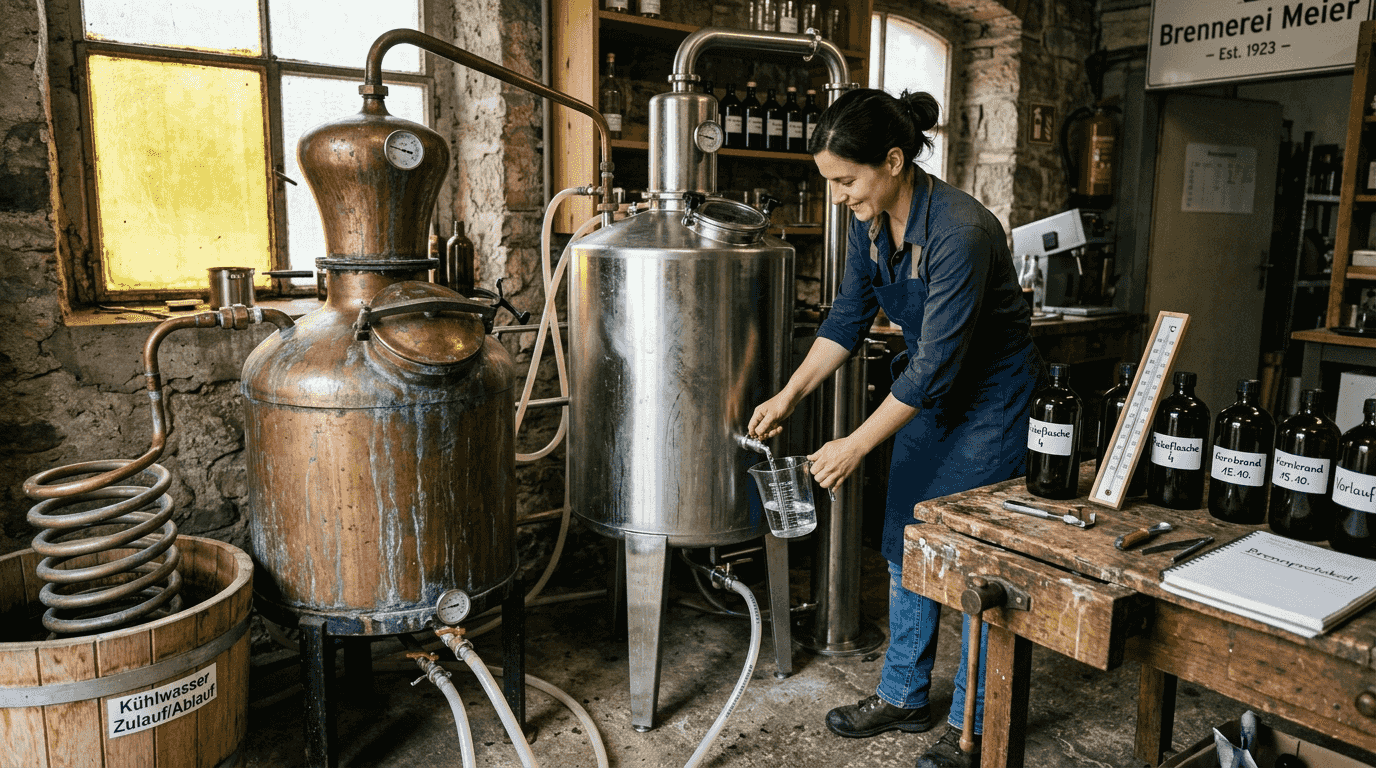
Copper, on the other hand, is highly chemically active. The metal removes sulfur notes and catalyzes the formation of fruity esters during distillation. These properties make copper indispensable for high-quality spirits. Modern distilleries strategically combine both materials.
Advantages of different materials:
- Copper: Removes sulfur compounds, catalyzes ester formation, traditional aesthetic, requires regular maintenance
- Stainless steel: Corrosion-resistant, easy to clean, durable, no flavor alteration, more cost-effective to maintain
- Hybrid systems: Stainless steel kettles with copper plates combine advantages of both materials
Pro Tip: For craft distillates with distinct character, at least 60% of the distillation surface should be copper. Too little copper contact leads to flat, one-dimensional flavors.
The balance between both materials enables quality and operational efficiency. Here is an overview of their applications:
- Fermentation tanks: Stainless steel due to hygiene and ease of cleaning
- Stills: Copper for chemical reactions and flavor complexity
- Condensers: Copper for further flavor refinement
- Storage containers: Stainless steel for long-term storage without oxidation
- Piping: Stainless steel for durability and ease of maintenance
Learn in our article on Artisan Distilleries how these material choices shape the identity of craft products.
Craft Distillation Versus Industrial Production: A Comparison
The difference between pot stills and column stills defines two entirely different philosophies of spirit production. Pot stills operate in batches, with each batch distilled separately. Column stills produce neutral spirits through continuous distillation, ideal for mass production.
| Criterion | Pot Still | Column Still |
|---|---|---|
| Production method | Batch, discontinuous | Continuous, 24/7 |
| Alcohol strength | 60-80% ABV | 95-96% ABV |
| Flavor profile | Complex, characterful | Neutral, pure |
| Production volume | 500-5000 L per batch | Infinitely scalable |
| Quality control | Each batch individually | Continuous process monitoring |
| Typical products | Single Malt, Cognac, Rum | Vodka, neutral alcohol, gin base |
| Investment costs | Moderate | Very high |
Over 90% of premium whiskies are distilled in pot stills because the method preserves complex flavors. The slower distillation allows more copper contact and retains congeneric compounds that create character and depth.
Advantages of small batches in craft distilleries:
- Precise quality control for each individual batch
- Flexibility for experimental recipes and seasonal variations
- Expression of terroir through local botanicals and ingredients
- Direct traceability from raw material to bottle
- Ability to adjust based on sensory feedback
Industrial column distilleries, on the other hand, aim for consistency and efficiency. They produce highly pure neutral alcohol, which then gains character through flavoring or aging. This approach is legitimate for certain spirit categories but does not achieve the flavor depth of craft pot-still distillation.
Our guide helps you to avoid common distillation mistakes if you want to delve into the matter yourself.
Market Trends and Cultural Significance of Craft Distilleries 2026
The craft spirits market is growing exponentially in 2026, reflecting a fundamental shift in consumer behavior. Buyers are no longer just looking for alcohol, but for experiences, stories, and authentic connections to producers. This development has transformed the entire spirits industry.
Consumers in 2026 particularly value transparency about origin, production methods, and ingredients. The question "Who made this and why?" is just as important as the taste itself. Cultural storytelling increases brand loyalty and enables premium prices that make craft production economically sustainable.
Key trends in the craft spirits market:
- Hyper-locality: Use of regional botanicals and grains
- Sustainability: Organic ingredients, circular economy, renewable energy
- Transparency: Disclosure of all ingredients and production steps
- Experimental flavors: Unusual botanicals, barrel aging, fermentation methods
- Direct-to-consumer sales: Tastings, distillery visits, online shops
“The most successful craft distilleries in 2026 are those that position their products not as commodities, but as cultural artifacts. Each bottle tells a story about place, people, and tradition that far exceeds the pure product value.”
The combination of mythology, pop culture, and regional identity creates emotional resonance. If a spirit not only tastes good but also has a fascinating origin story, it transforms from a consumer item into a collector's item. This strategy works particularly well with younger consumers who prioritize authenticity over mass brands.
Learn more about the culture behind premium spirits and how design and storytelling increase their value.
Discover High-Quality Craft Spirits at Mezzanotte
Now that you know the scientific and cultural backgrounds of craft distillation, it's time to experience this quality for yourself. Mezzanotte offers you a curated selection of Italian artisan gins and craft vodkas that embody precisely the principles you have just read about.

Every product in our range is produced in traditional copper stills in small batches. Our master distillers use regional botanicals and follow recipes that combine tradition with innovation. From mythologically inspired gins to vodkas with anime themes, you'll find spirits that not only taste exceptional but also tell stories. International recognition through awards confirms our uncompromising quality.
Frequently Asked Questions
What distinguishes craft distilleries from industrial distilleries?
Craft distilleries produce in small batches with traditional pot stills, allowing for intensive quality control and complex flavor profiles. Industrial operations rely on continuous column distillation for high volumes and neutral spirits. The focus for craft producers is on individuality rather than mass production.
What role does copper play in distillation?
Copper chemically reacts with alcohol vapors and removes undesirable sulfur compounds that would otherwise impair the taste. At the same time, the metal catalyzes the formation of esters, which create fruity and floral aromas. Without sufficient copper contact, spirits remain flat and one-dimensional.
Why are stories and regionality important for craft spirits?
In 2026, consumers are buying not just alcohol, but experiences and authentic connections to producers. Cultural storytelling creates emotional bonds and justifies premium prices because it expands the product value with a narrative dimension. Regionality also guarantees transparency regarding origin and production methods.
How does the distillation method influence taste?
Pot stills preserve congeneric compounds and flavors from fermentation, leading to complex, characterful profiles. Column stills produce highly pure neutral alcohol with minimal flavor notes. The choice of method fundamentally determines whether a spirit tastes complex or neutral.
What quality checks are typical for craft distilleries?
Each batch undergoes sensory evaluations by the master distiller, who separates foreshots, hearts, and feints by smell and taste. Additionally, chemical analyses of alcohol content, methanol levels, and congener spectrum are performed. The small batch size allows for individual attention that is impossible with industrial mass production.
Is the higher price for craft spirits worth it?
The price difference reflects higher production costs due to small batches, high-quality ingredients, and labor-intensive processes. You pay for demonstrably more complex flavors, transparent origins, and support for local producers. For connoisseurs who prioritize quality over quantity, the added value is clear.
Recommendation
- Traditional Gin Production: Craftsmanship and Character – Mezzanotte | Distilleria & Spirits
- Distilled Spirits Guide: Mastering Italian Distillates – Mezzanotte | Distilleria & Spirits
- What is Artisan Distillery: Craft Spirits 2026 – Mezzanotte | Distilleria & Spirits
- What are Premium Spirits? Understanding Craft, Culture – Mezzanotte | Distilleria & Spirits