

Discover what Italian bitter is, its varieties, artisanal process, and its role in European cocktail culture. Ideal for spirits enthusiasts.
What is Italian bitter: history, taste, and culture
Feb 27, 2026

When an authentic Italian bitter reaches a glass in Central Germany, it doesn't just bring flavor; it offers a direct link to Italian history and creativity. For those seeking unique taste experiences and stories behind every sip, bitter is much more than just a craft liqueur. The balanced bitterness and secret recipes that define these aperitifs invite you to discover new sensations and share the passion for Italian aperitivo culture.
Table of Contents
- Definition and Origin of Italian Bitter
- Main Varieties and Styles in Italy
- Key Ingredients and Production Process
- Use in Mixology and Cultural Pairing
- Common Mistakes When Choosing or Enjoying Bitter
Key Takeaways
| Point | Details |
|---|---|
| History of Italian Bitter | Born in 1860 with Gaspare Campari, it transformed from a remedy to a social aperitif. |
| Main Characteristics | It has an intense red color and a balanced bitter taste, created from secret recipes with natural ingredients. |
| Use in Mixology | Bitter adds depth to classic cocktails, being essential for balance in the mix. |
| Common Mistakes | Avoiding over-dosing and not trying bitter neat can ruin the tasting experience. |
Definition and Origin of Italian Bitter
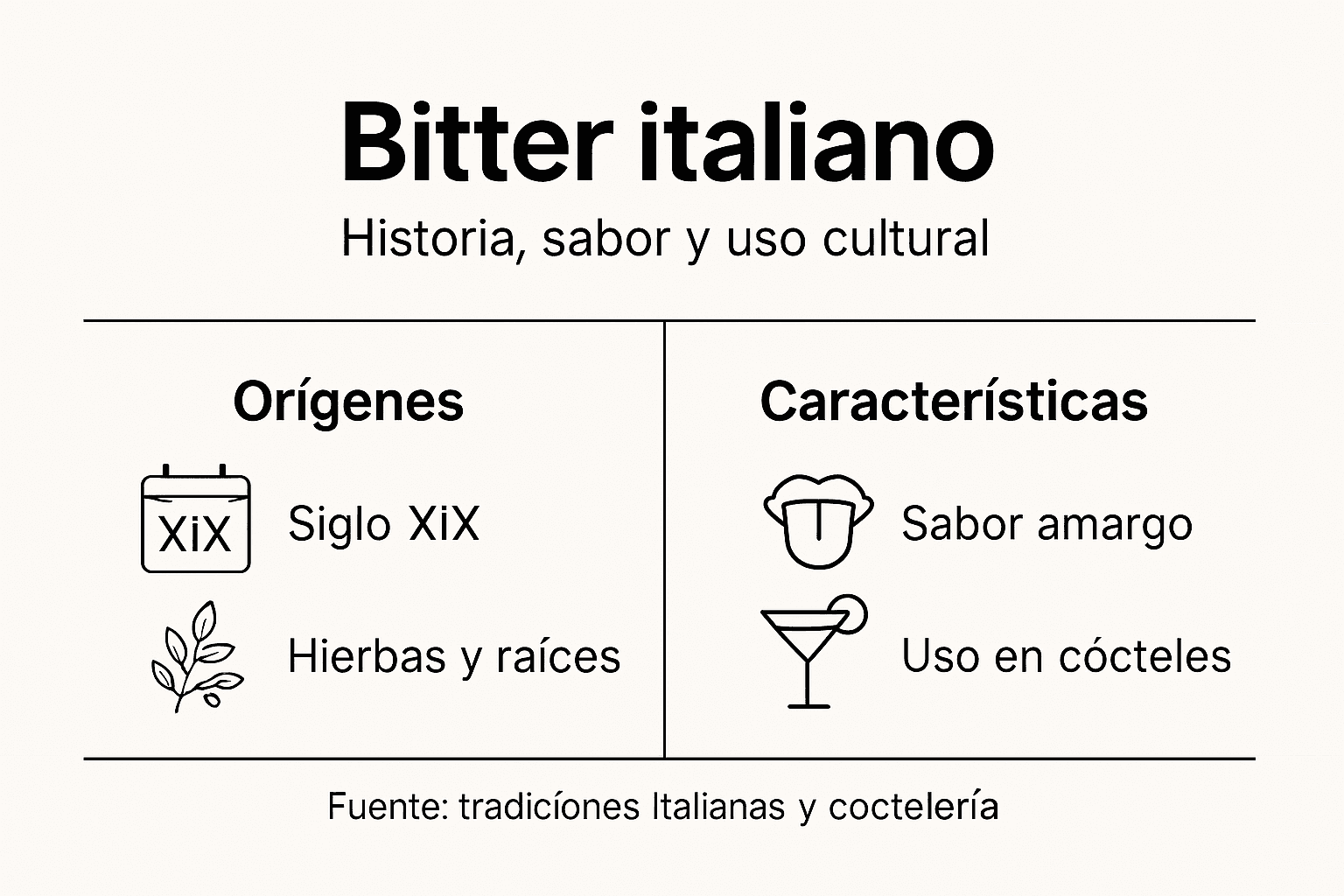
Italian bitter is an alcoholic beverage that combines alcohol, water, and infusions of herbs, roots, fruits, and aromatic spices. Unlike other types of bitters, Italian ones are characterized by their distinctive bitter taste and their role as a social aperitif, not just a medicinal remedy.
The history of bitters has deep roots. Originally, alcoholic solutions with aromatic plants were used exclusively to extract active ingredients from botanicals and treat various ailments. During the 19th century, mixology discovered the potential of these bitter flavors, integrating them into classic cocktails like the Old Fashioned and Manhattan.
But Italian bitter as we know it today emerged from a specific innovation. In 1860, Gaspare Campari invented his famous recipe in Novara, Italy, marking a turning point in tradition. His creation was conceived as an aperitif, not a digestif, differentiating it from other alcoholic beverages of the time.
Defining Characteristics of Italian Bitter
Italian bitters share key elements that make them recognizable:
- Intense red color (inherited from Campari, though other variants exist)
- Bitter but balanced flavor with herbaceous and floral notes
- Secret recipes with over 150 years of history in some cases
- Social purpose as part of aperitivo culture
- Natural ingredients without artificial flavors
From Medicine to Culture
The transformation of bitter is fascinating. It went from being a home remedy to becoming a symbol of Italian social life. In the aperitivo, bitter is served as a welcoming ritual, preceding the main meal and facilitating conversation among friends and family.
This evolution was not accidental. Italian producers recognized that bitterness, when well-formulated, can be pleasant. They combined ancient infusion techniques with local ingredients to create sophisticated beverages that delighted the palate.
Italian bitter represents the perfect confluence of medicinal tradition and social sophistication, transforming bitterness into desirability.
For those visiting Central Germany and seeking authentic taste experiences, Italian bitters offer a gateway to genuine Italian culture. They are not sweet or compliant drinks; rather, they challenge your palate with complexity and character.
Professional Tip: To truly appreciate an Italian bitter, try it at room temperature with a little ice and an orange peel; this allows the herbaceous aromas to fully develop without being masked by extreme temperatures.
Main Varieties and Styles in Italy
Italy doesn't have just one type of bitter. The reality is much richer and more complex. Since the late 19th century, the country has developed multiple regional styles and brands that offer completely distinct flavor profiles, each reflecting local tradition and available ingredients.
The variety is enormous because each Italian region has its own ancestral recipe. Some bitters are intensely bitter, while others balance that bitterness with sweet and spicy notes. This diversity is not accidental but rather the result of centuries of experimentation with macerated roots, barks, herbs, spices, and citrus fruits.

The Main Italian Styles
Although there are dozens of varieties, some styles dominate the scene:
- Intense and bitter-flavored bitters - ideal as an aperitif to stimulate the appetite
- Bitters with sweet notes - perfect after a meal as a digestif
- Herbaceous and floral bitters - featuring local aromatic plants
- Citrus bitters - highlighting lemon, orange, and bergamot
- Spiced bitters - with clove, cinnamon, cardamom, and other exotic spices
The Regional Artisanal Tradition
Each region of Italy has perfected its own formulas. In the north, near Turin, bitters that accompany the vermouth tradition proliferate. In the center and south, you'll find recipes that incorporate unique Mediterranean ingredients.
This artisanal production means that no two bitters are exactly alike. Small family distilleries jealously guard their recipes, passed down from generation to generation. Some have been made in the same way for over 150 years.
Italian bitters are regional expressions of a national tradition: each bottle tells the story of its territory.
The versatility of these liqueurs is surprising. While some producers conceive them as pure aperitifs, others design them exclusively as digestifs. Some manage to be both simultaneously, adapting to the time of day and the social context.
For lovers of artisanal liqueurs like you in Central Germany, this variety represents an endless opportunity for exploration. You don't need to look for a single "perfect bottle," but rather a collection that reflects Italy's regional richness.
To better understand the regional differences, here is a comparison:
| Italian Region | Distinctive Ingredients | Typical Application |
|---|---|---|
| North (Turin) | Alpine herbs, vermouth | Evening aperitif |
| Central | Mediterranean spices | Digestif and social |
| South | Local citrus, flowers | Aperitif and digestif |
| Sicily | Bitter orange, cardamom | Family ritual |
This table allows for a quick identification of how bitters vary by region in Italy.
Professional Tip: Start by trying small formats of bitters from different Italian regions; this will allow you to identify which styles and flavor profiles align best with your palate before making larger investments in full bottles.
Key Ingredients and Production Process
The magic of Italian bitter lies in its ingredients and how they are combined. It is neither a simple nor a quick process. It requires ancestral knowledge, patience, and a deep understanding of how each botanical component contributes to the final result.
The Essential Ingredients
Every Italian bitter begins with a base of high-proof alcohol combined with water. On this base, producers carefully macerate a selection of botanical components:
- Roots - gentian, angelica, and other bitter roots
- Barks - cinnamon, orange peel, and other aromatic barks
- Spices - clove, cardamom, anise, and cumin
- Seeds - coriander, fennel, and poppy seeds
- Flowers and herbs - chamomile, mallow, gentian, and lemon balm
- Citrus - lemon, bitter orange, and bergamot
This combination is not arbitrary. The botanical ingredients are selected to extract active principles that provide both flavor and aromatic complexity. Some traditional products contain more than 40 different ingredients.
The Maceration Process
Production begins with maceration. Ingredients are steeped in alcohol for weeks or even months, allowing the flavors and aromas to be slowly extracted. This is a process that cannot be rushed without losing quality.
Then comes filtration, where solids are separated from the infused liquid. This step requires precision to ensure clarity without losing flavor nuances. Finally, some distilleries add small amounts of sugar to balance the natural bitterness.
Traditional Italian bitter contains little to no sugar; bitterness is the dominant characteristic, never something to be masked.
The result is a liqueur with a moderate alcohol content, typically between 16 and 45 degrees. This range balances ingredient preservation with social drinkability. Each producer adjusts their own formula, creating unique flavor profiles.
The aromatic complexity resulting from this process is what differentiates an authentic bitter from cheap imitations. When you drink a genuine Italian bitter, you are tasting generations of refinement.
For connoisseurs in Central Germany like you, understanding this process adds depth to every sip. It's not just a drink; it's an expression of artisanal technique and regional tradition carefully passed down.
Professional Tip: When tasting different bitters, observe how the initial aromas evolve; long-macerated bitters reveal layers of flavor that are not apparent in the first few seconds, so wait before drawing conclusions.
Use in Mixology and Cultural Pairing
Italian bitter is not simply a mixology ingredient. It is a bridge between tradition and modernity, between ancestral medicine and contemporary pleasure. Its role transcends the drink itself.
In Classic Mixology
In the world of cocktails, bitter plays a fundamental role in adding aromatic depth and balance to emblematic drinks. With just a few drops, it completely transforms the drinker's sensory experience.
Some classic cocktails rely on bitter for their identity:
- Old Fashioned - bitter highlights the complexity of whiskey
- Manhattan - adds spicy notes and depth
- Negroni - creates the perfect triangle of bitter, sweet, and spirited
- Italian Margarita - adds complexity to lighter drinks
- Sazerac - emphasizes vegetal and herbaceous flavors
Dosing is critical. One or two drops can change everything; too much bitter ruins the drink. Expert bartenders understand that bitter is an instrument of precision, not a casual addition.
Cultural Tradition and Italian Rituals
In Italy, bitter represents something profound. Bitterness is integrated into daily culinary and social rituals, especially in the evening aperitivo. It's not just about drinking; it's an act of social connection.
The Italian aperitivo is a moment of pause. Around 6 PM, friends and family gather with a bitter in hand. This ritual precedes dinner, opening the appetite and facilitating conversation. There's no rush, no excessive volume.
Italian bitter is the expression of a life philosophy: savor slowly, connect deeply, value complexity.
This culture contrasts with how many alcoholic beverages are consumed in other parts of the world. Here, bitterness is not something to hide with sweetness or excessive dilution, but something to celebrate and appreciate.
Pairing with Gastronomy
The function of bitter goes beyond an aperitif. Some specific bitters work exceptionally well with certain dishes. They balance flavors, cleanse the palate, and prepare the body for digestion.
For connoisseurs of craft spirits like you in Central Germany, this understanding opens up new possibilities. It's not just about collecting bottles, but about understanding how each bitter dialogues with specific moments, specific people, specific contexts.
Below is a summary of the functions of Italian bitter in cocktails and gastronomy:
| Function | Effect on drink/food | Cultural Impact |
|---|---|---|
| Aromatic balance | Adds depth and complexity | Fosters conversation |
| Digestive stimulant | Opens appetite and prepares palate | Reinforces the aperitivo ritual |
| Adaptability | Integrates into classic cocktails and regional dishes | Promotes Italian identity |
This table helps visualize how Italian bitter influences both flavor and culture.
Professional Tip: When mixing a cocktail with bitter, add the main ingredients first, then place the bitter in the glass before pouring, allowing it to disperse naturally as you stir; this creates an even distribution without excessive dilution.
Common Mistakes When Choosing or Enjoying Bitter
Many people ruin their bitter experience before it even begins. Not for lack of passion, but out of ignorance. Making mistakes when selecting or consuming bitter is more common than you might think, and most are easy to avoid.
The Over-dosing Mistake
This is the number one mistake. Many believe that if a little bitter is good, more is better. Absolutely false. Correct dosing is key to optimizing its use, and adding too many drops can completely overpower the cocktail's balance.
One or two drops transform a drink. Five or six ruin it. Bitter is not a main ingredient; it is a flavor enhancer. When you overload it, it overshadows all other flavors, leaving you with only an unpleasant bitterness.
Ignoring Flavor Profiles
Not all bitters taste the same. Some are floral, others spicy, some citrusy. Choosing a bitter without considering its composition and flavor profile is like buying a wine without knowing its varietal.
Typical mistakes include:
- Using a herbal bitter in a cocktail that needs citrus notes
- Combining overly intense bitters with delicate spirits
- Choosing based only on brand, not on aromatic profile
- Not tasting before investing in full bottles
- Ignoring regional differences and their unique characteristics
Disregarding the Tradition of Moderation
Italian culture teaches that bitter is to be enjoyed with patience and respect. It's not for drinking quickly or in large quantities. Some consumers make the mistake of treating it like a regular social drink, when it should be a contemplative experience.
In central Germany, where quality is valued over quantity, this should resonate. Italian bitter deserves to be savored mindfully, in good company, without rush.
The bitter is never the protagonist; it's the musician playing in the background, adding depth unseen.
Another common mistake is serving bitters at the wrong temperature. Too cold dulls the flavors; too warm makes them harsh. Room temperature allows the aromas to fully develop.
Some also make the mistake of mixing inferior quality bitters. Saving money here is counterproductive. A cheap bitter has a poor aromatic profile and ruins even the best cocktails.
Pro tip: Before using any new bitter in a cocktail, try it neat in a small glass at room temperature; this will reveal its true character and allow you to decide how many drops to use and what to pair it with.
Discover the Authenticity of Italian Bitter at Mezzanotte
Understanding the history and culture of Italian bitter means delving into a tradition that combines patience, technique, and a passion for craftsmanship. If you're looking to enjoy the aromatic complexity and balance that only a genuine bitter can offer, our selection features products that honor this essence and allow you to experience Italian tradition with every sip.

Explore our collection of Artisanal Italian Amaro, where each drink tells a unique story based on traditional recipes and contemporary creativity. Don't miss the opportunity to bring sophistication and authentic flavor into your home with the quality you can only find at Mezzanotte. Discover now the spirits that merge tradition, culture, and craftsmanship to transform every moment into a memorable experience.
Frequently Asked Questions
What is Italian bitter?
Italian bitter is an alcoholic beverage made from alcohol, water, and infusions of herbs, roots, fruits, and spices, characterized by its bitter taste and its social use as an aperitif.
What is the history of Italian bitter?
Italian bitter was born in 1860, when Gaspare Campari created his famous recipe in Italy, marking the beginning of a tradition that has led it to be known primarily as an aperitif rather than a digestif.
How is Italian bitter served and enjoyed?
Italian bitter is recommended to be served at room temperature with a little ice and an orange peel slice, allowing its aromas to fully develop.
In which cocktails can Italian bitter be used?
Italian bitter is a key component in several classic cocktails, such as the Old Fashioned, Manhattan, and Negroni, where it adds depth and balance to the drinks.
Recommendation
- Italian Bitter Liqueurs: History and Tradition of Italian Bitters – Mezzanotte | Distilleria & Spirits
- Italian Bitter Liqueurs: A Guide to Traditions and Innovations 2026 – Mezzanotte | Distilleria & Spirits
- Best Italian Amaro: A Guide to Excellence 2026 – Mezzanotte | Distilleria & Spirits
- Discover the Best Italian Bitter Liqueurs: An Unmissable 2026 Selectio – Mezzanotte | Distilleria & Spirits